
Brig. Gen. Mitchell M. Zais, (ret.) Ph.D.
Vice Chairman of the STARRS Board of Directors
Remarks Delivered by Webinar to the MacArthur Society of West Point in February 2026
Introduction
My name is Mick Zais. I’m a member of the Board of Advisors for the MacArthur Society. I’ll be talking about accreditation and how it affects West Point.
By way of introduction, my experience in education is fairly unique. After leaving the Army as an infantry brigadier general, I spent 10 years as president of a small, private, liberal arts, residential, faith based college in South Carolina, Newberry College. It’s a venerable institution, having been around since before the Civil War.
At the end of my 10-year tenure, at age 63, I had a midlife crisis and entered politics. I ran for statewide election as State Superintendent of Education. Because I had five opponents in the primary, I didn’t win the nomination outright, but did take the runoff. Finally, I won the general election as the second Republican and the first Conservative to serve as State Superintendent. In that capacity, I oversaw the operation of 83 school districts and, in round numbers, 1250 schools, 51,000 school teachers and administrators, and 720,000 students.
Subsequently I was able to go to Washington and work in the U.S. Department of Education after President Trump nominated me to be his Deputy Secretary. After I was ultimately confirmed by the Senate, I served in that capacity for almost three years.
Additionally, I have served on the board of trustees for the University of South Carolina, Winthrop University, and the Citadel. I served as Chairman of the Board for South Carolina’s 21 independent colleges and universities, and as Chairman of the President‘s Council for the South Atlantic Athletic Conference. Currently, I serve as the Governor’s appointee to the South Carolina Commission on Higher Education, a position I have held for eight years.
I also served on the boards of the Southern Regional Education Board in Atlanta, the Lutheran Education Conference of North America in Chicago, the Foundation for Independent Higher Education in Washington, and South Carolina Educational Television. Most importantly for this presentation, I worked as an accrediting team leader for the Southern Association of Colleges and Schools.
What is Accreditation?
Definition
Accreditation is voluntary, non-governmental, peer review process that evaluates higher education institutions and programs to ensure they maintain quality standards. Accreditation by an organization approved by the U.S Department of Education is a requirement in order to receive federal student aid. That’s the primary reason it’s important, but, not the only reason.
Types of Accreditation
There are two types of accreditation:
+ Institutional
Institutional accreditation evaluates the entire college or university. Areas that are examined include its mission, its finances, its governance, its programs, its operations, its faculty qualifications, student services, athletics, admissions, financial aid, facilities, and just about anything that can be checked, will be checked.
+ Specialized / Programmatic
Specialized or programmatic accreditations evaluate specific programs or majors, or departments, or schools. Some examples include areas such as nursing, education, engineering, law, medicine, and many others.
I will talk about institutional accreditation and specialized or programmatic accreditation at West Point later on in the presentation.
The Process
The process of accreditation for institutions typically occurs every 7 to 10 years, depending upon the accrediting agency. For West Point, every eight years they must undergo what is called reaffirmation of their accreditation, or simply, reaffirmation. This process typically takes around 18 months. This entails a year of preparation and then four to six months for is what is called the self-study, followed by the site visit.
+ Self-Study
The self-study involves a massive amount of work by all the administrators. I’m going to go into some detail, just to give you an appreciation for how much work is involved.
Every office, every program, and every department must prepare a report that explains how they are in compliance with all the standards established by the accrediting agency. When complete, these reports total thousands of pages.
To get ready, the college or university will usually establish a task force, with representatives from the major departments, who will oversee the work in their departments and the campus-wide effort. These reports will be reviewed and fine-tuned within house. Eventually, they will be submitted electronically to the accrediting agency.
The accrediting agency will then convene a team from peer institutions to read the reports. This team of readers will be chaired, or led, by a serving president. Members will include an academic dean or vice president, a dean of students, a vice president for business and finance, an athletic director, a dean of admissions, and so on. I served as team chief for one of these teams. Our job was to figure out what areas merit further scrutiny and should be followed up with additional information in another written report, or examined in depth during the subsequent on-site visit.
+ On-site Visit
The group conducting the on-site visit will be composed much like the self-study team. But, they will be from different peer institutions than those who read and evaluated the written reports. The on-site team will follow up on the recommendations and observations of the self-study team.
When on campus, they will conduct interviews with specific individuals and with select groups of students, faculty, staff, athletes, and so on. Among other things, they want to gage the organizational culture, or what we would call the command climate, of the institution.
The on-site team will then write a lengthy report in each area. The institution undergoing reaffirmation must respond to the issues raised.
All in all, the process is long, extremely labor intensive, bureaucratic, expensive, and mostly focused on inputs. I also served as a team chief for a site visit.
Who Vets and Approves the Accreditors?
United States Education Department
The U.S. Department of Education is the federal agency that recognizes accrediting institutions. They expect accreditors to be reliable authorities on education quality.
It’s important for me to emphasize again, accreditation not only conveys a certain status or prestige. It’s the gateway that allows students at these colleges and universities to receive federal funds such as Pell grants, work-study grants, and federal student loans. Without these funds, most institutions will immediately close.
Council on Higher Education Accreditation
The Council on Higher Education Accreditation is also recognized by the Department of Education, but it is not a gateway for federal student aid. Rather, CHEA vets and approves specialized and programmatic accreditors as well as specialized institutions such as faith-based and others. In other words, CHEA “accredits the accreditors and specializes institutional accreditors.”
Examples of these specialized accreditors include the Accreditation Council for Business Schools and Programs, the Commission on Collegiate Nursing Education, and the Commission on Sports Management Accreditation. There are about sixty more accrediting organizations. Accreditation by a CHEA member organization is often recognized internationally and by private foundations as a marker of academic excellence. But, CHEA also has standards of its own which these 60+ accrediting organizations must incorporate within their standards.
In summary, the U.S. Department of Education approves or recognizes institutional accreditors for colleges and universities. CHEA approves or recognizes accreditors for specific programs.
We’ll talk more about programmatic accreditation as it pertains to West Point later.
Who Are the Accreditors?
Institutional Accreditors
The big six accreditors were formally known as regional accreditors. But, in the first Trump Administration, we were able to break these regional monopolies and expand the geographic scope of all accreditors across the nation. Now, accrediting agencies must compete nationally.
Under previous administrations, colleges and universities could only seek institutional accreditation from their regional accreditors. There were no options and no competition. Today, they can seek accreditation from any institutional accrediting agency. As an example, due to these reforms in 2019, the newly established University of Austin has been able to seek accreditation from the Higher Learning Commission rather than the Southern Association of Colleges and Schools
+ Middles States Commission on Higher Education
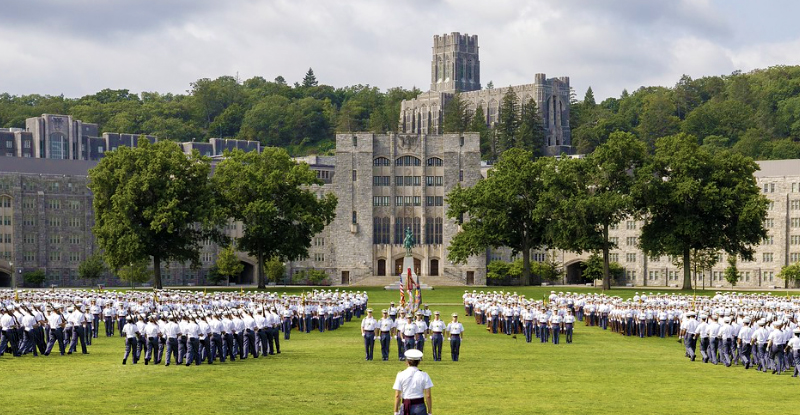
West Point is accredited by the Middle States Commission on Higher Education, as is Annapolis.
+ Higher Learning Commission
The Air Force Academy is accredited by the Higher Learning Commission.
+ Accrediting Commission for Community and Junior Colleges
There is a separate accrediting body for community and junior colleges.
+ Council on Higher Education Accreditation
And, we have already talked about CHEA which recognizes accrediting agencies of all types.
Who Accredits West Point?
Middle States Commission on Higher Education
West Point’s institutional accrediting agency is, as previously noted, the Middle States Commission on Higher Education. We’ll talk more about them when I explain why they are a problem.
Council for Higher Education Accreditation
We have talked about CHEA. CHEA certifies, or recognizes, three different organizations that accredit programs at West Point.
+ Accrediting Board for Engineering and Technology
ABET, accredits ten different majors at West Point. These are Chemical, Civil, Electrical, Environmental, Mechanical, Nuclear, and Systems Engineering. ABET also accredits majors in Computer Science, Cyber Science, and Applied Statistics and Data Science.
What’s important to note here is how critical ABET accreditation is for the academies. For example, to sit for the exams and licensure in Fundamentals of Engineering or for the Professional Engineering exam, one must have completed an ABET accredited program.
Also, many employers, especially in defense and aerospace, only hire graduates of ABET accredited programs. They view it as evidence of having mastered core technical competencies. And almost all reputable master’s and doctoral engineering programs only accept graduates of ABET accredited undergraduate programs. So, ABET standards must be complied with.
+ American Chemical Society
The ACS accredits the Chemistry major.
+ U.S. Geospacial Intelligence Foundation
West Point’s Geospacial Information Science Engineering major is accredited by this organization.
Bear in mind, these three specialized accrediting agencies march to the tune played by CHEA. In other words, CHEA dictates many of the standards that are imposed by these program accreditors. In turn, these program accreditor‘s impose these standards on West Point.
I’ll explain why the standards mandated by these accreditors, Middle States and CHEA, are a problem. I’ll be using a mix of quotations from the standards and summaries of the standards.
Why Are West Point’s Accreditors a Problem?
Middle States Commission on Higher Education
The Middle States Commission on Higher Education is West Point’s institutional accreditor. MSCHE integrates diversity, equity, and inclusion into its accreditation process by requiring institutions to demonstrate a commitment to DEI principles across their mission, throughout the student experience, and incorporated into institutional practices.
Let me provide some examples of how this is done in five different areas of the Middle States accreditation process.
+ The Self-Study Process
In the self-study process, institutions must demonstrate how their mission, their planning, and student learning include DEI initiatives which align with the Commission’s seven standards of accreditation. In other words DEI must be embedded in everything.
+ Data-Driven Evaluation
The Middle State Commission also requires data-driven self-evaluations. They do this by looking for institutional decisions that reflect a focus on DEI to ensure equitable student outcomes – not fair outcomes, but equitable outcomes.
+ Institutional Climate
In the area of institutional climate, standards and requirements must cover institutional ethics and integrity, specifically focusing on the climate for diversity.
+ Commitment to Equity
In examining an institution’s commitment to equity, the Commission emphasizes the “centrality of the student experience” that must encourage inclusive practices.
+ Holistic Admissions
In their examination of admissions practices, the Middle States Commission specifies that institutions should use diverse factors, not just test scores, to advance the organization’s mission.
In summary, according to the Middle State Commission, just about everything that an institution does must be done with an eye toward DEI. This means DEI must permeate everything that happens at West Point.
Council for Higher Education Accreditation
CHEA is no better. It has embedded DEI values into the standards for the more than 60 accrediting bodies it oversees. Let me provide some examples.
+ Standard 3.A.
Standard 3.A. specifies that every recognized accrediting organization must demonstrate a “manifest commitment to diversity, equity, and inclusion.”
+ Operational Requirements
Under operational requirements, CHEA specifies that accreditors must provide evidence of DEI in their own internal operations, such as ensuring that their staff, their boards, their committees, and their site review teams reflect diversity in their membership.
+ Quality Assurance Linkage
In one of their standards called Quality Assurance Linkage, the Council explicitly defines DEI as “inextricably linked to quality assurance,” and student success. This positions equity not as a separate initiative, but as a core component of every educational program.
+ Education Advocacy
Under the standard for educational advocacy, the Council provides a series of research papers and webinars entitled “Pillars of Change.” These resources are designed to show accreditors and institutions how to put equity into practice.
+ Respect for Institutional Mission
As a sop, in a section called Respect for Institutional Mission, the Council mandates that accreditors must have DEI standards, but they allow individual schools to define how they manifest these values within the context of their specific mission. In other words, DEI is not optional and it must be infused within the mission.
Again, accreditation by specialty organizations and intuitions recognized by CHEA must have DEI embedded throughout their programs. In this regard, it is no different than West Point’s overall accreditor, the Middle States Commission.
What Are the Options for Alternative Accreditation?
Current Situation
West Point’s accreditation was reaffirmed in March 2021. Since the Middle States Commission operates on an eight-year cycle, the next reaffirmation is scheduled for academic year 2027–2028.
Probably the easiest and most logical way for West Point to get out from under the thumb of the Middle State Commission is to switch to another accreditor. As I mentioned earlier, this was made possible in President Trump’s first term when the U.S. Department of Education broke the regional monopolies that the institutional accreditors had previously enjoyed.
During my 10 years at Newberry College, we went through the accrediting cycle. Later, as previously mentioned, I was invited to be a part of their accrediting program. As a serving president, I presided over both self-study programs and an on-site visit.
So, I’ve seen up close and personal how these things operate. Accreditors control so many aspects of the operations of an institution. And most of these things have nothing to do with student learning outcomes.
In fact, student learning outcomes are rarely a factor in accreditation. Graduation rates are not a factor. Default rates on federal student loans are not a factor. And, default rates are an important indicator because they answer the question, “Did your investment in higher education have the payoff you had hoped for?’ In other words, was there an appropriate return on your investment?
In any case, for the last five years, institutions have been free to pick a different accreditor other than the regional accreditor that they were forced to live with previously. In fact, the Florida legislature has directed that all public institutions of higher education seek accreditation from a different accreditor than their current one which is the Southern Association of Colleges and Schools.
Because of this newfound freedom, for the first time, colleges and universities across the country are beginning to think about shopping around.
New Accrediting Organizations
+Post Secondary Commission
Established in 2023, the Post Secondary Commission, unlike traditional accreditors, focuses almost exclusively on student economic outcomes such as wage gains and career mobility rather than internal operations and academic processes. It is currently working through the multi-year process required by the U.S. Department of Education. The Commission plans to seek formal recognition this year.
+Commission for Public Higher Education
Another new accreditor is the Commission for Public Higher Education. It’s an emerging accrediting body focused on academic quality, student outcomes, and reducing costs. It seeks to provide a new, all public model as an alternative to existing accreditors.
* Founding Members
The Commission is being formed through an agreement by six original founding members that are helping to sponsor its establishment. These founding members are:
State University System of Florida
University of North Carolina System
Texas A&M University System
University of South Carolina System
University System of Georgia
University of Tennessee System
Subsequently, the State of Louisiana has officially expressed interest in joining the Commission.
* Goals
The goals of the Commission include reducing the academic bureaucracy and its attendant expense, to increase responsiveness to their states rather than to the federal government; to focus on merit as opposed to DEI; to promote viewpoint diversity; and to focus on student learning outcomes rather than inputs and processes. They plan to seek federal recognition by 2027- 28.
The current leaders of the Commission include Mark Becker, President of the Board. He’s the former president of the Association of Public and Land Grant Universities as well as the former President of Georgia State University. I spoke with him recently, and among other things, told him that there is interest among service academy graduates to a long-term relationship with his organization.
The other most prominent leader of the Commission is Cameron Howell, who is the Senior Advisor and Secretary to the Board. I met with him personally and have had several phone conversations with him. He said they are very interested in working with West Point and the other service academies. He believes that they would be a good fit.
And finally, the U.S. Department of Education recently approved a $1 million grant to help kick-start this Commission. So, indications are good that it will be recognized as an approved accreditor.
+Association of Military Colleges and Schools
Another option, but less likely to come to fruition, in my opinion, is to facilitate the establishment of a new accrediting organization, focused on military post-secondary education. Such an organization could accredit college-level institutions under the operation of the Department of War, such as the military academies, the staff colleges, and the war colleges. It could also include public institutions, such as VMI, the Citadel, New Mexico Military Institute, Marion Military Institute in Alabama, and Georgia Military College. But currently, I’ve seen nobody interested in this course of action.
+ Department of War Accrediting Agency
Finally, the Department of War can look to establish its own accrediting body focused exclusively on its post-secondary institutions. It could be done if the will is there, but, frankly, I don’t see it happening.
Potential Obstacles to Alternative Accreditation
So what stands in the way? What are the obstacles to alternative accreditation at West Point and the other service academies? Why can’t we move from a system focused on DEI and inputs to a system focused on merit and student outcomes?
Permanent Faculty at West Point
I think there are two possible reasons why transitioning away from the Middle States Commission will be opposed.
Understand that people who support DEI and put in place the DEI practices at West Point believe in their heart of hearts that it’s the right thing to do; that it’s to the ultimate benefit of the Army and society; and that it helps right the wrongs of the past.
And, they believe that people who oppose DEI are fundamentally racist and that racists are intrinsically evil. Some of you might disagree with this perspective and that’s your prerogative. But from what I’ve seen, I believe it’s true.
It’s also true that, in the past, DEI has been embraced by the faculty and staff at West Point. I’ve seen it in unrepresentative numbers in cadet leadership positions, in the composition of the Corps of Cadets, and specifically in the detailed nitty-gritty of the admissions process and the whole candidate scores for different demographic groups. There is a retired West Point JAG colonel who has these patiently biased admissions data in excruciating detail.
I would suspect that the majority of the full-time, permanent faculty members are comfortable with the current DEI policies, particularly the civilian instructors. And, they’ve learned how to maintain accreditation under the Middle State Commission.
In instances like this, resistance is seldom overt. It’s manifested in foot-dragging and delay, in study groups and committees. The permanent faculty might enthusiastically embrace a new accreditor, but if so, I’ll be greatly surprised.
As Machiavelli astutely noted, “There is nothing more difficult to take in hand, more perilous to conduct, or more uncertain in its success, than to take the lead in the introduction of a new order of things. Because the innovator has for enemies all those who have done well under the old conditions, and lukewarm defenders in those who may do well under the new.”
Inertia in the Departments of War and the Army
Of course, organizational inertia within the Department of the Army, the Department of War, and the faculty and staff at West Point are real things. They are real in most organizations, particularly in long-established, bureaucratic organizations. As an aside, I did teach organizational behavior at West Point.
In any case, people in the Pentagon are busy, particularly at the top levels. The senior leaders are trying to be transformative. Things are changing there quickly; there are so many initiatives, and so many new programs and organizations.
And, senior leaders are changing so fast that it’s hard to get their attention, particularly for something as arcane as accreditation. Finally, and most significantly for these busy leaders, there is a war in Iraq which may last longer than anticipated.
Under these circumstances, the propensity is to defer to the experts. And, the experts in this case are the permanent faculty at West Point who supported and implemented current DEI programs and policies in the first place.
Conclusion
Let me wrap up here with an interesting twist. As of February 17, I am more optimistic than I have ever been about eliminating DEI at West Point, the other service academies, and public education at large.
On that day, the Chronicle of Higher Education, the industry equivalent of Army Times or Military Times, sponsored a webinar on accreditation.
The first speaker was the Under Secretary of Education, Nicholas Kent. The whole field of accreditation is part of his portfolio. He described in detail the efforts underway to transform accreditation from the national level on down. Their goals at the Education Department align almost perfectly with the goals of the new Commission on Public Higher Education which we discussed as a possible option for West Point.
The new accreditation regulations under consideration by the Department of Education will prohibit accreditors from using their standards to push institutions, under the guise of DEI and gender identity theory, to violate civil rights laws like Title XI and Title VI, which bar sex and racial discrimination in education, respectively. These new regulations will also require accreditors to ensure that schools maintain clearly articulated and consistently applied standards on academic freedom and intellectual diversity.
Next on this webinar was a panel discussion. Panelist included the president of two of the former regional institutional accreditors, the Western Association of Schools and Colleges and the Southern Association of Colleges and Schools. The third panelist was Mark Becker, the Board Chair of the newly forming Commission on Public Higher Education, which, as we discussed, is a possible future solution for the service academies.
Surprisingly, all panelists seemed to embrace the coming changes as described by the Under Secretary.
Finally I would add, last April, President Trump signed an Executive Order titled “Restoring Accreditation to Strengthen Higher Education.” This order seeks to achieve all the things we’ve talked about: eliminate DEI, focus on outcomes, increase competition, and strive for intellectual diversity. The draft for this order was produced by the education group of the America First Policy Institute where I served as a Senior Fellow, as well as by members of the Defense of Freedom Institute for Policy Studies, where I currently serve on the Board of Directors.
So, change is coming. It’s not coming as fast as we would like. Currently it’s part of a Department of Education process known as negotiated rule making. We know many people won’t like the changes. But they’re coming. Look for new accreditation regulations to be published in November. So, yeah, I’m more optimistic than I have ever been.
This article in printable PDF format: Accreditation and West Point – Zais
Accreditation for Service Academies – Brig. General Mick Zais, PhD, USA ret






Leave a Comment