
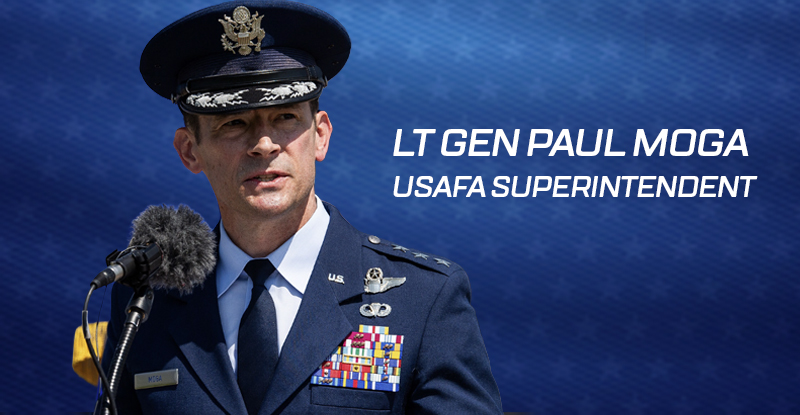
Opening remarks given by Lt. General Paul Moga, Superintendent of the Air Force Academy, at today’s Board of Visitors meeting:
Thank you and warm welcome again to everybody here joining us in person and everybody that’s dialed in virtually. Rep. Pflueger, thank you for your kind opening remarks. I just want to thank all members of the BOV for everything they have done, are doing, and I know will continue to do to support this great institution on behalf of America.
I’m going to speak relatively briefly, just some strategic-level headquarters updates with regards to the first 60 days of my tenure as the new superintendent, and then I’m going to hand it off to our professionals, our amazing and elite team from the cadet wing, the academic wing, the athletic department, and then our Space Force detachment as well.
First 60 days – I took over the first week in August. I’m obviously quite familiar with this institution as a graduate and a former commandant, and I’m married to a graduate as well, so showing up, I pretty much had a good understanding of what this institution is all about.
I spent the majority of the last two months really taking an assessment of our allocation of manpower resources and funding and authorities to make sure, because those things are for the most part relatively easy to fix rapidly with decisions from the superintendent’s level. I’ve already made several changes specifically, I would say, with regards to where the decision-making authority lies.
My initial impression was that a lot of authorities had been pulled up to the headquarters level. I’m more of a delegate until you get uncomfortable, and then once you get uncomfortable, delegate a little bit more. So I made a deliberate effort to make sure that every authority that I had the ability to delegate was pushed down to the lowest level that I am comfortable with it residing at. So those were probably the immediate changes I made in the first, week or two.
Then I really wanted to make sure that we had the right people in the right place doing the right things. In this world of finite and limited resources with money and manpower, you’re never going to get everything you need. So I needed to make sure that we were getting the biggest bang for our buck based on our people and our, and primarily our money.
I think we’re in about as good a place as we can ask for currently. We’ll always take more people. We’ll always take more money. I understand there are competing resources across all this inside of the service and across all the services inside of the Department of War. But we are ripe for, I think, some help with regards to increasing our resources, and I’ll talk more about it here in just a sec.
It’s all about supporting the cadets in their 47-month journey here at the Academy. The last one, we received about a month ago, give or take, the USAFA guidance letter that was signed off on by the Secretary of the Air Force, also signed by the Chief of Staff of the Air Force and the Chief of Space Operations.
It basically gave us some direction clearly, and it tasked us within 60 days of receipt to circle back with regards to where we are aligned, where we might not be aligned, what resources we might need from the department, and then what policy changes we might request to become in better alignment with the guidance we recently received from the Secretary and the two chiefs. We are in the process of reviewing that and writing our response that will be submitted back to the Honorable Richard Anderson, and then eventually make its way back to Secretary Meink.
In general, I think we are in very strong alignment with the language that is in that, the USAF guidance letter, but more to follow. We owe that back up by the middle of November, so the senior leadership at the Academy is going to hold a 2-day offsite in the second week of November. We’re going to finalize our response to make sure everybody’s on board with it, and then we’ll submit that back in accordance with the direction from the Secretary.
A little bit on my perspective with regards to our mission: I will say that I don’t think that the mission of this Academy has fundamentally changed over the years. It is, in my mind, and you can pick whatever words you want to describe it, but we build and inspire the next generation of warfighters that are prepared to go out and lead with character so we can deliver elite military leaders to win the future fight. And I guess some of the words and the way you describe that changes relatively, but that’s the way I boil it down.
That’s what we do. That’s why all the permanent party, the faculty, the staff, that’s what gets us out of bed every single morning, is to make sure that we are doing everything within our means and in our power and within our resources to make sure that that is what we are doing every single day for the cadets.
I’ve made it a deliberate effort, not necessarily because I thought that cadets had lost their purpose, but I think it’s important for us as an institution to remind them all as quickly as possible and as often as possible why they are here.
So in my first week, week and a half, I had an all-call with all four classes, every cadet that was available, and this is one of the things I focused on, not because I thought that they were here with the wrong purpose, but I wanted to make sure that they understood the right purpose because they are the best of the best of this country, without a doubt. These phenomenal young men and women that compete, apply, and get selected to attend this Academy are the best our nation has to offer. Full stop.
I remind them that some of them might think that they are here to play Division I athletics. And about 25% of them on average do because we recruit them to play sports, to compete and win. But that’s not their purpose for being here.
Some of them are extraordinarily intelligent and they want to compete and be selected for scholarships— Martinson, Rhodes, Olmsted, you name it. I think that’s great. And a handful of them will meet the cut and they will be selected to eventually go on and participate getting a scholarship, but that’s not their purpose for being here.
Their purpose for being here should be to complete the 47 months, get their degree, get their commission, and go out and serve their country as members of the profession of arms.
Fight and win wars on command and on demand, because that’s really, that’s what we do.
So I made a deliberate effort to communicate that message to all the cadets, and we’re going to routinely do that throughout every opportunity we get throughout their 47 months here.
That comes with some commitment.
It comes with some commitment from us as faculty, staff, and permanent party to make sure that we, when we get out of bed every single morning, we understand that we are committed to making sure that every cadet has the highest quality training, highest quality education, and the highest quality facilities that they deserve to make it through this institution, get their degree, get their commission, and then go forth and conquer. That is our job as permanent party and senior leadership at the Academy.
Then I remind them of their commitment.
We make several assumptions when cadets get selected and show up here at the Academy. I think two of the most, when they raise their right hand and they take that oath, not all of them understand what they’re really signing themselves up for. So it’s on us to make sure that we remind them the most consequential things that they are signing themselves up for here at the Academy.
They are not going to deploy and be put in harm’s way throughout their time here as cadets—they will eventually be down the road. But one of the things I’ve made it a point to remind them of is when they raise their right hand, take that oath, and make a commitment that 99% of their peers across the country either couldn’t or wouldn’t, they’re signing themselves up for a couple of things.
One of them is they agree to follow a different set of rules than their peers across the nation in civilian colleges and universities. We follow a different set of rules here at the Air Force Academy.
Second, they will be held to a higher standard without a doubt, because if we don’t, tragic things and the consequences of failure down the road could be very, very dire.
So I do my best, and I— and the other thing is, I ask— I’ve been also really focused on making sure that there is synergy and synchronization across all of our mission elements, mission units, and mission leaders. Everything the cadets experience here should optimally be complementary. It should never be contradictory, i.e., if a cadet goes and takes a class and they hear one thing, and they go back to the squadron and they hear something that conflicts with it, then we’re screwing up.
So we need to strive to be complementary yet never contradictory across all of the major areas that the cadets go through their training, their education, coaching, teaching, mentoring across the board.
Then the last area before I talk about some ongoing institutional changes, and I’m not going to steal the thunder from our senior leaders, is institutional pride is a really big thing for me. A lot of people have already heard this about— heard this from me, several in the room.
I don’t expect every cadet that goes through the 47 months here, I don’t expect every single day to be the best day of their life. That is by design. It is not meant to be fun. It is not meant to be easy. It is meant to be challenging. Even though not every single day of their life here is their best day, they should be dang proud to be here.
Because again, they made the cut, and their peers across the nation that worked really, really hard and didn’t make the cut, they should be proud to be here as a cadet. When they graduate, they should be proud to be from here.
I’ve asked all of our graduate communities to help me get that message out, because graduating from this institution genuinely means something.
I don’t want to wax too much poetic, but eventually, if you decide to separate or retire from the military and you go out and try to find a job in the civilian world, when you slide a piece of paper across the table and somebody reads where you went to school and it says that you have a degree from the Air Force Academy, they are going to make several assumptions.
Number 1, you’re smart and you’re well-rounded. Your degree was not an easy one and wasn’t handed to you and you didn’t buy it. Number 2, you’re tough. You know how to persevere. You know how to perform under physical, mental, and emotional stress. And number 3, you got character and integrity.
People will make that assumption without ever, ever meeting you because you have a degree from this institution. And we have to maintain that high degree of standard across the board.
Okay, the last one is executed and ongoing institutional changes. I get asked a lot, or at least relatively routinely, what are your big changes that are on the horizon? I’m taking my time. I’ve already made some relatively small and some easy changes for efficiencies and administratively, and I talked about a few of those previously.
The larger institutional changes, when you’re talking about mission, vision, and priorities, I’m deliberately taking my time so we as a senior leadership team at the Academy have the opportunity to discuss it, agree on it, and then when it’s time for me to roll that out, probably early next year is what I’m looking at for a variety of reasons.
One of those reasons is that we already have some relatively major institutional changes that are ongoing inside of the academic wing, the cadet wing, the airfield, and the athletic department that our amazing team is about ready to socialize with you as soon as I start to stop talking here, which is pretty much right now. So again, thanks for your time.
Maj. General Paul Moga nominated to lead U.S. Air Force Academy






Leave a Comment