

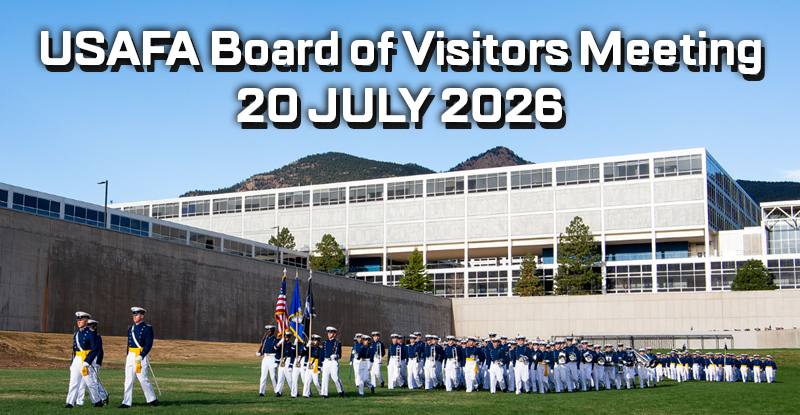
The USAFA Board of Visitors met on July 20, 2026, to review academy updates including new leadership introductions, AI integration in academics, chapel restoration progress, NCAA eligibility changes, and NDAA legislative wins. The board also addressed serious concerns about cadet disciplinary due process and called for greater transparency and timely responses from the Air Force Academy.
Here is the video followed by detailed notes and the full transcription.
Here are detailed AI notes:
Chair: Rep. August Pfluger
Facilitator: Dr. Raquel Rimpola
Attendees & New Members
- New Congressional Members: Senator Mike Rounds (SD), Senator Chris Coons (DE), Senator Jackie Rosen (NV)
- New Presidential Appointees (sworn in during meeting): Jon Hotaling, Erika Kirk
- Reappointed: Dina Powell (by President Trump)
- USAFA Leadership: BGen Evans (Acting Superintendent), BGen James Valpiani (New Dean of Faculty), Col. Brandon Tellez (New Commandant of Cadets)
- DAF Representative: Brian Scarlett, Principal Deputy Assistant Secretary for Manpower & Reserve Affairs
- Also present: Gen. Miller, Jennifer Block (Athletics), Dan Clark, Stoli Nickolai (Vice Chair), Rep. Crank, Mike Rose, Larry Card, MajGen (Ret.) Bentley Rayburn, Col. (Ret.) Ron Scott, Dr. Kent Murphy, Zach Miller
1. Chairman’s Opening Remarks (Rep. Pfluger)
Recognition & Congratulations
- Thanked outgoing Superintendent Lt. Gen. Tony Bauernfeind for 2 years of service; currently in retirement transition and unable to attend.
- Congratulated Coach Mike Kozlowski (promoted to Athletic Director of Leadership and Institutional Strategy) and Coach Sam Barber (promoted to Associate Athletic Director for Development and Strategy).
- Forbes recognized USAFA as a “new Ivy.” Four athletic programs (baseball, lacrosse, women’s tennis, rifle) earned perfect NCAA 4-Year Academic Progress Rate scores.
NDAA Legislative Provisions Secured
- Restore cadet wing to 4,400 cadets
- Authorize superintendents to contract with affiliated nonprofits for campus modernization
- Review of future of service academy athletics
- Require Air Force to assess establishing a dedicated USAFA funding line
Area of Concern: Transparency & Timeliness
- Second time this issue has been raised in the Chairman’s tenure.
- USAFA requested multiple extensions on Questions for the Record (QFRs); responses deemed incomplete or lacking transparency.
- Specific example: Defense Organizational Climate Survey (DOCX) received 3 months late and only included the cadet portion; full report finally received July 16.
- Similar delays on chapel renovation, cadet standards, and other issues.
- Chairman emphasized the board reports directly to the Secretary of the Air Force (Secretary Hicks), who is closely interested in meeting outcomes.
2. Remarks — Brian Scarlett (Principal Deputy ASMRA)
- Echoed appreciation for USAFA legislative advocacy.
- Acknowledged and committed to fixing QFR response timeline issues; met with staff the previous Friday to establish a plan.
- Key initiative: Officer Production Task Force directed by SECAF — a full review of OTS, ROTC, and USAFA to determine the right officer mix for the Air and Space Force. Outbrief to SECAF expected last week of August.
- USAFA 250 (now “USAPA 250”) initiative moving forward with DAF-wide partners; focused on long-term USAFA vision to 2050.
3. Superintendent’s Update (BGen Evans)
Command Team Changes
- Col. Javi Brown remains Air Base Wing Commander for another year.
- Col. Paul Brehm is the new 306 Flying Training Group Commander, leading the Airmanship for All program — now returned to USAFA from AETC, enabling greater adaptability.
- Two new major unit commanders: Col. Brandon Tellez (Commandant of Cadets), BGen James Valpiani (Dean of Faculty).
Airmanship for All
- BOV members invited to attend fall visit to the airfield to observe airmanship opportunities firsthand.
AI at USAFA (BGen Valpiani)
- Challenges identified: integrity pressure, tool dependence, varying faculty engagement, preparedness gaps from high school AI overuse.
- “Both-And” approach: Cadets must first develop independent foundational thinking without AI, then achieve mastery with AI before graduation.
- “What’s First, What’s Next” sequencing: Tiered AI framework established — from no AI use to unfettered use — mapped to class years and skill development.
- USAFA’s institutional advantage: clear mission, command structure, and mandate allow a coherent institutional response rather than ad hoc faculty experimentation.
- Formal institutional AI policy expected to be published in the near term.
- Chairman Pfluger noted opportunity for partnership with Dina Powell (at Meta) and her AI working group.
Academic Mission (BGen Valpiani)
- Three pillars of USAFA’s academic distinction:
- Distinctive value proposition — excellence in critical thinking
- Integration by design — coherence across disciplines
- Military focus — preparing officers to deter and win conflict
- Core curriculum: ~90 credit hours covering humanities/social sciences (Western civilization, US constitutional order, competitor nations), STEM with AI/ML integration, and warfighting core (air, space, cyber).
Commandant’s Vision (Col. Tellez)
- Focus on transforming cadets from students into warfighters — instilling willingness to fight and cultivating character-based leadership.
- Acknowledged resource constraints; committed to stretching them to expose cadets to air, space, and cyber power realities.
- Highlighted drone technology and emerging domains as critical areas for cadet exposure.
- Will review all policies as new leadership; specifically noted Cadet Wing Instruction 36-3501 (flight suit restrictions on terrazzo) as flagged by Vice Chair Nickolai for review.
5-in-5 / NCAA Age-Based Eligibility (Jennifer Block)
- NCAA passed a new 5-year eligibility model in June 2026.
- Immediate benefit for USAFA: reduced age disparity against older opponents.
- Potential benefits if USAFA adopted a 5th year: master’s degrees, additional STEM/warfighting minors, Airmanship for All, guardian officer training at USAFA.
- Challenge: would require legislative change to 10 USC Chapter 953 (currently mandates a 4-year program); would also require expanded facilities if cadet wing grows above 4,400.
- Dan Clark suggested a gap/stop-out semester (“turnback”) as an alternative that does not require legislation — already available at superintendent’s discretion (6 months to 1 year).
- Sen. Coons asked about the Tech College Sports Act (Cruz/Cantwell co-sponsored) — Block confirmed it would be beneficial, particularly in context of ongoing lawsuits challenging age-based eligibility.
4. USAFA Chapel Restoration Update (Gen. Miller)
Progress Since December Meeting
- SECAF memo (30 October) empowered accelerated decision-making, removed constraints, and established a dedicated O-6 PMO lead.
- Expanded contract oversight and inspection; use of undefinitized contracting authorizations to keep contractor working during negotiations.
Key Milestones
| Milestone | Target Date |
|---|---|
| East & west elevations weather-tight | November 2026 |
| Curtain wall (ends) installation begins | December 2026 |
| Curtain walls complete | April–May 2027 |
| Temporary enclosure (box) begins coming down | July 2027 |
| Box fully removed | January 2028 |
| Beneficial occupancy (handover to USAFA) | April 28, 2028 |
| Contract completion (punch list, exterior, documentation) | August 2028 |
Other Updates
- Last 12 Protestant pews being restored (complete within 2 weeks).
- Catholic organ installed; gutter/weather panel system installed.
- Stained glass installation and interior trim underway.
- QR code on slide links to public-facing progress website.
- Story banners installed along exterior construction fence (terrazzo and opposite side).
- Class of 2026 toured the chapel interior before graduation; Class of 2027 tours being planned.
- Signage (outdated completion date) acknowledged as an issue; being updated.
Vice Chair Nickolai’s Challenge
- Suggested exploring opening the lower/Catholic portion of the chapel earlier, as an all-faith facility, before full completion.
- Will submit the idea in writing.
5. Working Group Reports
Disciplinary Focus Group (Vice Chair Nickolai)
- Task force established: 3 distinguished lawyers + a former USAFA commandant.
- Finding: USAFA’s disciplinary process needs significant improvement.
- Cadets being disenrolled without due process or fair hearings.
- December 2025 GAO report independently identified severe limitations in USAFA’s conduct and disenrollment system.
- USAFA was the only one of 5 service academies unable to provide GAO data on conduct violation cases.
- Plan: Request a meeting with new Commandant Gen. Tellez; submit formal QFRs.
Infrastructure Working Group (Rep. Crank)
- FY27 NDAA HASC markup included two key BOV-secured provisions:
- Public-private partnership language — changes how USAFA can work with the Alumni Foundation, enabling faster, cheaper projects.
- Dedicated FSRM (Facilities Sustainment, Restoration & Modernization) funding line for USAFA — prevents the academy from competing with warfighting installations for funding.
- Chairman noted the importance of USAFA 2050 plan trajectory and the need for appropriations alongside policy wins.
- Six cadet classes have never seen the chapel open — highlighted as both an infrastructure and spiritual concern.
6. Public Comments
| Speaker | Topic |
|---|---|
| MajGen (Ret.) Bentley Rayburn | Value of academies vs. ROTC/OCS; argued distinct military culture is the key differentiator; called for restoring “motivation to become a career officer” to the mission statement |
| Col. (Ret.) Ron Scott | Disciplinary philosophy — balance of accountability and rehabilitation; warned against excessive punitive measures that promote submissiveness over character |
| Mike Rose, USAFA ’69 | GAO findings on USAFA conduct system; argued system is unlawful for not providing hearings before disenrollment; recommended Secretary of Air Force order fair hearings |
| Larry Card | Personal case: son disenrolled without a required hearing; exculpatory evidence removed; Article 15 based on unverified 8-sentence summary; called for investigation of similar cases |
| Dr. Kent Murphy | Questions about the 26 reinstated civilian faculty slots (civilian vs. military ratio unclear); concerns about PhD faculty percentage ahead of 2028 HLC accreditation review; recommended reconsidering “Cadet AFSOC Wing” model and restoring “educate” to mission statement |
| Zach Miller | Chapel restoration — outdated signage; spiritual importance to cadets; referenced Charlie Kirk’s role in accelerating project; urged accountability on completion dates |
BGen Evans’ Response to Public Comments
- Curriculum review underway under BGen Valpiani.
- Character-based leadership and military culture remain central emphases.
- Unable to discuss individual cases publicly due to Privacy Act.
- Affirmed due process: cadets can reject Article 15, meet with squadron/group commanders, commandant, and superintendent before any disenrollment decision.
- Honor cases decided by cadet peer boards.
- JAG legal advisors involved in all significant decisions.
7. Action Items Review
Three open action items reviewed:
| # | Item | Category | Decision |
|---|---|---|---|
| 1 | Space Education Center | Resources | Merged with Item 3 under “USAFA 2050” — kept open |
| 2 | Military Professor Copyrights | Curriculum | Kept open (note: offering copyright retention seen as key to attracting PhD faculty) |
| 3 | BOSI USAFA Update | Resources | Merged with Item 1 under “USAFA 2050” — kept open |
Vote: Motion by Rep. Crank, seconded by Dan Clark — passed by voice vote (ayes, no nays).
8. Closing Remarks
Dan Clark: Urged changing base access from digital military ID to photo ID / driver’s license to reduce barriers for families, alumni, and community members visiting for athletics or the cemetery.
Rep. Crank:
- NDAA provision to preserve the 70th Flight Training Squadron (Air Force Reserve unit supporting USAFA airfield) — preventing it from being stood down.
- 26 civilian faculty positions reinstated after 2026 Workforce Optimization Reduction Plan review by Secretary Meink.
- FY27 president’s budget only requested 4,000 cadets (not 4,100 or 4,400). Space Force growing from 600 to ~1,800 second lieutenants/year — USAFA must be resourced to support that demand.
Vice Chair Nickolai: Called this a “dawn of a new era” with incoming leadership (Tellez, Valpiani, Moga as new Superintendent). Strongly recommended the next Athletic Director be a USAFA graduate to reinforce service culture.
Chairman Pfluger (closing):
- Described a once-in-a-generation opportunity to recapitalize and restructure USAFA funding.
- Called on USAFA to use the BOV as a leverage point for resourcing.
- Next visit planned for October; questions for the record due to Dave Nugent by 31 July; USAFA/DAF responses due by 30 September.
- Meeting adjourned.
Key Deadlines & Next Steps
| Action | Owner | Deadline |
|---|---|---|
| QFRs from board members to Dave Nugent | All BOV members | 31 July 2026 |
| USAFA/DAF responses to QFRs | USAFA / DAF | 30 September 2026 |
| Officer Production Task Force outbrief to SECAF | Brian Scarlett / DAF | Last week of August 2026 |
| East & west chapel elevations weather-tight | Gen. Miller / Contractor | November 2026 |
| Request meeting with new Commandant on disciplinary process | Vice Chair Nickolai | TBD |
| Disciplinary focus group formal submission | BOV Disciplinary Task Force | TBD |
| Submit gap-semester/chapel early-opening proposals in writing | Nickolai | TBD |
| Update chapel signage with accurate completion date | Gen. Miller | In progress |
| Fall BOV visit to USAFA airfield | BGen Evans / BOV | October 2026 |
AI Transcription of meeting:
Rep. Pfluger
. . . . .Senator Mike Rounds of South Dakota, Senator Chris Coons of Delaware, and Senator Jackie Rosen of Nevada. Welcome to those new members, very much valuable to the endeavors that we have. Additionally, we have several presidential appointees that have recently been appointed, Mr. Jon Hotaling and Ms. Erika Kirk, and I look forward to working with all of you and appreciate your participation in this voluntary board. I would also like to note that Ms. Dina Powell was reappointed by President Trump to continue her service on the board. You know, I’m encouraged recently Forbes’ recognition of the Academy as a new Ivy. This distinction is important, and it highlights top-tier employer-preferred colleges and academic institutions.
And additionally, Air Force had 4 athletic programs earn a perfect score in the latest NCAA 4-Year Academic Progress Rate report., and I’d like to congratulate the baseball, lacrosse, and women’s tennis and rifle teams on this accomplishment. I think it’s important at this point to, to say thank you to Lieutenant General Tony Bauernfeind for his service, not just as the Air Force Academy superintendent for the last couple of years, but also for his career of service in the Air Force. He’s a 1991 distinguished graduate from the Air Force Academy.
He had many different joint and command-level positions, including as a special operations pilot, as a commander in the Air Force Special Operations Command, and he recently took over the Air Force Academy in 2024. General Bauer found, as every superintendent finds, had many challenges and different things in the environment of just where we are geopolitically, where his leadership was absolutely instrumental and key. And so, General Bauerfeind, we thank you for your service. We thank you for service before self and for leading the Air Force Academy. We wish you well in the next phase of your career and your life, and sincerely, with gratitude from a grateful nation, thank you.
I would also like to congratulate A few others, including some folks that have really demonstrated a high level of leadership, including Coach Mike Kaz Kozlowski on his promotion to be the Athletic Department’s Director of Leadership and Institutional Strategy, and Coach Sam Barber on his promotion to Associate Athletic Director for Development and Strategy. These are two outstanding leaders who, yes, in their careers as coaches cared about winning, But I would say more importantly, they cared about our nation winning, and they, they showed that every single day demonstrably through the way that they developed warriors.
And the record on the field and on the athletic performance was important, but it was less important than how our nation performs. And so we sincerely thank you. Over the last several months, the board has had multiple engagements, including ones focused on the Academy’s infrastructure, Budget and athletics. The board secured multiple provisions in the House and Senate National Defense Authorization Act bills that are currently moving through the legislative process, and I’m proud to highlight to you that the NDA provisions that include initiating the process to restore the cadet wing to 4,400 cadets, authorizing the service academy superintendents to contract with affiliated nonprofit organizations for campus modernization projects, reviewing the future of service academy athletics, and requiring the Air Force to conduct an assessment on establishing a dedicated funding line for the Air Force Academy. I’d like to thank our Board of Visitors members who were involved in this work, and in advance, I would like to thank the Board of Visitors on the, the House and Senate side for continued work to advocate for these issues as they approach a conference point between the House and the Senate in the NDAA. I don’t like saying things that, you know, getting to a negative point, but there’s a few things that I think I need to address in an area of concern.
Unfortunately, for the second time during the tenure as Chairman that we need to discuss. This Board works hard with volunteers that have other things and other jobs, but they care deeply about the Air Force Academy.— and timeliness in responses, especially from the Air Force Academy, are very important, as well as transparency in getting a timely and transparent response to the board’s questions for the record. And the Air Force Academy unfortunately has, has requested multiple extensions with what has been perceived ample time to respond. And additionally, the board is concerned that those responses are either incomplete or don’t show the entire picture with a lack of transparency.
An example of this, the Board requested the Air Force Academy Defense Organizational Climate Survey, otherwise known as DOCX, and the Board received the DOCX 3 months after the initial agreed-upon suspense, but the report only included the cadet portion and excluded other elements of the USAFA organization. As we made another request and received a more detailed report on July 16th, then we could piece this together. And unfortunately, this is just not acceptable. We’ve had similar challenges receiving information related to the chapel renovation, to cadet standards, and other issues.
These questions, for the record, are essential for this board to fulfill our mandated responsibilities and to report to the Secretary of War, which we directly do. And he is very interested— Secretary Hicks is very interested in the result of each of these meetings. But unfortunately, like I mentioned previously, this is the second time that we’ve had to address these types of communications between the board and, and the department and the academy. We look forward to shaping that up and having a, a more timely response. As you can see, the importance of this is that these briefings that you provide us and the discussions that this board has directly lead to legislation or partnership with industry or a, a better understanding and a better communicative model for the country to know, the nation to know what the Air Force Academy is doing. So please think of us as the chief advocate for this institution, a board of well-accomplished leaders throughout the country that want nothing more than to see the Air Force Academy succeed, but we have to have timely, accurate, and transparent responses in order to accomplish our statutory responsibilities. I look forward to our discussion today, and the board continues to, to work to ensure that the Air Force Academy remains the world-class institution that it is and to produce the finest officers for the Air and Space Force.
Stoli Nickolai
Thank you.
Host, Dr. Raquel Rimpola
Sir, if you’d like to take a moment to swear in our new presidential appointees as special government employees, sir.
Rep. Pfluger
Well, outstanding. I think this may be the first time that I’ve issued an oath of office virtually, but for those new board members, presidential appointees, if you would please raise your right hand. You can— If you’d like to come off of mute and repeat after me. I, state your name.
Rep. Pfluger
Do solemnly swear.
Rep. Pfluger
That I will support and defend the Constitution of the United States.
Rep. Pfluger
Against all enemies foreign and domestic.
Rep. Pfluger
That I will bear true faith and allegiance to the same.
Rep. Pfluger
That I take this obligation freely without any mental reservation.
Rep. Pfluger
And that I will well and faithfully discharge that I will well and faithfully discharge the duties of the office on which I am about to enter, the duties of the office of which I’m about to enter, so help me God, so help me God.
Host, Dr. Raquel Rimpola
Thank you. I’d like to turn it over to Mr. Brian Scarlett, Principal Deputy Assistant Secretary for Manpower and Reserve Affairs. Sir, over to you.
Brian Scarlett
Good afternoon, Chairman Pfluger and members of the boards, as well as our guests. Thank you for letting me spend a few minutes with you guys. I want to first thank the board for all of the efforts that they have done over the past couple of years. Your partnership and your recommendations are critical. Chairman Pfluger, I want to thank you for your— you and your members of Congress for the additional amendments that you guys have been putting up that are going to advance the agenda of The academy, those are all critical and we continue, we look forward to working with you over the coming weeks and months to get, get them over the, the line and get them any additional ones into the process that we discover in these meetings in the future meetings. So I really appreciate there. Before I go any further, I do want to like you, Chairman Pfluger, call out Lieutenant General Bauernfeind and thank him for his service. He came in at one of the most challenging times in the academy, probably in recent memory, as we came out of COVID in an environment that was fraught with a lot of issues, a lot of isolation, and an environment where cadets just quite frankly were not used to how things used to be before COVID at an academy.
And he had to quickly install the warrior ethos into the academy and bring back different types of a mindset. That’s hard. It alienates people. It also brings and makes enemies. And he did a remarkable job over the past 2 years of really bringing the academy into where we need to be for the future. So we will be grateful for him for what he’s done at the academy. We’ll be grateful for what he has done in his whole time for the Department of Air Force. And so, Thanks to Tony for all of his support and his counsel over the past year for myself. Um, the next thing I want to thank you, Chairman Pfluger, as I said, your recommendations that this Board makes, not just for what we’re going to go through for Congress, but what we are doing just in general day to day is critical, and those things are helpful. We are starting to action some of those, and we really appreciate it. We also have heard you loud and clear that the timelines to response so that you guys can give those high-quality recommendations is critical. I met with my team last week.
I think we are going to see a much quicker turnaround. I met with your staff on Friday, and I think that between the plan and the way ahead, that we won’t be seeing the same delays and issues that we’ve plagued some of our RFIs in the future. And so I’m hoping that we can correct that and that this is— was the last meeting that you had to call, call that out. But that is something that we are very aware of and we are working towards to end. We have a plan forward on that. So, because the, the, these type of responses, these type of conversations, I can tell you your recommendations have led to things such as the Officer Production Task Force that the SECAF has directed. That is something that is currently in the final stages of being finished. Our team at OLEA within the MR at A1 are conducting a full soups-to-nuts review of officer production, looking at OTS, looking at ROTC, and looking at the academy, looking at where we wanna see the future mix of officers coming out of the Department of Air Force for space and for the Air Force to see if we, what that exact number should be for USAFA, what should OTS be and ROTC, what we can do for strengthening.
So some of your recommendations from the winter directly contributed to the SecAF wanting to do a comprehensive review of the full officer review because that is something that is important. Our officers are critical to our warfighting function and making sure that we have that mix set up is correct. We will be outbriefing the SecAF the last week of August on that report. And happy to bring that to you once that is complete. Another thing that is very exciting is the SecAF, obviously you are tracking, created USAPHA 250, and that is moving forward with full force. It has DAF partners from all the different two letters, and they are working hard to try to make sure that that future and what USAPHA looks like, in 200— the 2050 is made. Some of the line items that you’re talking about and some of those, uh, budget, um, fixes that we’re talking about directly calling out, uh, the lines for USAFA will be critical to that, and I really appreciate your work on those efforts. Um, this is a partnership, and we are here to work with the Board of Visitors, take your recommendations. What you see and what you’re able to do is not necessarily what we see.
You have the unique, uh, experiences of either being in the service and/or coming from private sector or seeing what’s going on from Congress. Those are unique perspectives that sometimes the individuals that are in the fight down at USAFA and/or at the DAF can’t see and different perspectives. I look forward to having continued dialogue, to continue conversations, all with the same goal of advancing the Academy, making it the best place for officers to come out of, making it an experience for our members and our cadets that is memorable and also something that is proud of the rest of the nation. It is one of the best institutions in the country, and we want to maintain that and continue to improve that and make sure that the best officers in the country are coming out of there to help represent the Air Force and the Space Force. And with that, I thank you for the time.
Rep. Pfluger
Thank you very much.
Host, Dr. Raquel Rimpola
We now have the superintendent’s update.
BGen Evans
Yes, ma’am. Thank you. Good afternoon, Chairman Pflueger. I also want to welcome all the Board of Visitors members and also a particular welcome to all the new Board of Visitors members. I appreciate all of your support and advocacy. Chairman Pfluger, as you mentioned up front, you guys do so much to help advocate for this institution. And continue to make sure we can execute our mission well into the future. So thank you. And also on behalf of Lieutenant General Bauernfeind, as you mentioned, he is in the process of going through his retirement process, so he cannot be here right now, but I appreciate your comments about his leadership here over the last 2 years. And Mr. Scarlett, thank you as well. I’ll pass along your kind words. I also appreciate, Chairman Pfluger, that you acknowledged Coach Kaz and Coach Barber. The two of them both incredible coaches. And I was talking to Leslie, I wasn’t sure, did you get to play for Coach Kaz here at the Academy, Sharon Pfluger, or was that before your time? Or is that after your time?
Rep. Pfluger
I think I still have some eligibility, so if it’s not too late, maybe.
BGen Evans
Ms. Block, our Executive Director of Athletics, will talk about the 5-5 program here in a minute, so potentially there’s an option there. We’ll see. But the two of them, you absolutely nailed it. Obviously, they put excellence on the field and the mat every time their teams took the field., but their focus on building leaders of character and turning, you know, these amazing young men and women into leaders in the Air Force and Space Force, just an amazing track record. And they always spoke not just about their wins and losses on, wins on the field, but also the number of cadets who would be squadron commanders and take on other leadership opportunities around the cadet wing or the GPAs that their cadets were maintaining. So their focus was absolutely exceptional, and we’re excited to bring them up into leadership positions underneath Ms. Block where they can now impact not just the cadets on their team, but all of our 25% of our cadet wing, which is IC athletes. So thank you for that. I also acknowledge your concerns about the timing and echo Mr. Scarwitz’s comments. So we’ll work with DAF leaders to make sure we can get you the information you need on a timely basis so that you can go out there and execute the Board of Visitors’ mission, which is to support the institution and help where you guys can.
So thank you very much for all of that. With that, we have a couple of new teammates here. So Colonel Javi Brown is still the Air Base Wing Commander for another year. Ms. Block and Dr. Hickson are all representing the Athletic Department. We also have a new commander of the 306 Flying Training Group, and I’m excited since some of our last updates, the 306, the airfield, which is, they manage all the airmanship opportunities from jump to powered flight to soaring. We have a new commander, Colonel Paul Brehm is down there as the commander., and he’s really leading the Airmanship for All program that we talked about just a little bit ago, but we’re excited to bring that program. It used to be under Air Education and Training Command, and now it is back home where it belongs underneath the Air Force Academy, which means it has a full focus and we have opportunities to be more adaptive and responsive with our syllabus as we find best practices to go out there and get more cadets airmanship opportunities. And we’re excited for your next visit, for all the Board of Visitors members that can make it, to host you in the fall and get you down to the airfield and see some of these airmanship opportunities firsthand.
So we’re excited about that. But we have also of our kind of the major units between AD, Air Base Wing, DF, and CW, two new commanders of the Dean of the Faculty and the Cadet Wing. So I’ll give them an opportunity to introduce themselves next. Next slide, please. Thank you, sir.
Col. Brandon Tellez
To this incredible board, if I may just start first with my gratitude. I may be one of the newest guys around here, but I come with absolute respect and certainty as to the tremendous impact you guys have had on the success of this institution. So first, if I just may, thank you for your service and support to this place and the greater public that’s watching now that we all serve. If you can click the next slide, please. Out of respect for your time and really to save you from that picture on the slide, I’ll I’ll be brief here, but I am grateful to be back here as a bottom line. I was a graduate of the greatest class to ever go through here, 2001, fired up. And I can say with absolute certainty that I was well educated and highly motivated, but as part of the driver for why I’m here now, I will tell you, I don’t think I was fully informed. I come with a little bit of regret and a little bit of learning as to the opportunity to set our current leaders on a stronger footing as to what is waiting for them when they graduate from this fine institution.
Quite bluntly, I was not hired for any other purpose other than one— well, largely because of the tremendous opportunity I’ve had to serve this country. I’ve had the privilege and honor of fighting on behalf of this country for the last couple of decades, and I’ve learned a lot throughout the those experiences. If you can click the next slide, I’ll explain to you how I plan to put those into practice. Quite practically, we inherit our nation’s finest. As you all know, they come well, well accomplished, highly motivated, and I would count those incredible young men and women as warriors all. It is my job now to ensure that through every experience that they go through here, that they walk away as warfighters. And that is a significant pivot. That picture on the top right, I think, is incredibly telling. There’s, there’s a stare in that young man’s eyes that has a question and inherently a challenge and a response all baked together. And these are the moments that it is my job to create while we are here. Our nation demands folks that are pushed to the edge of what they think is possible and given the opportunity, realize that they can push much, much further.
And to constantly present those challenges in front of them so that by the time they graduate, they’re prepared to fight. The vision I have is shared by all these fine folks at the table. Elevating the prestige and effectiveness of this institution is a significant challenge, one that requires your partnership, as you all are well aware of, but the opportunity is near limitless if we get this right. So very excited to join that partnership. The directions I’m trying to point in my short tenure of assessment, I can tell you that while I do see opportunities, I am tremendously encouraged by the progress we are making. While I acknowledge the fact that resource constraints can sometimes limit the training environment that we can give to our cadets, this place is stretching those resources to the absolute limit, to the point that we can now expose our youngest warriors in transition to warfighters to what it means to be an Airman or a Guardian and the implications of air power and space power when employed effectively, as we’ve seen on display, as many of you all know from your tenure careers, these folks show up without that exposure.
So it is my job to start first with teaching them the willingness to fight and then cultivating the character that it needs to translate that willingness to fight into effective leadership, not just of themselves from a moral ground, but effective teamwork as they transition to officership and go on to the, to the greater forces. But I do acknowledge, again, to the point on resource limitations, the game has changed even in the last couple of years. The picture of the drones on the right is a great example that we’ve all learned over the last couple of years and the tremendous potential that it is to born leaders here that have a foundation that we are just starting to build now, an imagination to create a future where these types of technologies are fundamental baseline for them. The opportunity here is tremendous. I aim to leverage that significantly. The reality is we will teach them to fight, but we need to give them the tools that will enable them to be effective when they actually transition to the force. Tomorrow. And again, that applies both to the air layer and the space layer, as well as the cyber force that underpins it all.
That picture in the background with the B-2, I think it’s a tremendous example of when done right, our Air Force, our department has proven that we can keep the peace if we can develop the technologies and hone the warriors needed to employ them effectively. That peace has the potential to persist well into tomorrow if we get it done right here. But foundationally, we’ve got some opportunity that we’re going to take advantage of. And with my time, that’s all I have. Thank you.
BGen Evans
And I, how I just, we’ve made a lot of, just in the year that I’ve been here under General Marks before, made a lot of incredible successes from the common exercise to other things. And it’s been awesome to see Colonel Taylor over the last 2 months build on the successes before and continue to expand that with the new class of 2030 going through basic training right now. They’re doing amazing things and we’re continuing to build on the successes of the previous leadership that was here. So, Thank you and welcome, sir. General Vipiani, next slide, please.
BGen James Valpiani
Chairman Pfluger and members of the board, it’s a privilege to address you, and I’ll just echo General Evans and Colonel Tellez in their comments of real gratitude and appreciation for your advocacy on behalf of the institution. We have assembled an extraordinary number of members with great interest in the institution, and we’re grateful for you using your positions of authority and influence to help advance the institution. Next slide, please.
Host, Dr. Raquel Rimpola
So, sorry, I have Mr. Nikolai’s hand up, wanted to see if it was for the previous section.
Stoli Nickolai
Yeah, thank you, Raquel. General Tejas, under the previous administration, Cadet Wing Instruction 36-3501, Uniform and Standards, was updated where paragraph 824 says flight suits will not be worn on the terrazzo. I asked numerous questions and have yet to receive an answer from USAPA. This is one of our sticking points we talked about. One of the easiest ways, I think, to promote air and space mindedness is just wearing the simple uniform around campus. So no real need for an answer. I would just recommend that you take a look at Cadet Wing Instruction 36-3501 as you start your tenure and see where we can promote that air and space mightiness. Thank you.
BGen Evans
Yes, sir, it’s Brigadier General Evans. Appreciate the question. And as with any new leadership that comes in from Colonel Tellez to, you know, General Mogo, we always relook through all policies, procedures, techniques to make sure that we continue to adapt and evolve. And that’ll be up to, you know, General Moga in the future and whether or not he wants to make any changes over. General Valpiani.
BGen James Valpiani
Yes, next slide, please. So by way of introduction, I’m a graduate of the class of 2004, ready for war, or with respect to, say, it’s by far the best class in the Air Force Academy. I’ve been very privileged across my career to delve into many different domains of the Air Force, first with operational flying combat opportunities and then ultimately transitioning into the test community where I’ve had the privilege to lead a number of different missions and organizations advancing the test mission, developing capabilities for the warfighter. I’ve also been very privileged to attend a number of educational opportunities on behalf of the Air Force, And so it’s a real privilege to be able to return to the institution, to be able to shape the academics in a similar way to the way that I’ve been shaped, oriented towards the mission and oriented also towards the development of leaders’ character. Not listed on here as the most important part is my family, my wife and 5 children, who are all very excited to be here as part of Team USAPA. Next slide. So the academic mission here at the Air Force Academy is distinct from that of other institutions of higher learning, specifically in our alignment towards the Air and Space Force mission.
And it is my job to ensure that the education here is not only excellent, but excellent in a particular way, which is the orientation towards the profession of arms. At the top there, you see three marks of the education that we are orienting ourselves around. The first is providing a distinctive value proposition for the Air Force, Space Force, primarily in the form of excellence in the way that we think, distinctiveness in the minds and the kind of critical thinking that our officers graduate with. The second is integration by design. So one of the unique aspects of the military academy not only is its orientation to the mission, but also its ability to create coherence across the different disciplines courses so that when cadets leave here as officers, they know how to think in multiple disciplines and multiple domains at once. The future fight, the fight that’s emerging today, is growing increasingly complex, and officers who can think across disciplines have a great advantage of being able to bring to bear the full—
The, the third element, uh, the third mark of the education here that, that makes us distinctive is that military-focused, uh, component, right? So again, as an institution of higher education, we’re very fortunate to have a very clear target that we’re aiming at, uh, these officers who are able to deter conflict, and if necessary, to win decisively if called upon. And so these three elements of intellectual excellence, that distinctive value proposition, integration by design, and a military focus are what my aim is to drive throughout the education. In the middle tier, you see one of the most unique aspects of our academic experience here is the core curriculum, which constitutes roughly 90 credit hours, and that’s the education that we hold is the common education all officers from this institution require in order to be effective officers for the Air and Space Force. And so you can see here the three focuses for that core curriculum in addition to our, the core components that belong to the athletic department and the Commandant of Cadets. From the academic focus, we are aiming to integrate these, the humanities and social sciences oriented around Western civilization, US constitutional order, and a clear-sighted study of potential competitor nations.
In the middle, our main focus with STEM is to drive integration across the technical and scientific disciplines with a specific focus on operational problems and an integration of artificial intelligence and machine learning to accelerate the design and development of war-winning capabilities. And on the right-hand side, you see a warfighting core foundation, which is designed to ensure that all officers who leave this institution have a clear-sighted understanding of air, space, and cyber power as it applies at the tactical, operational, and strategic level, not perhaps to the depth that we would achieve in a professional military education, but providing them a comprehensive understanding, integrated understanding of how these instruments of power come together to serve the national interest. And so it is my privilege to lead the faculty here, very distinguished educators, many of them also veterans and leaders in their own right. In providing this extraordinary mission-aligned and deeply integrated education for the Air Force Academy cadets.
BGen Evans
Thanks and welcome. Chairman Pfluger, I’ll defer to you. We’re a little bit over the time that we allocated for the SUPS updates. We had two topics that we were prepared to discuss, AI use at USAFA, and then the 5-year plan regarding the athletics and other opportunities. We can send the information through bullet background papers, or we can brief those, or we can table those. I’ll defer to you on what you would like to do.
BGen James Valpiani
So next slide, please. Oh, thank you. So as all of us in the room know, artificial intelligence is a major driver of the conversation in higher education. There are tremendous opportunities that artificial intelligence presents to us as we think about that integrated and mission-aligned education that I spoke of just a minute ago, and there are also a significant number of challenges that artificial intelligence presents to the conventional model of higher education, and this slide is designed really to reflect both of those realities. The, the main takeaway that I would want to leave the board with is that as we think to the future of education here at the Air Force Academy, we are taking a both-and mentality and a what’s first, what’s next mindset And by both end, what I mean is there are foundational elements of thinking that our cadets need to develop here. And much of that has to happen in an environment in which they are not dependent upon artificial intelligence. By the same token, by the time they depart this institution, they must be masters of artificial intelligence, knowing how to use it effectively to accelerate how we do business in the Air and Space Force, so that they can be leaders of their institutions, their units, in educating the rest of the force on how to apply these incredible tools.
The what’s first, what’s next mindset speaks to the sequencing. So it’s necessary as we bring in a wide variety of educational backgrounds from high school to the Air Force Academy where artificial intelligence has been applied at the high school level in a wide variety of ways, completely unconstrained in some cases to completely constrained or even precluded from the education in others. So it is necessary in the first instance to provide a clear baseline for what it means to think independently, to develop a strong set of foundational knowledge and principles across our disciplines, and then to sequence in a deliberate buildup fashion towards clear objectives of mastery of artificial intelligence across the core and ultimately into the majors. So on the left-hand side, you can see the sort of one element of this discussion. Which is a number of challenges. There have been a number of reports both in magazines and newspapers of record as well as trade magazines regarding higher education concerning the impact of higher education. There’s a number of concerns including integrity pressure, tool dependence, a wide variety of faculty engagement with the tool, which— with these tools, which prevent— presents a opportunity to, to be more disciplined and more intentional with the use of these tools.
And then ultimately, for those, those some segments of, of the high school population that we receive, there’s a number of preparedness gaps that are related to the overuse or the misuse of artificial intelligence. And so our objective in the first instance is to provide the kind of environment and assessments which allow us to ensure that the foundational elements of knowledge are both— that there’s an opportunity for the cadets to engage with those foundational elements to develop good habits of thinking, and then ultimately to evaluate them fairly on that basis. On the right-hand side, you can see the, the “and” portion, that the opportunities that exist here at the institution. So we’ve already taken some preliminary steps to establish a set of tiers for engagement with AI that allow our faculty to provide clear guidance to the cadets on how they are to engage with AI that begin with essentially no use of AI all the way up to complete and unfettered use of it. That gives us a deliberate process or deliberate framework to incorporate AI into the education. And you can see across those numbers there the way in which we’re thinking, at least at a provisional level, of going from that foundational mastery in the absence of AI all the way to operational application of AI in the upper-class years.
One of the things I think that’s worth highlighting is that the Air Force Academy has a unique institutional advantage. Unlike other institutions of higher education, we have a very clear mission and a very clear mandate for integration, as well as command structure that allows us to respond to this historic development of artificial intelligence. And so it’s my intent to leverage the incredible opportunities that we have here and the institutional advantage in order to drive an institutional response to artificial intelligence rather than to leave it at the faculty, individual faculty levels of experimentation, which drives confusion and incoherence in our application of these incredible tools. As you can see there at the bottom, my vector is that AI should be used in such a way to sharpen cadets’ thinking and prepare them for the conditions of modern war, but at the same time not replace the hard thinking that it is their obligation to develop, and it’s the nation’s expectation that they do so. There’s a number of elements of thinking there at the bottom that we are looking at in terms of preserving and enhancing with our AI policies, and you can expect that in the near term, the institution will be publishing a set of institutional responses to artificial intelligence that both protect that foundational thinking and also accelerate its adoption throughout the curriculum.
Host, Dr. Raquel Rimpola
Sir, we have a question from the chairman, sir.
BGen Evans
Yes, sir.
Rep. Pfluger
Yeah, General Evans, this is a great example of the— where I think the partnership can be, you know, really enhanced with Ms. Dina Powell at Meta as, you know, the CEO that has a tremendous amount of experience and also leading the working group on AI. To be helpful to bring industry together with a lot of, I think, a lot of opportunities here. So General Valpiani, outstanding brief. Thank you for your leadership on this. And I think we’ve got a real partnership opportunity here.
BGen Evans
Appreciate that, Chairman Pflueger.
Jennifer Block
Chairman Pflueger and to the Board of Visitors, hi, welcome. My name is Jennifer Block and As grateful as I am for my two classmates, my two teammates, they are a little bit misguided. The best class to graduate from the Air Force Academy is the class of 1992- True Blue.
And let’s hop right in. Next slide. Talk a little bit about what the NCAA passed in June of this summer, which is an age-based eligibility model commonly referred to the 5-in-5. And so for college athletics, now each college athlete could play 5 years of eligibility. So if you look at currently, we— USAPA is— all the service academies are a 4-year program. So we do— there are limited benefits for us now. I think the biggest benefit for us right now is the reduced age disparity in competition. So we are actually very excited that we won’t be playing 26- and 28-year-olds. Lining up against them again on the line. But if we kind of imagined what other, other ways to take advantage of this, if we looked at a 5-year program, I think for all of USAFA there could be some benefits. Some specific benefits could be, we could look at maybe a master’s degree for a portion of cadets. We could also probably an increase in STEM or warfighting minors We could also manage— we talked about Airmanship for All— look at maybe IPT or the officer training course that the guardians take could maybe happen here at USAFA.
So when we graduate cadets into second lieutenants, they would be ready to go straight into pilot training or straight in to be a guardian. And then obviously the huge benefit for our cadet athletes is that we would get the advantage of having our athletes have the 5th year when they’re at their highest performance. However, there will be some challenges. As you know, that would require a legislation change. Penn USC Code Chapter 953 currently says that it is a 4-year program. And so we would— this would be something we would need your advocacy on. We’ve talked a lot about going to 4,400. USAPA is built for 4,400. If we would go above that number, we would need some facility, we would need greater facilities and additional manpower.
BGen Evans
So I think the highlight there is it isn’t just an opportunity on the athletic side, it really does for select cadets. It might not be the entire class, it could be just some ones that we, you know, keep for 5th year. There’s some other things out there that are, that we could explore across all of our kind of academy domains to provide some advantages to select cadets. So with that, Chairman Pfluger, that is the, The end of the superintendent’s update. Again, I’ll pass along the kind words for Lieutenant General Bauernfeind. As you mentioned, and Mr. Scarlet mentioned, a lot of change over the last 2 years building on the successes of previous, you know, superintendents and different command teams. But we’re excited about what we’ve done, and we’re excited to move forward with a new command team here with General Valpiani and Colonel Tellez as well. So thank you, sir, and I’ll pass it back over to you.
Host, Dr. Raquel Rimpola
General Evans, we have one question from Mr. Clark.
Dan Clark
Just wanted to acknowledge the leadership of Nancy Hickson and Jen Block, and thanks for that. Maybe one quick suggestion that would be— that wouldn’t require the legislation change. The one semester stop-off, it’s often called a gap semester or leave absence, which is a temporary official break from the regular study students take this time to work, intern, travel, or handle personal issues while keeping their admission status intact. And from an athlete’s perspective, obviously when we win on the football field, when we win in sports, it elevates our national exposure. It, it improves our, our, our application process. It’s awesome. We know all the stats and statistics from previous winning seasons. So what we’d like to suggest that you think and seriously consider is implementing this semester one stop-off. Because what happens is it affects every single cadet. It’s not just giving preferential treatment to athletes, but think about how much growth mentally, physically, spiritually, emotionally that a cadet goes through in the basic training, in the 6-week in basic training. And what could occur in a 17-week period where every cadet gets a chance to take one full semester off, 17 weeks,. And from a football player’s perspective, think about how much stronger they’ll get, how much more emotionally stable and, and mature they’ll get.
And that will add to our ability to win games, giving that athlete that fifth season, if you will, without having to get a master’s degree, which might statistically only affect 10% of the cadets. So great program for the fifth year, 59-month program for master’s degree. But a one-semester stop-off would accelerate immediately our ability to compete at a higher level as athletes, especially in the football program.
BGen Evans
Yes, sir. Acknowledge your comment that we call them turnbacks here, and that is a superintendent discretion where they can do 6 months to 1 year turnbacks. That is available option, and different superintendents from across the different institutions will use those differently. But appreciate your comment.
Rep. Pfluger
Senator Coons, go ahead.
Sen. Coons
I’d just be interested in whether either of the leaders from the athletic department have any comment on legislation that’s going to be in front of us in the Senate. Uh, Senator Cruz and Senator Cantwell are co-sponsors of the Tech College Sports Act, and I’d be interested in whether that would be, um, helpful, to the Air Force Academy athletics program?
Jennifer Block
Yes, sir, I think it would. Um, what we’re seeing, I think, having a federal law, or what I was reading in the D1 Ticker, is that there’s already several lawsuits on the age-based eligibility, uh, for that, because against the NCAA. So I do think if there was, uh, if your bill passed, that would help across the board. That would help the NCAA with some of these lawsuits that are starting to pop up this summer.
Host, Dr. Raquel Rimpola
General Miller for the USAFA Chapel restoration project update.
Gen. Miller
Thanks, ma’am. Good afternoon, Chairman Pfluger and distinguished board members. I appreciate a few minutes to give you the latest on the USAFA Chapel restoration. Slide, please.
Just 2 slides here. The first one’s to talk a little bit about where we’ve been since the December meeting. Many of you know the Secretary of the Air Force last fall, after I had a chance to meet with him and then give a tour to the Undersecretary out of the chapel itself, issued a memo ultimately fortifying the resolve to accelerate this project and get it done as quickly as possible. Removed any constraints, empowered leaders to make risk-informed decisions, and opened up the aperture. And so we’ve done a lot with that memo to operationalize it, formally having an O-6 Air Force colonel out there as the project management office lead. We’ve expanded that oversight to make sure we have good oversight on the contract as well as inspection. We’ve also capitalized on the appointment or the head of contracting activity authority that was given to the commander of the Air Force Installation Contracting Center to use things like undefinitized contracting authorizations to allow us to get the contractor moving with work while we’re negotiating any changes or costs for that work. And so we’ve been— we’ve worked really hard to take down barriers, to get into the finances, to make sure we’re holding the contractor accountable, but also reducing the bureaucracy so that we are having live conversations versus a ping-pong effect in contract negotiations.
So appreciate the Secretary’s memo issued on 30 October. We are putting that to full work and have made some great progress since then. Some of the things I want to highlight is the current beneficial occupancy date. We have moved that beneficial occupancy date to 28 April, so by May we will have beneficial occupancy of the chapel. Of ’28, so May of ’28. What does that mean? That means we can hand the facility over to USAFA so that the chaplains can start to restore their artifacts and bring that place of worship back up to operational capability. In the meantime, the contract will end in August of ’28. That just leaves room for any punch list items, doing landscaping and finish work on the exterior of the chapel, and closing out any contract documentation. So big win there and ensuring that we can get the chapel turned back over to USAFA for May of ’28 for that graduating class. Even better news is we are going to work on getting that box down, the enclosure that is around the chapel, that’ll start to come down in July of ’27 with the target of having that box down by January of ’28 so folks can see what’s going on inside that box or see the chapel from, from the road or the terrazzo, wherever you may be.
Some other key milestones that have occurred over the course of the last several months: we’re down to the restoration of the last 12 Protestant pews, so we will have all the Protestant pews restored here within the next 2 weeks. We’ve installed the Catholic organ, we installed the gutter system, essentially those weather-resistant panels that did not exist prior to this restoration led to a lot of the water infiltration and damage to the facility. That installation is all complete, and so we continue to work on those east and west sides of the chapel, and everything is going well there. And we have also begun to— begun the stained glass installation and interior trim work, and so now we are working on the exterior and interior of the chapel. One of the things we wanted to do to increased transparency of the work going on as we’ve elevated our strategic communications. And you see the QR code that is there on this slide. If you scan that QR code, that will take you to our public-facing website where we’re sharing interesting facts and articles, providing progress updates, and keeping people informed of what’s going on inside the white box.
Uh, in the middle picture, you also see we’re starting to hang, uh, storyboards or banners along the exterior construction fence., and so this is on both sides, the terrazzo side as well as the other side of the facility, so that folks walking along the chapel can see the story of what’s going inside, what’s going on inside that enclosure. Recognizing the impact to the cadets and not having the ability to see the chapel itself, we made a concerted effort to work with USAFA to tour the Class of 2026. All cadets had the opportunity to get in there and take a look at the chapel. Before they graduated, and now we’re starting to plan for Class of 2027. We’re also working through alumni outreach and other areas to make sure that we are doing the best we can to inform folks of what’s going on in the current status of the chapel restoration. Slide, please. As we move forward, what you see at the top of this slide is a bit of a timeline of where we are today. I already mentioned a few items on here, most notably the beneficial occupancy date, the end of April, beginning of May of 2028, and the contract completion date on the far right in August of 2028.
But what happens between now and then? We’re going to continue to focus on the east and west elevations. That’s what you see in the picture on the bottom left. Those two sides of the chapel should be weather tight by November of this year. In December of this year, we will begin the ends. So think about the entrance where you walk into the chapel, and the back of the chapel. Those ends are called curtain walls, and we will start the installation of those curtain walls with the target of that being done by April, May of 2027. That allows us to have the chapel now watertight, which facilitates the temporary enclosure starting to come down in July, as well as us to get in there and really go full bore on the interior finishes, install the Protestant organ, install the Catholic and Protestant pews, and start to wrap everything up. So that’s just a quick look at where we’re at, where we’ve been since this last update, and where we’re going towards completion with beneficial occupancy at the end of April, beginning of May of 2028. And so I will pause there to see if there are any questions before I hand it back over.
Host, Dr. Raquel Rimpola
Mr. Nikolai, sir.
Stoli Nickolai
Yeah, thank you, General Miller. Great update, and I commend you guys on moving up the date to April of 2027, so the graduating class can use the chapel as it was supposed to and be that shining beacon on the hillside again. And our visit in August of last year, Charlie Kirk, I think he was the impetus of getting this thing moving again. After our visit, he called President Trump directly, which precipitated SECAF memo to give you these tools to accelerate the project. So Nice job on working with those tools. Uh, Erica Kirk is now on the board. I’m sure she’s going to pick up Charlie’s enthusiasm for the chapel initiation. And, uh, I’d like to continue to challenge you and open the chapel, not, not earlier, but maybe look at maybe opening the bottom half of the chapel when that box comes down, and we can open the Catholic portion of it, make it an all-faith facility until the rest of the chapel— and we have the chapel quote unquote, open a full year earlier for people to utilize the bottom half. So I’ll submit that in writing with some ideas for you. And the last thing is this sign here.
It’s been up for at least a year now with no date. I’ve sent numerous letters to USAPA and it’s still no date. So now that we have a date, please update this to hold everyone accountable and spread the good news. So thanks again, General Miller. Great job. Keep it up.
Gen. Miller
Yes, yes, sir. Appreciate those comments. That sign is on my radar and we are working that now to get the signage updated. Continue to encourage folks to go to that website and check out that progress tracking the ask to open up the bottom. We will continue to work with the contractor to accelerate everywhere we can accelerate. And just a quick clarification, because it might have been a slip You had mentioned having the chapel done by graduation of May of ’27. That’s May of ’28, and so we will continue to look to accelerate everywhere we can, but thank you for the support.
Host, Dr. Raquel Rimpola
Over to you, Chairman Pfluger.
Rep. Pfluger
Yeah, thank you. We had a good discussion on our focus groups. We have a total of 6 focus groups that we are working with and using to really dig into a few things. Those include accreditation, AI, athletics, infrastructure, merit-based admissions, and disciplinary issues. And so I think at this point in time, I’m going to recognize our Vice Chair, Mr. Nikolai, and then Congressman Crank, to talk about the disciplinary working group as well as the infrastructure working group. In the interest of time, those were the two that I thought we’d focus on. We already talked a little bit about athletics. If anybody else wants to talk, Ms. Powell, we had a good discussion about AI. Please raise your hand, but I’ll start with those two so we can keep moving. Over to you, Mr. Nikolai.
Stoli Nickolai
All right, thank you, Mr. Chairman. On the disciplinary focus group, we’ve established a disciplinary task force consisting of 3 very distinguished lawyers as well as a former commandant at the Air Force Academy. And what we’ve come to find is that the disciplinary process at the Air Force Academy needs improvement. Okay. When, uh, cadets are getting disenrolled without due process and without fair hearings. We think that’s an egregious mistake. The, uh, GOA report that was released in December also identified severe, um, limitations of the Air Force Academy disciplinary process. So we are working forward. We’re gonna submit some questions, ask for a meeting, uh, possibly, uh, Well, we will request a meeting with the new Commandant, General Tellez, and working forward to once again making sure all cadets get a fair hearing and due process as they face disciplinary positions.
Rep. Pfluger
We’ll go to Congressman Crank.
Rep. Crank
Thank you, Mr. Chairman. Appreciate it. With the infrastructure working group, had a couple of updates I wanted to talk about regarding the markup, the HASC markup of the FY27 National Defense Authorization Act. Working, of course, with your staff, Mr. Chairman, my staff, and many others, this Board of Visitors secured some pretty critical provisions. And I would say that this defense policy overall, this NDAA, is probably one of the most transformational bills that I’ve ever seen, but we, we helped on a couple of areas for the Air Force Academy, helped put in some language that would help change how the public and private investments work for all 3 service academies, and that’s aimed at improving how the US Air Force Academy works with the Alumni Foundation on projects across the Air Force Academy so projects can move faster and cost less. And I think this is a way for us to really accelerate the recapitalization of the U.S. Air Force Academy. So excited about that provision that, that your staff and, and mine and others worked on. And then we also recommend that the Air Force establish a dedicated FSRM line for the U.S. Air Force Academy, which would help ensure that the academy isn’t competing with warfighting installations for funding.
That’s been The problem over many years is that the Air Force sort of will, will look at warfighting projects and sort of prioritize those over kind of that consistent need to, to recapitalize at the, at the Air Force Academy. So this would help set some of that aside so that we’re always thinking about the Air Force Academy and recapitalization efforts. So really proud to do what we’ve done with, with you and your team to get that moving. So thank you for that opportunity to give the update.
Rep. Pfluger
Congressman Crank, great job. You represent your constituents very well. You’ve advocated for many of these issues on infrastructure. And as you point out, whether it’s the USAFA 2050 plan, which, which is on a really good path, or language inside the NDAA, and most importantly, funding from appropriations. I think this board is taking action, listening to what is needed, the resources that we’re falling short on and where we need to recapitalize. So I can’t— I just, for the public consumption, I can’t tell you how important the last year and a half has been to achieving some of these goals. And also second the comments by Mr. Nikolai earlier on the cadet chapel, because you basically have 6 classes that have never seen the chapel that went through the academy, which is a shame. So we appreciate what Mr. Charlie Kirk did to really light a fire under the administration and to advocate for how important it was on that piece of infrastructure, because the spiritual tenet of attending the United States Air Force Academy is so important. So I’ll pause there before we get to public comments. Any other of our working group leads that would like to provide any additional information.
Okay. Dr. Rimpola, we’re going to go to the public comment portion. As I understand it, we have 5 folks who are wanting to speak. There were some public comments that were submitted for the record. As we have done in the past, and this is new in the last 2 years since I became Chairman, we’re allowing these public comments to actually happen. But with time constraints, we’re gonna give each of the 5 2 minutes. And at the 2-minute mark, Dr. Rimpola, you’ve got the, the timer on that. We will just mute and go to the next one in, in the interest of, of time. For the Air Force Academy, General Evans and your team, if you’d like to make a quick response, we’ve got about 15 total minutes. So if you’d like to make a quick response, that’s fine. If you want to submit in writing your thoughts after the public comment portion, that’s fine as well. Dr. Rampolla, over to you.
Host, Dr. Raquel Rimpola
Thank you, sir. So as you mentioned, sir, there were 10 comments submitted, and 5 of the speakers— of the submitters would like to express their comments directly to the board. So I call on Mr. Donald Bishop for his recommendation on curriculum. Mr. Bishop, your 2 minutes is Now open. Sorry, Mr. Bishop, you’re still muted, sir.
So, Mr. Bishop, we’re having some background noise. I’ll come back to you for the sake of time, sir, and call on the next speaker, but I will return back to you. So for our next speaker, we have Major General Retired Bentley Rayburn, sir.
MajGen Bentley Rayburn
Well, as a grad, I want to express my thanks to the Board of Visitors for the interest you’ve taken in the operation of the Academy since ensure appointments, interest that I feel has been lacking for quite some time. In front of you is a paper entitled Position Paper on Academy Statutory Realignment. It’s very straightforward and it highlights several issues covered by other speakers, so I won’t reiterate those. Let me just make two quick points. I’ve served with many wonderful ROTC and OCS grads over the course of my nearly 31 years in uniform. But if we are adding $1 trillion to the national debt every 150 days or so, how can we afford the military academies when ROTC and OCS programs produce officers at a much cheaper cost? What is the fundamental difference between our military academies and our other officer accession programs that make the academies worthwhile? That answer goes to the very core of the academy mission, a mission I must say that has not been fully met for quite some time. One can get a degree in any of the majors offered at the academies from many colleges and universities. One can compete in intercollegiate sports at other schools as well.
So what makes, or what ought to make, the military academies different? The simple answer is culture. There must be a distinct military culture in all aspects of the cadet’s life. Academics, athletics, and the function of the cadet wing. That is the biggest difference between the experience of an ROTC or OCS officer candidate and a military academy graduate. The other item I would like to highlight is our mission. Several years ago, the phrase motivation to become a career officer in the United States Air Force, uh, was excised from our mission statement. I recognize that every grad isn’t going to stay for a full career, but if we aren’t judging ourselves on our success of producing career officers, we are missing the mark. We need to know the return on investment the citizens of this country are making in our academy. Thanks for listening.
Host, Dr. Raquel Rimpola
Thank you, sir. For our next speaker, we have Colonel Retired Ron Scott. For his comments regarding discipline.
Col. Ron Scott
Thank you, Mr. Chairman, members of the board. I am a 1973 Academy graduate and a retired Air Force colonel. I served over 30 years in uniform and commanded at squadron, group, and wing levels, and commanded an AFROTC detachment at Arizona State University. During that time, Major General John M. Schofield’s discipline, quote, served as powerful and enduring inspiration. Leaders, especially those in command positions, must balance accountability and rehabilitation within a unit to promote and preserve good order and discipline in the pursuit of excellence. Other factors that influence accountability include maturity, intent, and any harm caused by the misbehavior. The default goal is a recoverable redemption through appropriate and scaled accountability because the government has already invested in his or her performance and the individual should be allowed to learn and recover from the misbehavior. Moreover, shielding the individual from future misbehavior by controlling his or her behavior through excessive tours, confinements, other restrictions puts the burden on the commander and unit. Not the individual. This practice promotes submissiveness to the individual imposing punishment, like the effect of a Mao struggle session, which is counter to forging character-based leadership. There is a difference between a mistake and malintent.
Good leaders encourage learning from mistakes and use this experience in mentoring subordinates. Malintent is more challenging. Accountability in this case should reflect legal accountability commensurate with the extent of harm resulting from it. Finally, the ideal institutional standard for imposing discipline should ensure due process and accountability and serve as a teaching moment for the individual in his or her development as a leader of good character. Thank you.
Host, Dr. Raquel Rimpola
Thank you, sir. Our next speaker is Senator Retired Mike Rose on his recommendations and Mr. Stoops’ recommendation also on conduct honor disenrollment assistance at ISAPA.
Mike Rose
I’m Mike Rose. I’m a 1969 Air Force Academy graduate, a lawyer, general counsel for STARS, and a member of this Board of Visitors Cadet Disciplinary Task Force. In December 2025, the Government Accountability Office published a report comparing the conduct and disenrollment systems at the 5 service academies and found USAFA the most deficient. The GAO found USAFA does not collect data on conduct offenses, appeals, and the use of administrative sanctions or disenrollments resulting from conduct offenses. And USAFA was the only one of 5 academies that could not provide the GAO data about its conduct violation cases, including hearings and findings. The USAFA conduct system operates unlawfully because it does not provide cadets a hearing before disenrolling them Even though multiple federal court, circuit court decisions cited by the GAO ruled that a fair hearing before disenrolling cadets is required by Fifth Amendment due process, the hearing before the disenrollment should be about, one, whether facts alleged to justify disenrollment are accurate, and two, whether facts that are accurate warrant disenrollment versus a lesser punishment by clear and convincing evidence. Cadets disenrolled are required afterwards to repay as much as $150,000 or serve years in the Air Force enlisted status, all without a hearing where they can rebut charges and evidence and show why disenrollment, recruitment, and enlisted status should not be required.
Anywhere in America, we can get a jury trial about whether we must pay a small fine for driving a few miles an hour over the speed limit, but USAFA can throw out cadets shortly before graduation and require payment of more than $150,000 for years of enlisted service without first giving cadets a fair hearing. The Board of Visitors should recommend that the Secretary of the Air Force order a fair hearing for any cadet before disenrollment, that punishments be for rehabilitation and deterrence, not retribution, and that cadets be dis-enrolled only rarely and for a compelling reason based on facts determined with a fair due process hearing. Thank you.
Host, Dr. Raquel Rimpola
Thank you, sir. We now have comments from Mr. Larry Card on his statement about a cadet case.
Larry Card
Good morning, I’m Larry Card, a 1993 USAFA graduate, 30-year veteran, former weapons school squadron commander, fighter group commander, and a USAFA air officer commanding. Earlier this year, my son was disenrolled from USAFA after being accused of violating the law and found guilty by the commandant in Article 15 proceedings based on an accusation with no investigation taking place. The only evidence they considered was an 8-sentence summary of a phone call No one listened to the recording. No one called the accuser back. A sworn statement from another cadet which disproved the accusation was removed from evidence. The Article 15 gave a warning that further misconduct, it would be punished more severely, but just a month later, they start the disenrollment process with no further misconduct. By law, the Academy is required to conduct a hearing prior to disenrolling the cadet. This never took place. This would have been the opportunity to point out the fact that exculpatory evidence was removed and that the summary of the accuser’s call was both misleading and confusing. During the disenrollment proceedings, his commander characterized him as one of the most capable cadets in his class, operates at an extraordinary level, displaying the discipline and proficiency of a seasoned officer.
The commandant recommended the 1-year enlisted service with the opportunity to return. The superintendent recommended disenrollment with 3 years enlisted service and no return. The Secretary of the Air Force approved the commission through ROTC instead of enlisted service based on his strong performance. Cadet missteps will happen as part of the learning process. It is in the duty of USAFA’s senior leaders to set the culture and deliver punishments that ensure lifelong lessons. The institution instead has evolved into punishing to set the example, with the leadership failing to take responsibility for breakdowns in culture. When combining this with the failure to provide due process, we create an environment for mistreatment. This case and many similar cases need to be investigated, and these wrongs need to be righted. I thank you for your time.
Host, Dr. Raquel Rimpola
Thank you, sir. I’m returning back to Mr. Bishop. Mr. Bishop, can we try your audio now?
Rep. Pfluger
Okay, okay, okay. Dr. Rimpola, this is Chairman Pfluger. I’ll stand by and give General Evans, the United States Air Force Academy, a chance to respond to any of the Comments.
BGen Evans
Yes, Chairman, thank you. And first off, appreciate all the comments from all of the individuals. Mr. Bishop, I believe, is going to talk about the 3 history courses and request for a review of the curriculum. I’ll just highlight upfront that General Vapiani has mentioned in the closed session, as a new commander here, is reviewing the curriculum and going through and we’re making an assessment of the Corps. And we constantly reevaluate the Corps to make sure it is moving in the right direction., and we have lots of opportunities to provide input for that from other, other members as well. So I appreciate the, the comment that Mr. Bishop would’ve likely made, and we’ll provide more information to the Board of Visitors on that if, if desired. Uh, for the other, uh, people that spoke, uh, for Major General Rayburn, sir, uh, first off, I think, uh, speak for General Bauernfeind completely concurs with the, uh, focus on character-based leadership. That is absolutely an emphasis right here at the Academy, as well as the military culture That is absolutely permeates through all the different aspects, academics, athletics, and military training, certainly. But then also in the guardianship and airmanship training, there’s a constant focus on making sure that all of the things we’re doing have a tie back to military culture as a making sure that I think as was mentioned, the graduation is just part of it.
It’s about the commission here is the most important part of what we just did with the Class of 2026. They’re commissioned officers in the Air Force and Space Force. And we’re making sure we’re always moving in that direction. For the other individuals that had comments about specific cases or concerns about due process, I am unable to get into individual cases due to Privacy Act concerns over different, over these different cases. I would just say that in any Article 15, as is common with, same as is in the active duty Air Force, as having been an operational commander, a number of cases, as have many of the speakers, Article 15s, the individual always has the opportunity to turn down an Article 15, and they can go to different paths. So that is one thing we model, model the same process with the Article 15s as the rest of the military. And these cadets, they are here, they’re part of the military, so that process is similar as it is outside of USAFA. Additionally, concerns about due process, every single cadet has the opportunity to meet with their squadron commander. They have the opportunity to meet with their group commander.
They have the opportunity to meet with the commandant, and the superintendent has met with every cadet since I’ve been here, and I think since he’s been here, that is asked to meet with him before he makes a decision on either disenrollment or a recommendation of the Secretary of the Air Force on enlisted service or going to, or a fine. So the cadets at every step of the process, regardless of whether it’s an honor-based violation that they’re being, and that the honor-based situation, it is other cadets that make the determination on that. In a, we have an opportunity to go and discuss the case,. It is met before other cadets that form the jury in that case, and then it has to be a decision by the other cadets on the recommendation on that. For other individual cases for aptitude or academic or physical, those are cases that we discuss across all the senior leadership, and then in every one of those cases, the cadet has multiple opportunities to provide their side of the story and then to give input on, for ultimately for the Commandant’s and then the Superintendent’s decision on how to proceed. So Again, without getting into individual cases, which I will not do in a public setting, I want to make sure that there is a full faith and confidence on the due process that all these cadets are being afforded before we make a determination.
And then all through that, we have our military J.A. team, our legal advisors that are advising the superintendent, the commandant, and all the major unit leaders on any decision we make regarding cadet disenrollment or cadet active, or whether we keep or retain them. Pending that, Chairman Fugger, that is all the responses. Anything else, I’ll make sure we get these questions to General Bauernfeind, and he will provide a response to anything else that was not brought up today. Pending any questions, sir.
Rep. Pfluger
And Dr. Rimpola, are there any other attending members who submitted comments that wish to speak?
Host, Dr. Raquel Rimpola
There are other attend— we have one who has submitted a comment, would like to speak. Speak, Mr. Zach Miller, sir.
Zach Miller
USF Board of Visitors, I will make this real short, but I thank you for your time. My name is Zach Samson Miller, and I’m a proud graduate of the class of 2004. I’m actively monitoring the restoration of the USAFA Cadet Chapel And during the past 10 months, I have been able to tour inside the chapel and walk past the sign that, um, Vice Chairman Stolle, uh, shared. That, that sign, um, hopefully everyone gets a chance to see it, but I think that sign sends two messages that I would like to present to the board to at least consider, and then to all the rest of the, um, those in attendance, just consider. I think this sign that basically has not had a correct completion date— if you look at the sign, and I attached a picture It says it’s gonna be the fall of 2022, and the last digit’s been removed. And for at least the last 10 months, it’s never been updated. And then the cost on the sign has never been updated. And I think that that’s, um, just brings a lot of questions. Um, thankfully, those new banners that have gone up provide about the milestones, and that’s good.
But I think there’s still a puzzle, and I think this is what Charlie Kirk talked about last year, that when he went to the Air Force Academy the puzzle, and specifically the Cadet Chapel and it not being done and it not seeming to matter, I think it’s a question that we still as a community, as graduates, as officers, as representatives of our country, need to think about. The first I would contend is that maybe America is no longer exceptional because we can no longer post and hold to a completion date. Um, and I know talking with cadets recently that it’s a huge deal to them. Um, 7 years and now we’re in 21 contract modifications. The chapel is still closed to worship, weddings. This crushes the cadets, and instead of being a beacon of hope, it serves as an eyesore to the entire Colorado Springs community, especially those residing in Vandenberg inside John Hall. I’d like to go on, but I just— Representative Pfluger, you said it, I think, very well of there’s this spiritual tenet that we need to make sure that we don’t forget, that when we develop future and basically the next generation, um, I just hope that we don’t forget that.
And I think that’s part of the puzzle. Thank you.
Host, Dr. Raquel Rimpola
So we have one more comment from, uh, an individual who, um, present, uh, submitted their comment, and then, um, because of time, Mr. Coe, um, will share your comment to congratulate the board regarding the SOCCER 9 resolution. So I call on Dr. Kent Murphy for his comment.
Dr. Kent Murphy
Yes, I’m pleased to hear that we have an additional 26 instructor slots that the Secretary of the Air Force has deemed that we should have to replace some of the losses. I think it’s pathetic that Congressman Pfluger has multiple times asked for information on the DEOX survey, and we still don’t know, but from among the 136 slots, how many of those were instructors, educators, and how many were just support staff. And we don’t even know if those 26 slots are going to be civilian faculty or more military faculty. That hasn’t been made clear. So I’d like to hear more about that. And then after that, I have one quick comment about accreditation because Congressman Pfluger has asked me through Mr. Nickolai to keep an eye on that. And so, first, may I hear something about those 26 new slots?
Host, Dr. Raquel Rimpola
Sir, if you’ll just finish your comments, This is not intended as a Q&A with the board, sir, for this portion.
Dr. Kent Murphy
Okay, let me just, let me just say two other things. We need to know how many PhDs we still have on faculty percentage-wise. We’re going to face an accreditation in 2028 from the Higher Learning Commission. The percentage that we have matters to them, and if we don’t have enough to provide mentorship and evaluation we’re going to be deemed deficient. My hope for the two new incoming Brigadier Generals is for Commandant Tellez that he would reevaluate whether or not we want the 4-year experience at the Academy to be the Cadet AFSOC wing. I think that was something that was unique to our outgoing Superintendent, And I think a lot of graduates have questions about that. And with regard to Brigadier General Valpiani, it’s my hope, since he’s shown how important education is going to be with the technologies that we’re going to be dealing with in the future, that it’s my hope that he might actually reverse what happened in 2025 and put educate back into the mission statement. That’s all I have to say.
Host, Dr. Raquel Rimpola
Thank you, sir. Chairman, that concludes all of our public comments, sir. Would you like for us to move to action item review, sir?
Rep. Pfluger
Um, yes, unfortunately, in the interest of time, I think we need to, to move quickly to that, uh, so we can remain on schedule.
Host, Dr. Raquel Rimpola
Major Cassidy.
Major Cassidy
Good afternoon, members of the board, members of the public. We have 3 open action items. The first is going to be the Space Education Center under the resource category. The second is going to be the military professor copyrights under the curriculum category. And the third is going to be the update on BOSI USAFA under the resource category. In the last meeting, USAFA requested that the update on BOSI USAFA be renamed under USAFA 2050 and that the Space Education Center be reallocated to that action item as well. Pending any comments or coordination, sir.
Host, Dr. Raquel Rimpola
So the question for the board is, do we want to move these action items forward and continue to have them open, or do we want to close some of them, sir?
Major Cassidy
Additionally, we would like to merge items number 1 and 3 together under the title USAFA 2050.
Rep. Pfluger
So if I understand it, we’ll take number 1, number 3, merge under 2050, and keep number 2 open. Do we— do any board members have any ideas, comments, or— and especially in the negative on that plan, that proposal?
Stoli Nickolai
I concur with melding 1 and 3 together to track both, but we keep it as an open item so we track the 2050, especially with all the infrastructure moves going on here in the next few years.
Rep. Crank
Mr. Chairman, I would move that we merge 1 and 3 together, keep it open, and keep Item 2 open as well.
Rep. Pfluger
Do we have a second?
Dan Clark
I second it.
Rep. Pfluger
All in favor, aye.
Rep. Pfluger
Opposed, nay. Okay, we will, uh, go with the proposed plan, merging 1 and 3 and, uh, keeping that plan, uh, that, that, uh, as well as number 2 open.
Dan Clark
And if I just might say Number 2 will be an attraction to high-level PhDs to want to be a professor at the Air Force Academy when they’re given that opportunity to retain their copyright.
Rep. Pfluger
We’ve had a great, a great meeting. I’m so pleased to welcome our new board members. I have a few closing comments, but I’m going to yield to any of our board members that would like to make any comments. Just raise your hand and I’ll call on you. We’ve got about 5 minutes left or so. Chair— Vice Chairman Nikolai.
Stoli Nickolai
Yeah, thank you, Mr. Chairman. I want to thank the Academy and the Department of Air Force for putting this meeting together. Well done. Thank you, Raquel, doing a fantastic job for us. In my closing comments, I just want to say, hey, looking around, we have a dawn of a new era here. We have new leadership, phenomenal leadership coming in. We have General Tellez, we have General Valpiani heading their departments. We have General Moga coming in to be the new superintendent who’s had academy background already, so he knows the lay of the land. We have General Evans in the seat to continue his leadership. And now we have a chance to bring in an athletic director to make this a true dream team. So I would highly recommend that instead of focusing on athletic director duties and functions, we make it a top priority to bring in a grad, because as General Rayburn mentioned, it’s all about the culture, building that culture, building that service before self, and building that best athletic teams at the core and the core of the individual.
So I just want to say, hey, let’s pick up our game. Let’s look to the future and make these next few years just fantastic.
Rep. Pfluger
Thank you, Vice Chairman. Thank you for your work. Thank you for your effort. We’ll go to Congressman Crank now.
Rep. Crank
Thank you, Mr. Chairman. Just a couple of quick things. I know we talked about these before as we met, but in the open session, just wanted to reiterate that we were able in the defense authorization bill in the House version to preserve a key Air Force Reserve unit that supports the U.S. Air Force Academy’s airfield by preventing the 70th Flight Training Squadron from being stood down. And I look forward to getting that through the entire process. And I’m actually gonna go visit with the team later at the end of this week at the academy and looking forward to that. And then just wanted to mention the proposed civilian faculty and staff reductions that’s been brought up here in public comment as well. Earlier this year, along with Senator Hickenlooper, who serves on the BOV as well, we together wrote Secretary Meink, shared our concerns about reports of, possible reductions in civilian faculty and staff at the Academy. Obviously pleased that after review of the 2026 Workforce Optimization Reduction Plan, the Secretary decided that the Academy’s allocation should be reinstated, and those 26 civilian faculty positions have been reinstated. And this gives the Superintendent the authority to hire for funded positions as needed.
And then the last thing I just wanted to mention We’ve talked about this as well. The Academy needs to grow to 4,400 cadets, and we need to grow the faculty to match that increase. The president’s budget for FY ’27 did not request the increase in the cadet wing in strength even to 4,100. So even getting there in 4 years, the president’s budget requested a 4,000 in strength, and so we’ve got to work hard on that. Space Force, unlike the other services, we have a new service that draws out of this academy, and the Space Force is growing second lieutenants from 600 a year to about 1,800 next year. They need to come from somewhere. They need to come— part of those will come from the U.S. Air Force Academy. So as members of this board and as members of Congress, we need to really focus on that, make sure that we’re increasing that wing in strength. So thank you, Mr. Chairman. That’s all I have.
Rep. Pfluger
Thank you, Jeff, and thanks for your representation of Colorado Springs and the United States Air Force Academy. Very important that you’re on the board and that you’re right there. Dan Clark. Dan, I think you’re still on mute.
Dan Clark
Thanks, because we’re accelerating our community engagement, I just wanted to reiterate how important it is for us to change the access to the, to USAFA from that digital military ID that prohibits everybody, family members, whatever, from coming on base if they just want to visit the cemetery, if they want to engage and support an athletic event of any kind. It’s just too prohibitive. And all they have to do is simply change that to a photo ID, a driver’s license. And if we could do that as quickly as possible, then we wouldn’t have any stumbling blocks in what we’re trying to do with, with community engagement. Over.
Rep. Pfluger
Thank you, Dan, and thanks for your service as well. Are there any other board members that Wish to be called on? I’ll conclude the meeting. Dr. Rimpola, thank you for your work for your colleagues inside the Pentagon. General Evans, General Tellez, General Valpiani, please do pass my sincere gratitude to General Bauernfeind, who, as we know, is starting to transition into, into the next phase of his career. But his service to the, to the nation and to the Air Force Academy has been exemplary. And as was mentioned, a very challenging time, just geopolitically and also inside the country coming out of COVID So we appreciate and send our sincere gratitude to he and his family. These jobs are not easy, and a lot is expected, and it’s— there’s never a day off when you’re in these positions. So we recognize that, and we thank him for his service. And I do, I do believe that some members of the Board of Visitors are showing interest in attending the change of command. So we’ll be working with, with the USAFA and also with the Department of the Air Force to see logistically if that may be possible.
Let me just say, I think we have a once in a generation opportunity right now. I think politically you can tell from the bipartisan comments on this call today, and you can see the desire from members of this board who have visited the Air Force Academy recently that we have an opportunity to recapitalize, to find a way to do business differently, but not to change the mission, to restructure how the United States Air Force Academy is funded, to do things smarter. This board has identified within the last 12 months multiple different areas where that can be true, whether it’s public-private partnerships or a direct funding stream that would go to the Air Force Academy and, and not be subject to the siphoning that we do see happen and happening and has happened. So I think that Many of the actions that this board has taken have revolved around how do we make recommendations to the Secretary of War as statutorily required of us that would help restructure the way the Academy functions and how the organization of it can better, better be successful in, in graduating cadets with, with character and leadership skills to then fight our nation’s wars.
And obviously we don’t want that to be the case, but when called upon, we need to graduate these cadets to be ready to go. And I think that that brings me to the next point, that the threat landscape is real, that there are nation states and non-nation state actors around the world who seek to destroy freedom and liberty, and it is these graduates of the United States Air Force Academy that will defend our nation, defend our interests, defend our values at home and also abroad, and that is currently happening right now. We are praying for all of our military personnel who are in harm’s way, but we’re also confident because we know that graduates of even the 2026 class are very soon going to be called upon to lead this nation and to play a role in defending our country. And after 250 years, and isn’t it neat to be able to say that we have existed for 250 years, but that is due to the legacy, the Long Blue Line legacy that we have established in Colorado Springs. This board wants to see that legacy continue., and we want to do everything we can to advocate for those graduates to be as prepared as possible.
We have every confidence in the work that our new Commandant, General Tellez, and our new Dean, General Valpiani, are doing. General Evans, thank you for your leadership, and we have every confidence that General Bauerfeind and the change of command to General Moga will continue on with that mission. But now is the time So please use this Board of Visitors as a point of leverage to resource the Air Force Academy in the ways that will best achieve success. Please use this board, and as we visit, as we come out for a meeting in October, please think of ways to demonstrate the needs that you have and to put us into action to advocate in the roles that we sit in on the board and in the roles that we sit in off of the board. Again, thank you for a great meeting. Thank you for the time that it takes to put this meeting together. I want to thank my staff, Dave Nugent, and many others who have done a tremendous job of translating the work that the board is doing into legislative action. You can expect to see more of that. For the board members, please have any questions for the record to Dave Nugent by 31 July.
Again, 31 July. And then for the Air Force Academy and the Department of the Air Force, in advance by about 2 weeks of our expected meeting time in October, 30 September is a round number that we would be looking to get responses back to our board on. On those questions. So thank you. At this time, we will adjourn the meeting. God bless this great country that we get to live in, and God bless the Department of the Air Force, the United States Air Force Academy.
Host, Dr. Raquel Rimpola
Thank you, sir. On behalf of the Secretary of the Air Force, we now declare this meeting closed. Again, thank you everyone for your support for the Air Force Academy. Have a great afternoon.
BGen Evans
Thanks, Raquel.
Dan Clark
Nice job.
BGen Evans
Appreciate the board. Thank you.





Leave a Comment