

By Mark W. Castillon, Army National Guard Veteran
That label—“disgraced”—is not about accuracy. It is about insulation. It is designed to ensure that once you are marked, your role is no longer to speak, but to serve as a warning to others. The system does not need to argue with your facts if it can successfully disqualify your person.
I am a former National Guard officer. I’ve worn the uniform I’ve served, and I’ve watched firsthand how that system treats people who fall outside of its protection. I have seen how quickly credibility is stripped, how narratives are shaped, and how inconvenient voices are removed rather than answered.
So when I see the outrage over Secretary of War Pete Hegseth removing senior leaders, I don’t see a crisis of norms. I see a system reacting to being challenged by someone who is not bound by its internal rules.
The Reaction to Hegseth Is About Power, Not Principle
The public narrative is that Hegseth’s actions are reckless, destabilizing, and political. Former generals, defense analysts, and institutional voices warn that removing senior officers threatens professionalism and civil-military balance. That argument assumes the system those leaders represent has been functioning in a way that deserves preservation.
That assumption is the real problem.
What we are seeing is not the breakdown of a healthy system, but the disruption of one that has operated for years with uneven accountability, internal protection, and a clear divide between those inside and outside of it. When a system is confident in itself, it absorbs disruption. It adapts. It doesn’t panic. What we are seeing now is not adaptation. It is resistance.
The reaction is not about instability. It is about control. It is about a system that is accustomed to regulating itself suddenly being forced to answer to something outside of it.
The Club Exists—And It Has a Type
There is no need to dress this up as a conspiracy. It is a network built through predictable pathways: key assignments, Pentagon tours, fellowships, policy roles, and post-retirement positions in defense contractors and media. Government Accountability Office reporting documented roughly 1,700 former senior military and acquisition officials moving into 14 major defense contractors in a five-year span.
That does not make the system illegal. It makes it self-reinforcing.
Over time, it produces a type.
There is a profile that advances—a way of speaking, aligning, and operating that avoids friction. If you fit that mold, you are protected and advanced. If you do not—if you are Guard, prior enlisted, or simply unwilling to conform—you can still serve, fight, and lead, but you will not be afforded the same margin for error.
You can serve in it. You can fight in it. You can die for it.
But you are not protected by it.
That distinction is understood across the force, even if no one says it out loud.
Accountability Is Tiered—And Everyone Knows It
The most visible consequence of this system is how accountability is applied.
The United States spent twenty years in Afghanistan, ending with the collapse of the Afghan government and the return of the Taliban. Official reviews acknowledged failures in planning and execution. Yet there was no corresponding wave of accountability at the senior level that matched the scale of that outcome.
Promotions continued. Retirements were honored. Leaders transitioned into industry and media roles. The same names remained inside the system or adjacent to it.
Compare that to the rest of the force. Junior officers are relieved quickly. Enlisted personnel are disciplined immediately. Guard members can see careers end over single incidents, often without protection.
Even in high-profile cases, the disparity is obvious. Senior leaders can operate outside expected norms in ways that would end a junior officer’s career and still face limited or delayed consequences.
That reinforces what many already understand.
Accountability is not applied evenly.
That is not perception.
That is structure.
We Lost Wars—And Then Turned Inward
There is another reality that continues to be avoided.
We lost.
Afghanistan collapsed in days after twenty years of effort. Iraq remains unstable and unresolved. You can redefine success, but the outcome is clear enough that public confidence declined.
What matters is what followed.
There was no systemic accountability matching that failure. Instead, the institution turned inward.
Cultural initiatives expanded. DEI programs became institutional priorities. Messaging shifted toward identity and ideological alignment. Training time and command focus were divided between readiness and mandated programming that many at the unit level experienced as competing priorities.
Then came COVID.
Approximately 8,700 servicemembers were separated for refusing the vaccine mandate. These were not marginal losses. They included experienced NCOs, officers, and specialists. Their removal occurred during a recruiting downturn and retention strain. That experience cannot be replaced quickly. In many cases, it is gone permanently.
Recruiting has improved. In FY2025, all branches met or exceeded targets, with the Army reaching 101.72% of its goal. That recovery reflects a shift back toward warfighting, purpose, and lethality under Hegseth’s direction. But it does not erase the damage done or the loss of experienced personnel.
When you step back, the pattern is clear.
The same leadership class that oversaw strategic failure, avoided accountability, prioritized internal ideological initiatives, and removed experienced personnel during COVID remained protected.
That is not coincidence.
That is alignment rewarded over performance.
The Guard Fought Those Wars—But Still Isn’t in the Club
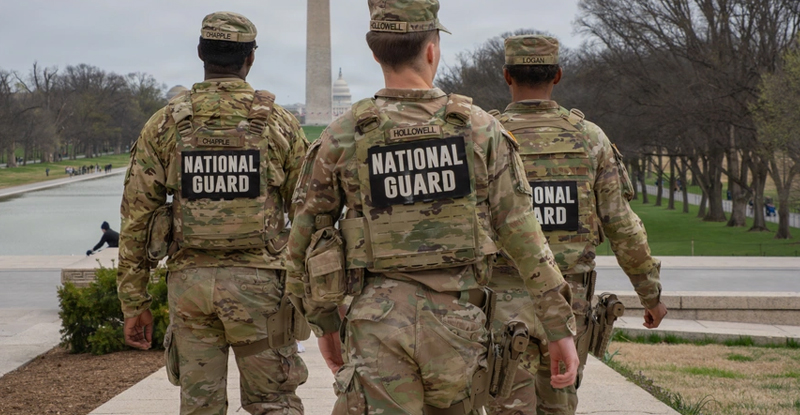
The National Guard is not a secondary force. Guard units deployed repeatedly, sustained casualties, and carried operational weight across two decades of war.
They took the same risks.
They took the same losses.
But culturally, they were never treated the same.
The most frustrating part is not just how the broader system views the Guard.
It is how Guard leadership operates within it.
Senior Guard officers often align themselves with the same institutional culture that marginalizes them because access depends on it. They enforce priorities, protect relationships, and maintain proximity to power.
I have seen Guard leaders destroy their own people to maintain that alignment. Careers end not always because of misconduct, but because someone does not fit or becomes inconvenient. Others are protected or quietly moved despite behavior that would end a career elsewhere.
That is not leadership focused on the force.
That is leadership focused on the club.
How the Divide Shows Itself
I learned where I stood early.
I was a 2LT at Fort Sill at a dining out. Prior enlisted. National Guard.
In the receiving line, a Brigadier General stopped and looked at my ribbons. He asked if they were from another service. I told him no, I was Guard. He said he didn’t know “we” wore Guard ribbons.
I told him I earned them during Katrina, in my hometown.
He said “good enough” and moved me on.
Later that night, he asked all Academy graduates to stand and addressed them as the future of the Army—the ones who would lead and win wars.
That told me everything.
That wasn’t an isolated moment. It was the signal. Guard officers and anyone outside the pipeline would operate with less institutional cover, no matter what they had done.
I walked out.
That was clarity.
Cultural Decisions That Broke Trust
As priorities shifted, decisions moved beyond policy into identity. Bases were renamed. Traditions reevaluated. Culture reframed through political lenses.
At the same time, battle streamers—earned through sacrifice—were removed or altered, including from Guard units tied directly to communities.
To those making the decisions, this was administrative.
To those who served, it was erasure.
And again, Guard leadership enforced it.
The Problem Isn’t Where You Come From—It’s the Club
This is not about one commissioning source versus another.
There are exceptional officers across the force. There are leaders who focus on the mission, not the system.
The problem is what the system does.
Over time, it elevates and protects a certain type—not strictly based on performance, but on alignment and behavior.
Officers who do not fit that mold are less likely to receive protection or second chances.
That is the divide.
The club versus everyone else.
Not All Leaders Played This Game
It would be wrong to suggest everyone operates this way.
There are real leaders—those focused on the mission, not the system. Leaders like General Tommy Franks and others who prioritized operational effectiveness over institutional alignment.
They were not outside the system, but they were not shaped by it in the same way.
Those leaders still exist.
But they are not defining the culture.
And that matters.
What Real Accountability Would Actually Look Like
Disruption alone is not enough.
Real accountability would mean promotion systems that reward performance, not alignment. Independent review of career-ending actions so the system cannot protect itself. Full integration of Guard and Reserve officers into senior leadership pathways.
Most importantly, it would mean visible consequences for senior failures before retirement—not after.
Without that, this becomes another cycle.
The Real Question
This is not about one man. Leadership removals are not new, but Secretary Hegseth is not masking decisions behind process — he is targeting the structure directly. That is what triggered the reaction, because the system is not being allowed to regulate itself.
I support what is happening. Not because disruption alone fixes anything, but because I have seen what the system protects: itself, its insiders, and continuity for those already inside the network.
Meanwhile, experienced personnel were pushed out, readiness was strained, and accountability never reached the top.
This is about a system that protects itself while others carry the consequences. The outrage over Hegseth is not about protecting the military. It is about protecting the club.
The real question is whether that club deserves protection at all.
Because from where I stood, it never protected us.
It protected itself.
And I’ve already been labeled disgraced—which makes it easier not to listen.
_
Mark W. Castillon served in the Army National Guard from 2004 to 2024, including deployments in support of Operations Iraqi Freedom and New Dawn, and emergency management responses from Hurricane Katrina through the COVID-19 pandemic. He advocates for veteran mental health, whistleblower protection, leadership accountability, and due-process reform.




Leave a Comment