

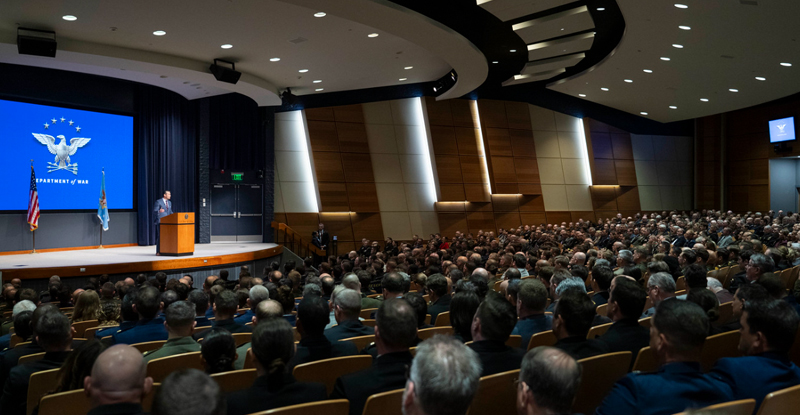
Transcript of speech:
“Thank you very much. Please take your seats, please. Well, it’s an honor to be here with you.
I want to take a note before I start, Admiral, something that was unseen but so often what you do is unseen, so it’s worth noting. We were on a convoy here and as always happens, the local law enforcement provides escort for our vehicle convoy.
And in this particular one, a state trooper from the Rhode Island State Police had an accident right in front of our convoy. Thankfully, we said a prayer for him, he’s stable at the hospital. He’s going to be fine; we’re going to keep checking in on him. But it was just a reminder for me of the silent dedication of so many incredible Americans across what you do and across law enforcement, who do things that we take for granted as routine and there’s nothing routine about them.
These guys and their motorcycles that go racing up and down the freeway to block the next exit, risking their own life and limb to defend our movement. They do that without seeking the spotlight and knowing that no one’s putting their name in headlines yet. They, I believe, are the true heroes of our society, the commitment they show to their community and to their service.
So, I acknowledge this state trooper and his dedication. We were praying for him and his family. And we thank everyone in the Rhode Island State Police for what they do and all those who support our communities and this great department.
So, President Walker, thank you. Now, Rear Admiral, more importantly, Walker, faculty members, flag and general officers, interagency partners, I’m also joined by the Undersecretary for Personnel and Readiness, General Tony Tata, who has been fundamental in helping us look at these senior service colleges. So, thank you, General. And above all, in this audience, future operational commanders of the War Department of the United States of America.
We gathered this morning at an institution founded on a sacred premise, that the intellect of the officer corps is a weapon system, no less decisive than our aircraft carriers, our armored brigade combat teams, or our nuclear deterrent.
For decades, our leaders have stepped onto the grounds of our senior service colleges and repeated solemn invocations of leadership and strategy and statecraft. They’ve debated grand theories in sunlit seminar rooms and drafted lengthy papers on international norms.
But this morning, we strip away the comfortable veneer of academic tradition and confront unyielding elemental truths. The fundamental duty of the armed forces of the United States of America is to assure America’s victory in war full stop, victory.
Our ultimate screening criteria, it’s the unsparing standard against which every regulation, every doctrine, every budget dollar, and every academic syllabus should be judged.
When an officer steps into a classroom, when a professor writes a course objective, when a commandant approves a curriculum, the essential question before them is not, is this intellectually fashionable? It is not does this satisfy an external civilian accreditor?
The only question that matters to the American Republic is this — will it help us achieve victory?
To be sure, there are plenty of other important considerations in military life — ethics, logistics, administration, diplomacy — but all of them are in service of victory. They come into play only in service of that primary objective. If our military fails to win our nation’s war none of the secondary virtues will matter. The Republic does not survive to debate them.
Consequently, the primary task of our senior service colleges like this one cannot be the passive transmission of credentials, it cannot be the curation of an insulated salon for intellectual leisure.
It must be teaching victory: The deliberate, uncompromising task of forging senior military leaders who are intellectually, ethically and operationally prepared to decisively deter but, if necessary, defeat our enemies in unforgiving combat.
We cannot teach victory in an intellectual vacuum. Strategy is, of course, as you know, defined by context. And over the last decade, the context of our era is transforming before our eyes, something we talked about extensively in our meeting just earlier.
The United States is currently in the midst of the most far-reaching strategic recalibration of our national security posture since the end of the Second World War. The pivot is deeper and more profound than the fall of the Soviet Union.
Under President Trump’s America First foreign policy paradigm and the 2026 National Defense Strategy, the assumptions that guided American statecraft for 80 years have been overturned. For example, we are redefining our relationship with Europe, ending the era of subsidized defense and demanding genuine burden sharing from allies who must bear primary responsibility for their own theater.
In our own hemisphere we’re acting decisively. President Trump has revitalized the Monroe Doctrine with the Trump Corollary. He’s expelled hostile regimes that have plagued our security for decades and is actively restoring stability across the Americas. This department also helped seal our southwest border, because countries are not countries without real enforced borders, without real sovereignty for their citizens.
President Trump has demonstrated our resolve against regional adversaries from the Middle East to Latin America. We have also oriented the weight of American national power toward the decisive theater of the 21st century, the Pacific, where our nation faces its nearest peer competitor, the People’s Republic of China.
At the same time, the battle space itself has expanded at, as you know, breakneck speed into joint all domain operations, demanding uncontested dominance on land and subsurface, in space, cyberspace and the cognitive domain driven by Super Intelligence. It is a time of unprecedented advancement and unprecedented change.
Yet too often, as we survey our senior service colleges, institutions that ought serve as the intellectual engine room of this strategic revolution, what do we find too often?
Too often in these institutions, we find that they’re intellectually trapped in the year 2015. While our schools have dutifully noted the release of the 2026 National Defense Strategy, they have not fully adapted to its realities.
We see faculty who spent their entire careers writing and teaching the prior paradigm, struggling to embrace the new strategic model.
Now that reluctance, understandably, may be human. It is comfortable to teach the same doctrines ones helped form decades ago. But in the profession of arms, nostalgia is fatal. History has repeatedly shown that you can never win by fighting the last war.
Our senior institutions must break out of the rear-view mirror. When our war college graduates walk across the stage and take command, their minds cannot be anchored on the strategic consensus of a vanished world.
So, how did our war colleges drift from this clarity of purpose?
The answer is uncomfortable, but it must be identified candidly.
Our military education system has become dangerously civilianized. Over the past two decades our service colleges increasingly imported the worst pathologies of contemporary civilian higher education, rather than maintaining the austere focus on the profession of arms.
Our institutions succumbed to the prevailing intellectual fashions of the civilian academy, a system that has largely abandoned teaching students how to think in favor of indoctrinating them into what to think.
Here, a real-life example of how bad it is — North Korean defector Yeonmi Park, a student at Columbia University years ago, said in an interview that even the propaganda in North Korea is not this nuts as Columbia University.
Well, until last month, and only after my direction, this institution had a long-standing partnership with Brown University, an MOU that we ended at my direction. The only place more stridently ideological in one direction more than Columbia or Harvard is Brown. It was long past due to end that relationship in service of breaking the paradigm of civilianizing military education.
Let’s be unequivocal, the philosophical doctrines of the Frankfurt School, critical theory and the corrosive apparatus of diversity, equity and inclusion are fundamentally incompatible with military service and antithetical to the Constitution of the United States of America.
The Constitution rests upon a natural law framework. It presumes objective truth, individual merit, and immutable rights.
Critical theory, by contrast, rejects objective truth altogether, reducing every institution, every human interaction and national virtue to a cynical contest of power between identity groups.
The officer corps takes a solemn oath to defend our Constitution.
An educational framework grounded in critical theory inherently undermines that oath.
It destroys the warrior ethos.
It replaces cohesion with grievance.
It replaces competence with quotas.
It replaces victory with political performance.
Our commander-in-chief, President Trump, has issued two very clear executive orders on this point that we follow: Executive Order 14151, ending radical DEI programs; and Executive Order 14173, restoring merit-based opportunity.
There’s a reason I repeat over and over colorblind, gender neutral, merit-based — colorblind, gender neutral, merit based. It’s those two executive orders in six words.
In complying with these executive orders, the War Department has initiated a decisive purge of these destructive ideologies.
Institutions like the United States Marine Corps War College, the Army War College, and the Eisenhower School stepped forward with professional vigor, dismantling overt DEI bureaucracies and scrubbing ideological jargon from their syllabi.
Frivolous research into gender fluid studies or climate fads has been removed, yet we must not confuse the removal of an office with the eradication of said mindset; serious structural vulnerabilities remain.
In specialized programs external pressures threaten war fighting focus.
The Inter-American Defense College in Washington remains structurally conflicted by its subordination to the diplomatic organization of American states, while the Space Force’s West Space Scholars Program risks ideological dilution through an overreliance on civilian university partnerships.
Most alarmingly, here at the Naval War College, a review identified a stubborn undercurrent of passive aggressive institutional resistance.
There are those who believe that they can hide behind academic — civilian academic tenure and regional accreditation mandates to wait out President Trump’s term in office.
They think they should or can ignore executive orders and quietly preserve false and sinister progressive frameworks until the political winds shift in their favor.
Hear me clearly, they’re wrong, they’re dead wrong.
We will not permit civilian accreditation bodies designed for civilian liberal arts colleges to dictate the standards, the governance or the curriculum of the United States military.
Civilian and military institutions have different missions with different objectives, and therefore they must have different standards.
You are set apart on purpose. The American people need you set apart on purpose to play a distinct role in our republic.
That’s why we’re currently overhauling the composition of our board to visitors to ensure rigorous oversight by leaders who understand warfare.
The exploration of ideas and freedom of debate exist not for their own sake, but for finding ways to outthink and out kill our enemies on the battlefield.
Toxic and destructive ideas that corrupted our universities have little by little crept into our war colleges.
And the reforms that I’m directing today are designed to reinforce military education, focus on winning our nation’s wars, and reinforcing each person’s oath to our Constitution, not to adopt ideas that perpetuate, that are anathema to the Western tradition.
You see, purging bad ideas, however, is merely clearing the ground, clearing the brush. The far greater challenge is erecting educational architecture that is capable of building architects of victory, which is what we need all of you to be.
For years, our war college mission statements have been choked with gauzy academic platitudes. We speak endlessly of producing critical thinkers, strategic enterprise leaders and officers with an appreciation of complex global security environments.
Just look at the mission statements from across our colleges. The word win is entirely absent. The word defeat does not appear. The word victory appears exactly once buried inside strained institutional jargon.
This is the language of civilian bureaucracy, not military command.
A civilian professor can indulge in vague abstractions because no one dies if a student fails to grasp 18th century English literature. But in your profession, the profession of arms, the price of strategic incompetence is measured in flag draped coffins, shattered alliances and a broken republic.
A true mission statement for a war college should be blunt — to educate senior military officers so that they can defeat America’s adversaries.
As a young lieutenant in the orders process, it was beat into us to say the mission twice. So, I say again, a true mission statement for a war college should be blunt — to educate senior military officers so they can defeat America’s adversaries.
It is essential to be a critical thinker, but a critical thinker who cannot bridge the gap between grand theory and operational execution is useless to a combatant commander.
The joint all-domain fight does not need senior officers who can write reflective essays; it needs critical doers, it needs commanders who can translate strategy into kinetic and non-kinetic actions, who can maneuver across multiple domains, sustain lines of supply under continuous attack and impose our national will upon an enemy force.
Now, some academics seem to think that teaching concrete military skills is merely training, and that addressing the operational or tactical levels of war somehow degrades the purity of strategic education.
Well, that’s nonsense, of course. Strategy divorced from operational reality is nothing more than academic daydreaming.
Wars are not won at the strategic level in the abstract, strategy succeeds or fails at the point where operational art and tactical lethality meet the adversary.
Think integrated cyber effects in Venezuela.
Think concealed logistics in Midnight Hammer or domain awareness in Epic Fury.
Our senior service colleges must cease producing theorists whose very first experience integrating the strategic, operational and tactical realms occurs when they step into a theater of war.
Look at the Marine Corps War College for how this balance is struck. MCWAR kept its focus — laser focused on war fighting and realistic exercises. The result, when joint headquarters in the Middle East faced intense combat operations during Operation Epic Fury, students were pulled directly from the MCWAR seminar rooms and deployed into the fight.
These officers stepped immediately into operational roles, performing with devastating effectiveness and outperforming peers who had spent their academic year writing essays. They were effective and lethal, with very little learning curve; that is the gold standard of professional military education.
To truly teach victory, our institutions must also possess the intellectual courage to confront defeat.
One of the most alarming findings of our comprehensive review was that our war colleges actively avoid the rigorous study of recent American strategic failures. Faculty dismissed them as sore subjects or politically sensitive topics.
But we have to ask ourselves, how can an institution claim to teach military strategy while refusing to conduct an unsparing autopsy of, for example, the catastrophic withdrawal in Afghanistan?
13 brave American service members murdered at Abbey Gate due to gross operational, strategic and political failures. The chaotic collapse of that theater was an unmitigated disaster for American credibility.
Our war colleges owe it to every sailor, soldier, airman and marine who served in that 20-year conflict to do a brutally honest postmortem.
Why did our senior leadership fail to foresee the collapse? Why did our operational plans unravel in days?
If our future generals and flag officers do not study and understand that collapse with clinical precision, they’re doomed to repeat it in other AORs and other domains.
Similarly, our colleges must frankly discuss and address the institutional crises within our own ranks.
For example, the execution of the COVID-19 vaccine mandate, which fractured trust, purged talented warfighters and damaged CivMil cohesion and, of course, the ongoing strains in CivMil relations as well.
We continue to assign Samuel Huntington’s classic 1957 texts, but our syllabi systematically ignore the modern crises unfolding before our eyes.
When a chairman of the Joint Chiefs of Staff engages in actions during a presidential transition that raised profound constitutional questions regarding civilian control of the military, that is not a topic to be swept under the rug.
Just because some of you know Mark Milley, doesn’t mean we should not study his failures. It is arguably the most significant civil military crisis since President Truman relieved General Douglas MacArthur in 1951. Our war colleges should study it, debate it, and reinforce the foundational constitutional principle that the military is strictly subordinate to elected civilian authority.
If we are to succeed in the revolution in military education, our pedagogy must change. We need to abandon some of the relics of 19th century academia and embrace the tools of 21st century warfare.
That is why today, at my direction, I’m announcing 33 new directives, a complete overhaul, to reform our Department of War senior service colleges, to forge leaders of unmatched competence, sound moral judgment and resolute warrior ethos.
That memo and those 33 directives will be arriving in your inbox today.
For example, effective immediately, one important change, one of many, there’ll be no more 80-page theoretical written theses as the primary capstone of war college achievement. In its place, we are establishing competitive SI-assisted wargaming and high-stress decision forcing scenarios as the centerpiece of senior officer evaluation.
Now, on that front, I want to give a hat tip to the Naval War College. I understand you’ve already done two of those SI-assisted war games this year alone. And in our discussions, that was a focal point of where they want this college to go. We will create a permanent inter-college war gaming architecture across all senior service colleges.
No longer will jointness be reduced to an Army colonel and a Navy captain sharing coffee in the same seminar room. True jointness is forged under competitive operational friction.
Our service colleges will execute interconnected capstone war games linking live, virtual and constructive forces against domains, testing students against complex unscripted peer adversary maneuvers.
Furthermore, these war games will feed directly into the newly established joint warfighter exercises and evaluations.
In the 1930s, General George C. Marshall utilized the legendary Louisiana Maneuvers to stress test the officer corps, identifying the leaders like Eisenhower, like Bradley and Patton, who possessed the operational grit to lead America to victory in a world war.
The same kind of urgency must exist today.
The senior service colleges will serve as the modern proving ground. Through intensive wargaming, combined with rigorous, adversarial oral defense boards that eliminate the ability to hide behind academic ghost writers or generative SI, we will stress test every perspective general and flag officer.
Promotion to senior rank will not be an administrative reward for longevity, it will be earned by demonstrating the intellectual agility, lethal operational competence and moral resolve required to win in combat.
We demand immense change from our colleges, but we know that we cannot demand world-class performance from an enterprise suffering from institutional decay.
For too long, our senior institutions have been neglected, something we talked about this morning as well.
Our task force visited National Defense University facilities plagued by black mold and obsolete IT networks.
They witnessed the Army War College struggle with a faculty manning crisis hobbled by its bureaucratic subordination to a tactical level command structure that fails to truly leverage and appreciate its mission.
They saw our reserve component officers crushed under unrealistic administrative burdens in distance learning programs.
Worst of all, nearly all of our senior colleges have been bottlenecked by a severe lack of authorized, modernized, sensitive, compartmented information facilities or SCIFs. You cannot study real-world pacing threats using open-source journalism. You cannot conduct realistic war gaming against an adversary’s operational plans on unclassified networks.
And that is why today, at my direction, this department is acting decisively to fix these structural failures. We’re accelerating capital investments to build, modernize, and expand SCIF capacity across every single war college campus, ensuring that our students learn, plan and war game at the highest levels of national classification.
We’re cutting through bureaucratic neglect to repair facilities, modernize digital infrastructure and resolve manning shortages.
And we’re establishing dedicated research institutes within the war colleges to study the operational and strategic requirements of the America First defense paradigm, ensuring our faculty have the time, the resources, and the institutional backing to produce pioneering military history and strategic theory.
Now there will be those who resist this realignment. There will be op-eds written by retired officers claiming that focusing on victory somehow damages our intellectual standing. There’ll be faculty who argue that the old ways are sufficient.
But we will not be swayed by their parochial self-serving protests. Nor will we share their complacency.
In 1901, Secretary of War Elihu Root founded the Army War College with a clear, timeless mandate, not to promote war, but to preserve peace by intelligent and adequate preparation to repel aggression. Simply put, that is peace through strength.
People think peace through strength is a some throw away phrase. But we know it’s something much more. It’s more than hardware; peace through strength is a discipline, it’s a mindset, it’s operational knowledge, strategy, discernment, will, determination, grit, guile, practical knowhow when it matters most at every level.
Peace through strength is not achieved by comfortable consensus and business as usual approaches. It is achieved by preparing our minds and our forces to wage war with such devastating speed, precision and lethality that no adversary dares test American resolve, that’s deterrence. And if they do, that they are completely and utterly destroyed that we achieve victory.
So, to the faculty assembled here, your country calls upon you to a critical mission. Their very lives may well depend on you achieving this mission.
You are tasked to be intellectual warriors.
Challenge your students, strip away complacency, drive them into the crucible of realistic operational thought, prepare them for war, for lethality, for the life and death struggles that they one day may face.
To the students, incredible Americans, future generals and admirals of the United States Armed Forces, look upon your time in these halls not simply as a sabbatical, but as the time to prepare for the decisive battles of your lives.
Each of you already, by being here, has achieved incredible things, the real 1 percent of our country. But resolve here and now to be ready to do even greater things for your country.
As we meet here across oceans, our adversaries are studying every day, preparing for the moment they will challenge you and try to kill you and break our national will and our national power.
You must be smarter than they are, you must be bolder than they are, and you must be more lethal than they are.
The American people do not entrust their blood, their treasure, or their sons and daughters in our armed forces to lose or to fight to a draw. They expect, they demand, they deserve nothing less than victory.
Reforge these incredible institutions that have done so much good. Renew your commitment to you students, and together we will continue to reclaim the warrior ethos.
Teach victory as we go forward together to defend this great country.
Thank you and God bless our great Republic. Thank you. Thank you.






Leave a Comment