

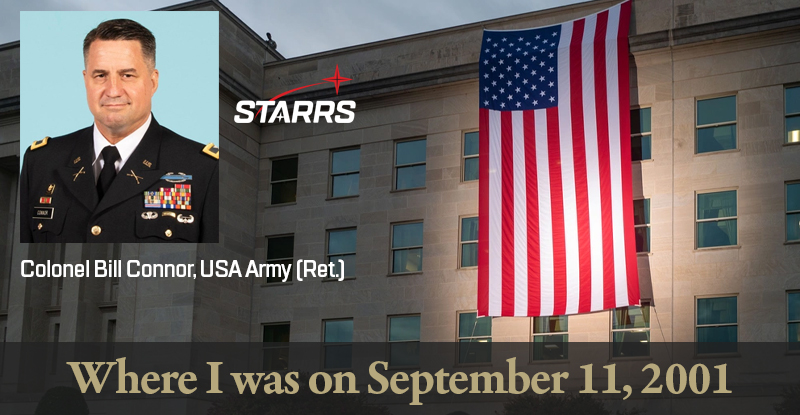
By Colonel Bill Connor, USA Army retired
Chairman of the STARRS Board of Advisors
As we approach the 25th anniversary of the attacks on September 11, 2001, my thoughts return to that fateful day and what came before and after it. With the distance of time to better appreciate what surrounded those attacks, I have come to a better perspective.
As happened with Pearl Harbor, almost everything changed for America, even if it has taken time to recognize the pivotal nature of the “9/11 attacks”. Every American’s prism is different, but also similar in relation to those events. I would like to give my own experience and with it show the profound nature of the events.
On September 11, 2001, I was an active duty Army Infantry officer stationed at Ft. Benning, GA and had been on active duty since the summer I graduated The Citadel in 1990. My wife, Susan, was an Army Doctor and we had three young children.
I had watched the constant growth of radical Islamic terrorism throughout my career, starting with the first World Trade Center attempted attack in 1993, but continuing with more brazen attacks against our embassies in Africa and even Navy Ships in the Persian Gulf.
Within the military, our primary focus was on either peacekeeping operations, like that in the Balkans and places like Somalia. My three deployments up to that point had been to the Middle East, with two to the Persian Gulf area and a 7 month peacekeeping mission between Egypt and Israel in the Sinai.
America was the clear world “Hegemon”, and with the exception of nuclear parity with Russia no military power was up to the point of being considered a peer military competitor. Up to that point, we had seen radical Islamic terrorism growing throughout the world, but America had not been hit beyond the failed attack on the World Trade Center in 1993.
September 11, 2001, therefore, was a complete shock to the system.
We went from virtually no attacks on our homeland to around 3000 Americans being killed in the four airline attacks of that day against our most iconic structures of economic and military power.
On Fort Benning, I had watch in uniform as the second airline hit the World Trade Center and all of us froze in disbelief. The first airline hitting could have been an accident we figured, but the second meant we were at war.
I knew what those of my parents’ generation felt when Pearl Harbor was attacked. The frustrating part was that unlike Pearl Harbor, we didn’t have a clearly defined enemy, and that became the source of so many problems in the years to come. During World War II, we knew who hit us and we dedicated ourselves to defeating the Axis Powers at all costs and finished that mission in under four years. That was not to be the case after 9/11.
After 9/11, we determined the terrorist group “al Qaeda” (“the base” in Arabic) was the direct enemy who planned the attacks. With the emotion of something worse than Pearl Harbor (an attack against a military target in a territory outside the Continental United States), however, we didn’t limit ourselves to going after al Qaeda or their Taliban hosts in Afghanistan.
We decided to go after the form of attack with a “War on Terrorism”, and included countries with virtually no connection to al Qaeda as being part of an “Axis of Evil” or something similar.
We also decided that as part of the emotion of going to “war”, we would dismantle regimes which might possess weapons of mass destruction (WMD). At least as long as they couldn’t retaliate with nuclear weapons, like with North Korea).
We went even further with holding that we would spread Democracy to also make ourselves safer.
The invasion of Iraq, unlike Afghanistan with al Qaeda and Taliban hosts, was justified upon the more indirect threats we came up with after 9/11. Iraq was thought to possess WMD, and when that proved to be questionable the justification came to spreading Democracy to create security for the United States.
In Afghanistan, we stayed beyond expelling al Qaeda and the Taliban and decided we had to rebuild Afghanistan into a Democracy for our security. I was part of that mission, and as an Infantry Major and then Lt. Colonel I advised the Afghans in their operations against insurgents attempting to overthrow the “new” Afghan government.
I will never regret my service, and believe we did make a positive difference despite the horrific strategic decisions made in the summer 2021 by the Biden Administration during the botched withdrawal.
Afghans experienced freedom and Democracy. The problem is that this positive good was outweighed by negatives in both Iraq and Afghanistan.
In other wars, with the potential exception of Vietnam, we fought against a nation state like Japan to defeat them in our direct self-interest. During the “War on Terror” we justified going to war by the indirect alleged interest of creating a similar Democracy free of things like WMD.
While we removed the al Qaeda threat that hit us on 9/11, we spent two decades at “War” for indirect justifications that proved a lousy return on investment of blood and treasure.
Despite the mistakes made, nobody can downplay the Patriotism and Heroism of so many Americans after 9/11 who answered the call.
In my case, I was already a professional soldier, but I saw so many who put off civilian dreams to serve.
If we can learn from the mistakes, we will grow as a nation and not repeat those mistakes. Perhaps in that way it will have been worth it, and the honoring of our servicemembers is something that must continue as long as America exists.
Chairman of the STARRS Board of Advisors Colonel Bill Connor, USA Army (Ret.) was commissioned as an Infantry officer after Graduation from The Citadel in 1990. After Infantry Officer Basic Course and Ranger School, Bill was assigned as Platoon Leader in 2-7 Infantry, and later as Executive officer of two companies.
Bill deployed on multiple operations to the Middle East. He served as commander in the 4th Ranger Training Battalion at Ft. Benning and was later selected as the Aide-de-Camp to the Infantry Commandant and commander of Ft. Benning.
Later he transitioned from Regular Army to the Reserve Component to attend law school at University of South Carolina, and was mobilized for 15 months to Afghanistan as an Infantry combat adviser to Afghan National Security Forces.
Bill was Distinguished Graduate of the US Army War College and retired in 2020 with over 30 years of service. He is the author of countless articles in sources including Infantry Magazine and Army Magazine and National and International publications. He is currently an national security contributor to Newsmax speaking on military issues and owner/founder of National Defense Consultants.
In 2021 the Governor of South Carolina awarded Bill the state’s highest award, The Order of the Palmetto. Bill owns and operates a law firm and helps veterans with various military related legal issues.
He is a member of the Board of Visitors of The Citadel. On June 6, 2026, he was inducted into the South Carolina Veterans Hall of Fame, the first living Citadel graduate inducted.
Interview with STARRS Board of Advisors Chairman Col. Bill Connor, USA ret

Leave a Comment