

Excellent article covering the big changes. Sec Hegseth is moving at a pace necessary to keep step with the rapid changing face of warfare and geopolitical conditions. Time is of the essence.
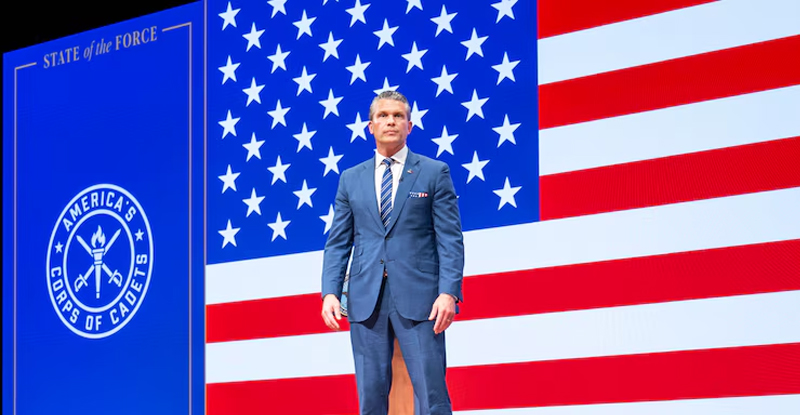
(Newsmax Wires) War Secretary Pete Hegseth on Wednesday laid out an expansive effort to remake the U.S. military, announcing deeper cuts to senior-officer positions while doubling down on physical standards, eliminating what he calls “wokeness” and restructuring how the military prepares for future warfare.
Speaking to junior officers and enlisted personnel at Marine Corps Base Quantico, Virginia, Hegseth said the number of positions designated for generals and admirals will be reduced by 20% by Jan. 1, 2027.
The move doubles the 10% reduction Hegseth ordered in May 2025 and applies to roughly 800 general and flag officer billets across the military, according to the Associated Press and Reuters.
The reduction is primarily a cut to positions rather than an order to immediately remove 20% of the officers currently serving.
Reuters reported that some billets will be eliminated while others can be downgraded to lower ranks.
Hegseth has argued that the military has accumulated unnecessary layers of senior leadership and bureaucracy that can slow decision-making and divert resources from troops in the field.
The Pentagon’s latest move follows a series of senior leadership changes under Hegseth and President Donald Trump, including the removal or early departure of more than 20 senior military and civilian leaders, CBS News reported.
Hegseth framed the latest cuts as part of his effort to return the military to what he calls a “warrior ethos,” with greater emphasis on combat readiness, physical fitness, discipline and battlefield performance.
His language at Quantico was characteristically blunt.
“We are no longer the woke department or the weak department,” Hegseth said, according to reporting from The Washington Post and other outlets.
He also declared that the military would have “no fatties, no beardos, no weirdos, no wimps, no radicals — just warriors,” reiterating the emphasis he has placed on physical appearance, fitness and military standards since taking office.
The secretary’s campaign against what he describes as “wokeness” has already produced major policy changes.
The Pentagon has eliminated diversity, equity and inclusion offices and initiatives and barred the use of race, sex or ethnicity as factors in military promotions, assignments and other personnel decisions.
The War Department said the changes are intended to establish a merit-based system focused on lethality, readiness, accountability and standards.
Hegseth has also ordered the military to stop providing training on subjects including critical race theory, DEI and gender ideology, according to the Pentagon.
Physical standards have likewise become a major focus.
Hegseth has pushed for tougher enforcement of fitness, weight and grooming requirements and previously told senior military leaders that troops must be capable of meeting demanding physical standards.
The Pentagon also screened service members selected to attend Wednesday’s Quantico event for fitness and grooming, with The Wall Street Journal reporting that commanders were asked to nominate troops who met specified physical standards, passed fitness requirements and maintained “impeccable” grooming and uniform standards.
The secretary is simultaneously changing how the military selects its future senior commanders.
Earlier this month, Hegseth announced the Joint Warfighter Evaluation, a new assessment for Army colonels and Navy captains being considered for promotion to general or admiral.
The evaluation is designed to test officers’ ability to “fight, adapt, and win” in complex combat situations, according to Hegseth’s announcement reported by Newsmax.
Hegseth said the military should select commanders based on demonstrated battlefield decision-making rather than what he called “paper credential.”
The broader effort extends into military education.
On Tuesday, Hegseth directed the service academies — West Point, the Naval Academy and the Air Force Academy — to stop appointing civilian professors to new tenured positions.
The change does not strip existing faculty members of tenure.
Hegseth said the policy is intended to ensure that the academies remain focused on preparing future officers for military service rather than allowing civilian academic priorities to dilute what he called the institutions’ warfighting mission. The Associated Press reported that civilian professors teach a substantial portion of the curriculum at the academies, including humanities and other liberal arts subjects.
Hegseth has also moved to reduce the military’s reliance on elite universities for professional education.
In February, he announced that the Pentagon would end professional military education programs, fellowships and certificate programs for active-duty personnel at Harvard beginning with the 2026-27 academic year.
Reuters subsequently reported that the Pentagon was ending or reviewing military relationships with other Ivy League schools, including programs that send officers to civilian universities for graduate study.
At the same time, Hegseth is pushing one of the most consequential technological changes in his tenure: a new four-star command dedicated to autonomous warfare.
The Wall Street Journal reported Wednesday that the Autonomous Warfare Command, or AutoWarCom, is scheduled to begin operating in October 2027 and will focus on the development, testing and deployment of drones and other autonomous weapons systems.
Hegseth also announced Project Agincourt, an initiative intended to accelerate the development and deployment of unmanned systems.
The Pentagon is using the name in reference to the Battle of Agincourt, where the English longbow helped defeat a much larger French force. Hegseth has likened inexpensive, rapidly deployable drones to earlier technologies that dramatically changed warfare.
Another initiative, Project Meridian, will examine how warfare could evolve over the coming years.
The project will involve SpaceX and Tesla CEO Elon Musk, Anduril founder Palmer Luckey and former House Speaker Newt Gingrich, with a report expected within 120 days, according to the Journal.
Hegseth also announced a “Fortress America” effort focused on making military installations more resilient against attacks on critical infrastructure, including by strengthening energy supplies and supply chains, the Journal reported.
The technology initiatives fit into Hegseth’s broader push to move the Pentagon away from lengthy acquisition processes and toward rapidly developing and fielding weapons.
He has repeatedly argued that the United States needs to build weapons faster, expand domestic production and give troops access to systems that can be adapted quickly as battlefield conditions change.
That emphasis has included expanded investment in drones, counter-drone systems, long-range weapons, munitions production and other technologies.
Hegseth has described the overall approach as a combination of rebuilding the military, restoring a warrior ethos and concentrating Pentagon resources on capabilities he believes will matter most in future conflicts.
The Pentagon’s own budget documents identify lethality, meritocracy, accountability, standards and readiness as central principles of Hegseth’s agenda.
But the sweeping changes have generated increasingly pointed criticism, particularly over the removal of senior officers and the potential effect of reducing the number of senior commanders while the military remains engaged in major operations.
Sen. Jack Reed of Rhode Island, the ranking Democrat on the Senate Armed Services Committee, said the senior-officer reductions should not be undertaken without congressional consultation.
“Reshaping the senior leadership of the world’s most powerful military is precisely the kind of decision that requires consultation with and justification to Congress,” Reed said, according to Air & Space Forces Magazine.
Sen. Mark Kelly, D-Ariz., also criticized the reduction, saying Hegseth was removing experienced senior officers that he believed the military needed, CBS News reported.
Earlier this month, House Armed Services Committee Chairman Mike Rogers, R-Ala., expressed concern about the broader turnover in military leadership. “I’m tired of all the churn. I want to see some stability,” Rogers told reporters Sept. 1, according to Roll Call.
Some critics have also questioned whether eliminating senior positions could create command problems at a time when the United States is conducting military operations around the world.
The Congressional Research Service has noted that there is debate over the appropriate number of general and flag officers. Critics of a large senior-officer corps argue that excessive layers can make the military more bureaucratic, while proponents of the existing structure point to the increasingly complicated nature of U.S. military operations, multinational coalitions and technological warfare.
The move to end new tenure appointments for civilian professors has generated a separate debate over military education.
Critics argue that tenure provides academic independence and that civilian faculty bring specialized expertise and perspectives to the service academies. The Associated Press reported that opponents of the policy fear eliminating tenure could make it harder for the academies to recruit and retain highly qualified civilian professors.
Hegseth has rejected that premise, arguing that the academies’ central responsibility is to produce officers capable of leading troops in combat.
The secretary’s broader personnel shake-up has also prompted bipartisan questions in Congress.
Newsmax reported in June that lawmakers from both parties had called for greater transparency surrounding Hegseth’s removal of senior military leaders. Republican Rep. Don Bacon of Nebraska, a retired Air Force brigadier general, said the secretary has the authority to make personnel changes but expressed concern about removing respected commanders without sufficient explanation.
Hegseth and Pentagon officials have maintained that senior officers serve at the pleasure of the president and secretary and that the changes are intended to produce a more effective military leadership structure.
For Hegseth, Wednesday’s address represented a continuation of a military transformation that now reaches from the number of generals in the Pentagon to the standards expected of individual troops and the technology the armed forces intend to take to future battlefields.





Leave a Comment