


By Lt Col. Stephen D. Cook, US Army Special Forces ret
In the winter of 1942, a family in Detroit huddled around a coal stove that barely fought the Michigan cold. The father had already shipped out to the Pacific after Pearl Harbor. The mother worked ten-hour shifts at a bomber plant, coming home to stretch rationed meat, sugar, and gasoline into another week.
Their teenage son drilled with the local defense corps, knowing the next telegram could change everything. Victory gardens replaced lawns. War bonds replaced new cars. Scrap metal drives emptied attics. Blackout curtains went up on coastal cities because U-boats were sinking tankers within sight of American shores.
The alternative to victory was not inconvenience. It was conquest, occupation, and the end of the United States of America.
Eighty-four years later, the average American household orders dinner from an app while the thermostat holds steady at 72 degrees. Same-day delivery, climate control, abundant protein, and on-demand entertainment are treated as entitlements.
Student debt, healthcare costs, and housing prices dominate conversation, yet the material floor of daily life would have registered as unimaginable luxury to that 1940s family.
The contrast is psychological and civic. The generation that defeated the Axis powers did so after a decade of Depression hardship and a willingness to sacrifice that current polling shows has thinned in measurable ways.
That thinning, paired with the rising appeal of democratic socialism, is creating a republic uniquely vulnerable to external pressure from a near-peer adversary determined to supplant American power and reshape the international order in its own authoritarian image.
The Greatest Generation’s hardship was total. After Pearl Harbor, federal orders curtailed civilian consumption of rubber, gasoline, meat, sugar, coffee, and shoes. Families received ration books that had to last the month. Automobile production halted as every factory retooled for tanks, planes, and munitions.
Women entered heavy industry not for self-actualization but because the war machine needed every hand. Young men volunteered or accepted the draft at rates that would shatter today’s political consensus.
Public support remained high even as casualty lists lengthened from Guadalcanal to Normandy to Iwo Jima. National pride and the willingness to endure were daily disciplines enforced by scarcity, gold-star banners in neighbors’ windows, and absolute clarity that freedom itself was at stake.
Today’s baseline is different in ways that matter for national security. Gallup’s June 1–15, 2026 poll found only 33 percent of Americans “extremely proud” to be American—the lowest reading in the survey’s 25-year trend—while just 53 percent expressed high pride (extremely or very proud).
Stark generational and partisan gaps persist: older Americans and Republicans register far higher attachment than younger cohorts and those on the political left. International polling shows similar erosion in resolve.
A Gallup International Association survey released in 2024 found only 41 percent of Americans willing to fight for their country if war came, well below the global average of roughly 50–52 percent.
A separate 2025 survey of NATO allies, commissioned by Riga Stradiņš University and the Center for Geopolitical Studies Riga, placed the United States even lower at 37 percent—near the bottom of the alliance.
Military recruiting faced significant shortfalls in the early 2020s before partial recovery under a new administration in 2024.
These are aggregate signals of a society whose default experience is abundance and convenience rather than shared sacrifice.
Comfort alone does not preclude courage; citizens of modern democracies enjoy similar conveniences yet have proven capable of fierce resistance when their borders are breached.
The fatal vulnerability emerges only when unprecedented material comfort is paired with ideological drift and a collapse in national pride.
When a society no longer believes its foundational system is worth saving, comfort ceases to be a byproduct of success and becomes the primary excuse for capitulation.
Elite polarization that frames fellow citizens as existential threats, two decades of wars with ambiguous outcomes that eroded confidence in leadership, collapsing institutional trust across government, media, and academia, and rapid demographic and cultural change have all frayed national cohesion.
When hardship arrives, it typically takes the form of policy frustration or social-media outrage rather than physical privation.
Younger Americans and Democrats show markedly higher openness to expansive government roles in housing, healthcare, and income security—attitudes that correlate with lower confidence that the American Dream remains achievable through individual effort.
Into this environment has stepped the Democratic Socialists of America. Pre-2016 membership hovered near 5,000–6,500. It surged past 50,000 during the first Trump administration and Bernie Sanders campaigns, then grew rapidly to more than 120,000 dues-paying members by early July 2026—making it the largest socialist organization in U.S. history, according to DSA’s own announcement and contemporaneous reporting.
Its growth and success in Democratic primaries signal a directional shift with severe national-security implications. DSA platforms call for sharp reductions in military spending, closure of overseas bases, and an end to sanctions on adversaries.
Crucially, they frame U.S.–China strategic competition primarily as American imperialism rather than as necessary defense of a liberal order against an authoritarian rival with explicit global ambitions.
Public reporting in January 2026, based on extensive internal DSA meeting minutes obtained by Newsweek, documented the growth of a China Working Group inside DSA’s International Committee.
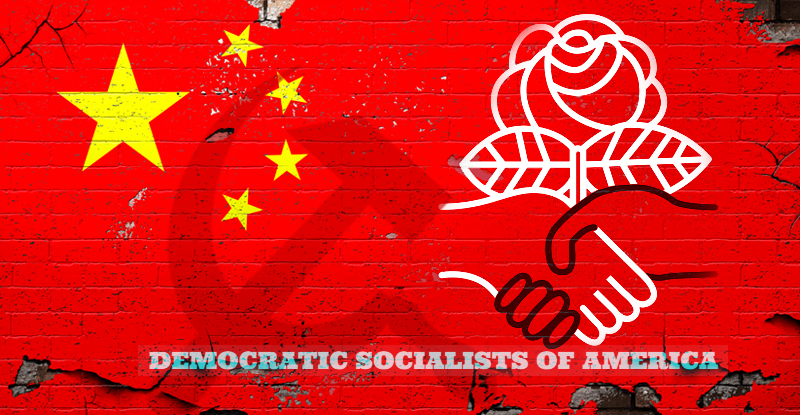
In those minutes, organizers openly described efforts to deepen organizational ties with Beijing and the Chinese Communist Party. Participants urged colleagues to avoid or downplay topics sensitive to the CCP—including threats against Taiwan, the Hong Kong crackdown, and repression in Xinjiang—while framing engagement through an anti-imperialist lens.
More broadly, the dominant rhetorical pattern within the organization and its aligned intellectual circles consistently prioritizes critique of U.S. power while treating Chinese actions in Xinjiang, Hong Kong, and the Taiwan Strait as secondary or reactive.
The consistent political move pairs ambitious domestic redistribution with foreign-policy restraint that treats great-power deterrence as optional or counterproductive.
The Chinese Communist Party’s aspirations extend far beyond economic dominance. Beijing seeks to export and normalize its authoritarian model:
- a surveillance state fusing facial recognition, social credit, and internet control;
- systematic suppression of dissent;
- centralized command over economy and information; and
- steady erosion of the alliances and norms that constrain its power.
Its United Front work, influence operations in academia and media, debt-trap diplomacy, and incremental advances in the South China Sea and toward Taiwan are components of a long-term strategy to make the world safe for authoritarianism and unsafe for the constitutional order.
The danger is not that domestic progressive policies are synonymous with authoritarian control; the danger lies in a shared geopolitical framework.
Democratic socialist foreign policy creates a dangerous alignment with Beijing’s aspirations through moral equivalency. By harboring deep skepticism of American military power and reflexively framing U.S. deterrence as ‘imperialism,’ this ideology inherently accommodates authoritarian expansion.
Both frameworks treat traditional American constitutionalism and exceptionalism as obstacles to be dismantled rather than foundations to be defended.
This ideological overlap provides a ready vector for foreign influence. A softened American public, less attached to its founding principles and more habituated to government solutions, becomes highly receptive to narratives that portray resistance to Chinese power as unnecessary escalation.
Consider a future in which a near-peer adversary possessing advanced military capabilities, economic leverage, long-range precision weapons, and strategic patience systematically degrades American forward-deployed forces, severs critical supply lines, and triggers cascading economic and societal collapse.
Power grids fail across major regions for weeks. Internet, cellular, and financial systems go dark or are selectively degraded. Fuel distribution collapses, grocery shelves empty within days, and medical supply chains fracture.
Basic services modern Americans have never lived without become intermittent or nonexistent.
In such conditions, the decisive variable is not whether some Americans would fight back. It is whether a nation whose median experience is comfort, whose national pride sits at historic lows, and whose rising political tendency frames its own military strength as suspect could organize and sustain the widespread, costly resistance that would make occupation or domination prohibitively expensive for the attacker.
Imagine an America in 2035, five years after a negotiated settlement with the Chinese Communist Party following severe economic contraction, military setbacks in the Western Pacific, and prolonged infrastructure disruption.
The United States has not been formally abolished with tanks in the streets; it has been “reformed” through emergency powers, new regulatory frameworks, and personnel changes justified as necessary for recovery.
New recovery and harmony councils at every level of government administer rationing systems and “civic reorientation” programs. Neighborhood and workplace committees monitor compliance through mandatory apps, flagging those who still advocate for the original Bill of Rights or question the new security partnership with Beijing—colleagues, neighbors, and even family members reporting any dissent.
The economy has been reoriented toward Chinese co-prosperity arrangements; constitutional holdouts are marginalized in employment, credit, and public life—and imprisoned.
The transition did not require a majority of Americans to become enthusiastic authoritarians.
It required only that enough citizens, shaped by years of comfort, declining national attachment, and ideological currents hostile to American power, lacked the will and conceptual framework to mount timely resistance when the moment of decision arrived.
This scenario is not a prediction. It is a warning about the logical trajectory of observable trends if left unaddressed.
The data on patriotism, military propensity, generational value shifts, and the growth of ideological currents that treat American strength as suspect are strategic indicators with direct implications for deterrence and resilience.
A nation that has lost the cultural muscle memory of shared sacrifice, contains a growing faction philosophically aligned with its primary geopolitical rival, and regards its own founding principles as outdated obstacles is poorly positioned to deter a patient adversary that has planned accordingly.
National security in this century begins with the recognition that external threats exploit internal weaknesses.
- Rebuilding the societal capacity for endurance,
- restoring robust pride in our constitutional order,
- maintaining credible military deterrence, and
- rejecting ideologies that weaken resolve against authoritarian competitors
are not optional cultural preferences. They are prerequisites for the survival of the American experiment under conditions of great-power competition.
The ration books and scrap drives of 1942 were evidence that a generation understood what was required to preserve liberty when it was under direct assault.
The question for this generation is whether it will recover that understanding before the test arrives, or whether comfort and ideological drift will have already done the adversary’s work for it.
_
Stephen D. Cook is a retired U.S. Army Special Forces Lieutenant Colonel with 25 years of service. A combat veteran decorated for both heroism and valor, he is the author of the field manuals “When We’re Finished” and “Choose the Heavier Ruck”, and the techno-thriller precision-strike trilogy leading with “In the Shadows of the Sky“. His work explores the intersection of elite military decision-making, intuition, and disruptive leadership. He is based in St. Augustine, Florida.





Leave a Comment