
“God is good. Evil is not. America’s military must understand the difference.”–SecWar
From SecWar’s speech: ” . . . Finally, cutting edge technology, which we talked about, new basing and bases, which we talked about, and a better educational pipeline are still incomplete without the most essential component of our Republic: faith. Faith in something greater than us.
When an American warrior raises their right hand to defend our Nation, you sign away a lot more than just time. You miss births, you miss first steps, you miss final goodbyes. You miss other civilian careers. But one of the costs that is rarely thought about or talked about is the loss of your religious community.
Every time we issue orders to move a warrior to a new location, they leave behind the faith community, the church that grounds them.
For people of faith, that community isn’t just a “nice to have.” In many ways, it’s an extension of their family. It’s their moral foundation or their personal and spiritual accountability. The very bedrock of their warrior ethos.
When you actually look at the numbers, and this will be good for the press, less than 5% of our force identifies as non-religious. Less than 5%. Meaning, 95% of our force recognizes an Almighty God. Accordingly, our department therefore has a sacred duty — first-class religious support wherever we send our warriors.
Now for far too long, you know, we didn’t prioritize that duty at all. It was an afterthought. Political correctness and secular humanism got a vote — chaplains did not.
Budgets were cut. Resourcing and manpower needs were ignored. Base chapels fell apart. Decisions about faith and religion were made by secular careerists in cubicles and lawyers running around with red tape.
We don’t put non-lawyers in charge of our JAG Corps. Or non-doctors in charge of our military surgeons. Yet for decades, we let people with no expertise in faith or religion dictate the spiritual life of our warriors.
The people who actually practice faith and religion, our chaplains, were buried echelons deep, waiting for permission. We asked chaplains to serve and sacrifice and then sidelined them with paperwork and process.
And that ends now.
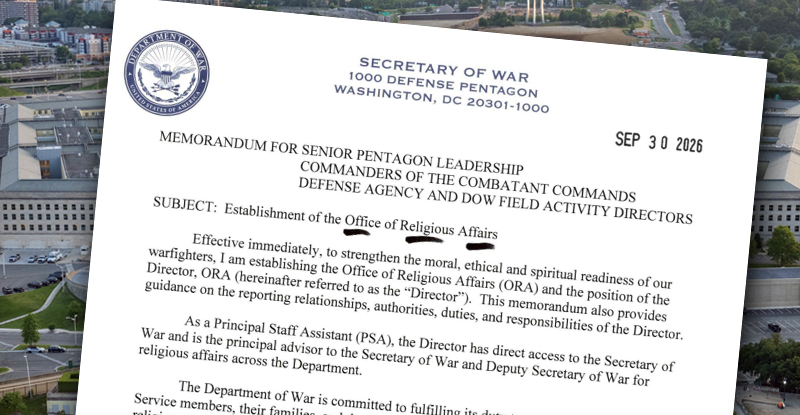
Today, at my direction, I am establishing the Office of Religious Affairs. Starting today, and for Secretaries of War after me, the Office of Religious Affairs will report straight to the top. No staff filters . No bureaucratic dilution. A direct line to the Secretary.
This won’t be a paper pushing shop. It will have real teeth. It will protect budgets, demand infrastructure, and strengthen religious support. The experts, our chaplains, will finally have an advocate at the highest levels. Policy and resources will serve the mission, not smother the mission.
As Psalm 33:12 extols us: “Blessed is the Nation whose God is the Lord.”
Two hundred and fifty years ago we rejected an earthly King an ocean away, appealing instead to a Heavenly King above.
George Washington made sure the Continental Army had chaplains back at the beginning, back in 1775. That force appealed to Heaven, and we still do today.
Our national motto is, after all “in God we Trust.” Today we reaffirm that trust.
We are placing spiritual health at the same level as physical health. Our department is, you might say, is putting on the full Armor of God.
Because while we wage physical war, we all know the real battle is spiritual.
God is good. Evil is not. America’s military must understand the difference.
To our incredible chaplains and religious support teams, live your calling. Stand firm. Preach Truth. Minister to the Flock. Fear no man.
Or, as the Psalmist put it, “The Lord is on my side; I will not fear: What can man do unto me?” Amen to that.
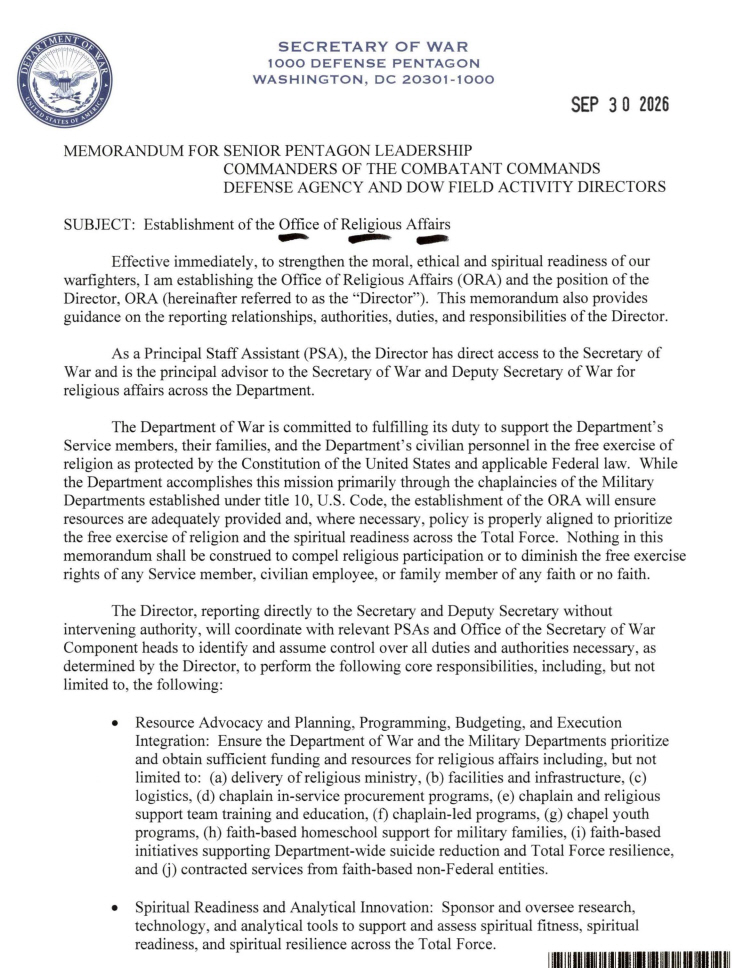
MEMO TEXT:
Effective immediately, to strengthen the moral, ethical and spiritual readiness of our warfighters, I am establishing the Office of Religious Affairs (ORA) and the position of the Director, ORA (hereinafter referred to as the “Director”).
This memorandum also provides guidance on the reporting relationships, authorities, duties, and responsibilities of the Director.
As a Principal Staff Assistant (PSA), the Director has direct access to the Secretary of War and is the principal advisor to the Secretary of War and Deputy Secretary of War for religious affairs across the Department.
The Department of War is committed to fulfilling its duty to support the Department’ s Service members, their families, and the Department’s civilian personnel in the free exercise of religion as protected by the Constitution of the United States and applicable Federal law.
While the Department accomplishes this mission primarily through the chaplaincies of the Military Departments established under title 10, U.S. Code, the establishment of the ORA will ensure resources are adequately provided and, where necessary, policy is properly aligned to prioritize the free exercise of religion and the spiritual readiness across the Total Force.
Nothing in this memorandum shall be construed to compel religious participation or to diminish the free exercise rights of any Service member, civilian employee, or family member of any faith or no faith.
The Director, reporting directly to the Secretary and Deputy Secretary without intervening authority, will coordinate with relevant PSAs and Office of the Secretary of War Component heads to identify and assume control over all duties and authorities necessary, as determined by the Director, to perform the following core responsibilities, including, but not limited to, the following:
• Resource Advocacy and Planning, Programming, Budgeting, and Execution Integration: Ensure the Department of War and the Military Departments prioritize and obtain sufficient funding and resources for religious affairs including, but not limited to :
(a) delivery of religious ministry,
(b) facilities and infrastructure,
(c) logistics,
(d) chaplain in-service procurement programs,
( e) chaplain and religious support team training and education,
(f) chaplain-led programs,
(g) chapel youth programs,
(h) faith-based homeschool support for military families,
(i) faith-based initiatives supporting Department-wide suicide reduction and Total Force resilience, and
(i) contracted services from faith-based non-Federal entities.
• Spiritual Readiness and Analytical Innovation: Sponsor and oversee research, technology, and analytical tools to support and assess spiritual fitness, spiritual readiness, and spiritual resilience across the Total Force.
—Policy Issuance: Align and, when necessary, issue policies concerning religious affairs on behalf of the Secretary of War.
– External and Interagency Representation: Represent the Secretary of War on all matters pertaining to religious affairs in engagements with Congress, external governmental departments and agencies, and civilian religious endorsing organizations.
– Governance of the Armed Forces Chaplains Board: Realign the Armed Forces Chaplains Board (AFCB) and its Executive Director under the authority, direction, and control of the Director to provide chaplain advisement to the Secretary of War.
PSAs and Office of the Secretary of War Component heads will assist the Director in identifying and assuming control over all duties, authorities, and funding necessary to execute this mandate.
The Director, Cost Assessment and Program Evaluation (CAPE), in coordination with the Under Secretary of War (Comptroller)/ChiefFinancial Officer of the Department of War(USW(C)), will work with ORA to establish an initial baseline budget and submit a plan to me in 60 days for funding ORA in FY27.
The Director of Administration and Management (DA&M) will work with the Director to formalize and establish ORA in the Department’s organizational framework, including the integration of authorities identified by the Director and the drafting of a Department of War Directive chartering ORA within 90 days.
The DA&M shall also identify an appropriate initial allocation of Senior Executive Service (SES), civilian, and military billets for the stand-up of ORA and coordinate with the USW(C) and CAPE to incorporate permanent manning requirements into the budget and FYDP requests.
Within 90 days of the date of this memorandum, the Secretaries of the Military Departments, in coordination with their respective Chiefs of Chaplains, will submit to the Director a comprehensive baseline report of all unfunded and underfunded religious affairs requirements, including, but not limited to,
- delivery of religious ministry,
- facilities and infrastructure,
- logistics,
- chaplain-led programs,
- chapel youth programs,
- faith-based homeschool support for military families,
- programs related to suicide reduction, and contracted services from faith-based non-Federal entities;
- research,
- technology, and analytical tools to support spiritual fitness, spiritual readiness, and spiritual resilience;
- chaplain in-service procurement programs,
- chaplain and religious support team training and education.






Leave a Comment