
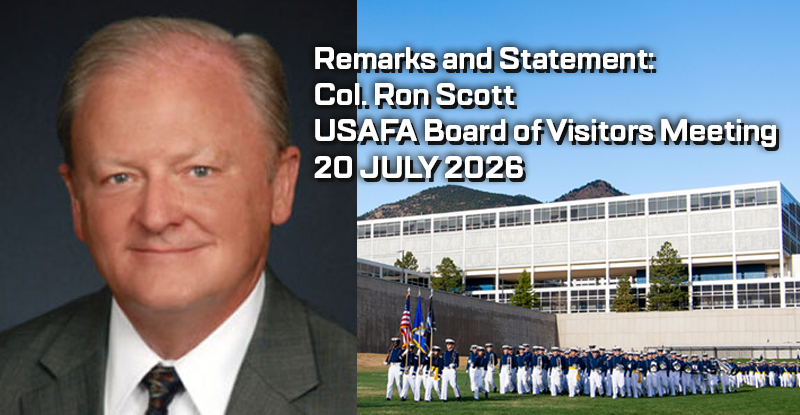
Remarks and paper submitted by Col Ron Scott, PhD, USAF ret, USAFA ’73 (STARRS President & CEO) to the July 20, 2026 USAFA Board of Visitors meeting:
Transcript:
“Thank you, Mr. Chairman, members of the board. I am a 1973 Academy graduate and a retired Air Force Colonel.
I served over 30 years in uniform and commanded at squadron, group, and wing levels, and commanded an AFROTC detachment at Arizona State University.
During that time, Major General John M. Schofield’s discipline, quote, served as powerful and enduring inspiration.
“Leaders, especially those in command positions, must balance accountability and rehabilitation within a unit to promote and preserve good order and discipline in the pursuit of excellence.”
Other factors that influence accountability include maturity, intent, and any harm caused by the misbehavior.
The default goal is a recoverable redemption through appropriate and scaled accountability because the government has already invested in his or her performance and the individual should be allowed to learn and recover from the misbehavior.
Moreover, shielding the individual from future misbehavior by controlling his or her behavior through excessive tours, confinements, other restrictions puts the burden on the commander and unit. Not the individual.
This practice promotes submissiveness to the individual imposing punishment, like the effect of a Mao struggle session, which is counter to forging character-based leadership. There is a difference between a mistake and malintent.
Good leaders encourage learning from mistakes and use this experience in mentoring subordinates. Mal-intent is more challenging.
Accountability in this case should reflect legal accountability commensurate with the extent of harm resulting from it.
Finally, the ideal institutional standard for imposing discipline should ensure due process and accountability and serve as a teaching moment for the individual in his or her development as a leader of good character. Thank you.”
Discipline: Balancing Commander Discretion within Institutional Standards and Norms
By Colonel Ron Scott, PhD, USAF, Retired, Class of 1973
(Command experience at squadron, group, and wing levels)
Prompted by the recent soccer player incident and in support of the newly formed Air Force Academy Board of Visitors Cadet Discipline Task Force, I offer some food for thought for your consideration.
In adjudicating misbehavior (both criminal and non-criminal), commanders are empowered with discretion depending upon the egregiousness of the behavior within the context of a unit’s culture. This is why there is a range of actions that can be exercised from verbal counseling to UCMJ action (Article 15 or court martial).
The two parties that factor in this decision are the individual to be held accountable and the perception of other members of the unit, especially if the behavior is known to them. As a matter of discipline, the commander acts in a way that keeps the individual a productive member of the unit while ensuring accountability, fairness and professionalism among other members of the unit.
Other factors that influence accountability include maturity, intent, and any harm caused by the behavior.
The default goal is recoverable redemption through appropriate/scaled accountability because 1) the government has already invested in his/her performance and 2) the individual should be allowed to learn and recover from the misbehavior.
The form of accountability then records the misbehavior while putting the individual on notice that it should not happen again. This places the burden on the individual.
Shielding the individual from future misbehavior by controlling his/her behavior (such as excessive tours, confinements, other restrictions) puts the burden on the commander (and unit), not the individual. This practice promotes submissiveness to the individual imposing punishment, similar to the effect of a Mao struggle session, which is counter to forging character-based leadership.
There is a difference between a mistake and mal-intent.
Good leaders learn from mistakes and use this experience in mentoring subordinates.
Mal-intent is more challenging. Accountability in this case should reflect legal accountability commensurate with the extent of harm resulting from it.
Example: Yokota had a WAPS cheating scandal in the late 90s. Because it involved over 50 individuals across the wing with potential of inconsistent commander discretion, we elevated action to the wing level. In the end, Article 15s were issued, those promoted in the most recent promotion cycle were redlined, thereby moving others not promoted up into the promotion range. There are other details beyond the scope of this discussion to include an attempt to try it in the court of public opinion. Bottomline: there was mal-intent, it harmed others, accountability was imposed, and those harmed were remedied.
The ideal institutional standard for imposing discipline should ensure accountability and due process and serve as a teaching moment for the individual in his development as a leader of good character.




Leave a Comment