
By Lt Col Eric Vogel, USAF ret, USAFA ’73
STARRS Connecticut State Leader
“So by all means, celebrate the Declaration of Independence. It is the most important act in American history…the foundation of our Constitution…But, I implore you to celebrate it by standing up for it, by defending it, and by recommitting yourselves to living up to its ideals.” —Supreme Court Justice Clarence Thomas, Speech at the University of Texas at Austin, April 15, 2026
“Old and intricate, these roots [of order] give life to us all…the roots of the moral order, of order in the soul; and the roots of the civil social order, of order in the republic.” —Russell Kirk, The Roots of American Order
“In fact, all too often the sentiments [of fellow citizens today] tend toward cynicism, rejection, hostility, and animus toward our county and its ideals.” —Justice Thomas, in his University of Texas at Austin speech
Associate Justice Clarence Thomas of the United States Supreme Court anticipated our nation’s Semiquincentennial in his brilliant speech at the University of Texas at Austin. (1)
He praised the heritage of our Declaration of Independence and highlighted its magnificent principles. Noting the “animus toward our country and its ideals,” he issued several warnings for the future of our country.
Thomas summarized and echoed, in his short speech, much of the grand theme of a written work published just over 50 years ago.
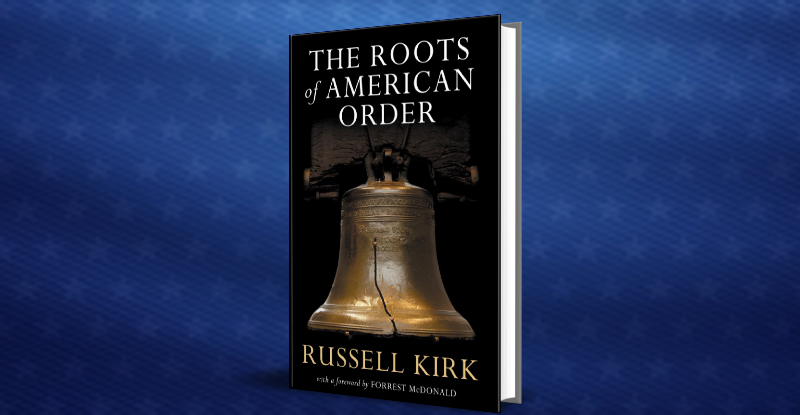
 Russell Kirk’s The Roots of American Order, recently featured by the Intercollegiate Studies Institute, is an impressive analysis of our nation’s background, emphasizing the importance of order. (2) Published shortly before our nation’s Bicentennial Celebration, it serves as a meaningful complement to the thoughts of Clarence Thomas in 2026.
If we look back another 50-odd years from Kirk’s book, we would do well to acknowledge The American’s Creed, and recognize that both Kirk and Thomas have reinforced, at greater length, the elegance of that two-paragraph work of 1917. (3)
Kirk’s theme is timeless—as important to the understanding our nation today as it was when published in 1974. The exquisite depth and breadth of his analysis is consistently supported by fine examples of historical events. The 500 pages of Roots offer a detailed—and, actually, delightful—background for the beauty of our nation’s order.
Reflecting for a moment on order in our personal, family and professional lives, most would agree that it is an essential requirement for stability, security and advancement. In a similar manner, order brings strength to community and government. Order is fundamental to our lives.
Kirk begins with a reference to Simone Weil and her description of order as “the first need of all.” (4) He writes that order is “…the pattern by which we live with purpose and meaning.” In fact, the human condition is “insufferable unless we perceive a harmony, an order, in existence.”
The Roots of American Order surveys previous civilizations and cultures—notably, their struggles and gifts—which contributed to our country’s founding and development. Jerusalem, Athens, Rome, London and Philadelphia are featured as both critical and fundamental influences on the establishment of order in our nation.
Jerusalem was the “city of divine wisdom”; Kirk finds Israel’s belief that God is the source of order and justice “a dominant contribution of order in our country.” He returns to this thought throughout the book, and provides extensive discussion of the influence Christianity— rooted in Judaism—has had on the world.
His detailed writing on religion in America includes an interesting account of the conflict and dominance of various sects. Most assuredly, Kirk believes that the United States has truly been blessed.
From the classical world of Athens, we were gifted with the ethics and philosophy of Socrates, Plato and Aristotle. (5) Their writings offered fundamental guidance to colonial Americans. “Hellenic thought influenced American morality and political principals.” Many see the roots of democracy in ancient Greece; Kirk, however, notes that “its hubris, arrogance” was no perfect model for American politics.
Nevertheless, Greek poet and lawgiver Solon stands out for his writing on “righteous order, eunomia.” He was the “Greek architect of order most impressive to Americans of their country’s formative years…” (6)
The Roman Empire—intermittently—offered the virtues of piety, integrity, law and obligation. The Romans acknowledged the concepts of checks and balances, and separation of powers, during various periods of the empire’s existence.
Cicero offered writings on republican virtue, justice, reason and law—particularly Natural Law. In his poetry, Virgil brought us the concepts of labor (“the dignity of labor”), pietas (“humility before the gods, a love of one’s country, and a sense of one’s duties”) and fatum (“imperial destiny…to maintain the cause of order and justice and freedom”).
However, as much as the Roman Empire exemplified virtue and order at times, disunity, division, wars and the “decay of classes” exhausted the empire.
The “Genius” of Christianity and the values of Jerusalem would outlast the Romans. Paul, Augustine and Gregory the Great, among others, stand out as key figures in the strength, influence and dominance of the church. Clearly, Christianity would have a profound impact on our founding fathers, as manifested in the documents they created.
London’s major influence was based on British history of centuries of conflict between English kings and their subjects, religious struggles, and civil wars. The completion of a British Bill of Rights, the growth of Parliament in opposition to the king, and the development of common law also impacted the establishment of our American government.
In addition to the civilizations just mentioned, Kirk cites several individuals—philosophers and political intellectuals—whose ideas were fundamental to the creation of our nation. These four eighteenth century intellectuals—who often countered Enlightenment thought—were major influences in the development of our founding documents.
Montesquieu, in disagreement with Hobbes, believed that “law is not despotic.” (7) Furthermore, he wrote that “Ordered freedom [is] maintained by the separation of powers and by checks and balances.”
David Hume, Scottish historian and philosopher, was “admired by Hamilton and Franklin, [and] detested by Adams and Jefferson.” (8) He was critical of the thinking of Hobbes and Locke regarding the idea of a social contract, and influenced James Madison in his drafting of the Constitution.
Englishman William Blackstone’s Commentaries on the Laws of England was widely read in the colonies and had a substantial influence on our laws. (9) He emphasized common law, equity and natural law.
For Blackstone, the Natural Law was “rooted in Christian Ethics.” The “natural liberty of mankind” consisted of three articles: “the right of personal security, the right of personal liberty, and the right of private property.”
Kirk highlights Edmund Burke as a “role advocate of political prudence and compromise, for which he was best known in the Thirteen Colonies.” (10) Burke was a member of the House of Commons who opposed many of the King’s policies regarding the colonies. Nevertheless, he was against the American Revolution.
These philosophical influences—and more—coalesced in Philadelphia during the latter half of the 18th century, bringing superb order to the establishment of our nation.
Kirk’s penultimate chapter is a beautiful essay on our Declaration of Independence and Constitution.
He then closes with a chapter on “Contending against American Disorder,” his thoughts echoed by Supreme Court Justice in the epigraphs above. When Kirk wrote in the 1960s and the early 1970s the nation was in turmoil, as it is today.
How prescient, then, was Jefferson in his 18th century thought on order, noted by Kirk: “[Liberty] can be maintained only by ceaseless vigilance; it is as true that order can be sustained only by endless patience.”
Several noteworthy aspects of this book complement the overall outstanding writing. For example, the summaries of subchapters in the table of contents are a great aid, as is a chronology of the events (2500 B.C. to 1866) mentioned in the book.
Kirk’s discussion of differences in the American and French Revolutions is particularly enlightening, including the idea that the Declaration of Independence was written as an appeal to France. (11) Explanations of Federalism and Deism, such important aspects in our history, are helpful.
The Roots of American Order is not light reading. It is, however, so rich in history and philosophy—both eloquently intertwined—that is it quite enjoyable and worthwhile.
The reader’s efforts in focus and concentration pay off in a fascinating journey into the background of our origins and the strength of our nation’s order.
And what a story it is!
- https://www.civitasoutlook.com/research/justice-clarence-thomas-remarks-on-the-250th-anniversary-of-the-declaration-of-independence-b1d62423-c04b-4aae-aab3-b35d648f9209
- https://isi.org/
- https://www.ushistory.org/documents/creed.htm
- Simone Weil (1909-1943): French philosopher, writer, mystic and political activist. She is not to be confused with Simone Veil (1927-2017), who, as French Minister of Health, was responsible for La Loi Veil (The Veil Law) legalizing abortion in France.
- Although the following quote of Alfred North Whitehead (English Mathematician and Philosopher, 1861-1947) refers to Plato, it applies to the monumental contributions of all three Greek giants of philosophy to Western Civilization: “The safest general characterization of the European philosophical tradition is that it consists of a series of footnotes to Plato.”
- We thank this fine citizen of ancient Greece for our English word solon: a wise and skillful lawgiver; a member of a legislative body (Merriam Webster)
- Charles Louis de Secondat, Baron de la Brède et Montesquieu (1689-1755), better known as simply “Montesquieu.” Jurist, historian and political philosopher.
- David Hume (1711-1776), Scottish philosopher, historian, economist and essayist.
- Sir William Blackstone (1723-1780), British jurist, justice and Tory politician.
- Edmund Burke (1729-1797), British (born in Dublin) writer, philosopher and statesman.
- https://www.instagram.com/reel/DaEUR8KvXSe/ This short video segment features Os Guinness explaining the basic differences between the American Revolution (“Biblical based and realistic”) and the French Revolution (“French Enlightenment based and utopian”).
Clarence Thomas warns America: Liberty dies when we choose comfort over courage






Leave a Comment