

By R. Jordan Prescott
On September 10, 2001, Secretary of Defense Donald Rumsfeld delivered a speech identifying the department’s bureaucracy as the nation’s most pressing adversary and asserting his determination to liberate the Department of Defense.
Twenty-four years later, Secretary of War Pete Hegseth delivered a comparable speech outlining revisions to military fitness standards and training requirements and declaring his intention to “liberate America’s warriors.”
Rumsfeld grandly characterized his reforms as transformation; Hegseth humbly characterized his changes as common sense.
Indeed, Hegseth restated an enduring adage that to ensure peace, one must prepare for war and articulated “a simplifying test of truth – the department’s golden rule would be ‘Do unto your unit as you would have done unto your own child’s unit.'”
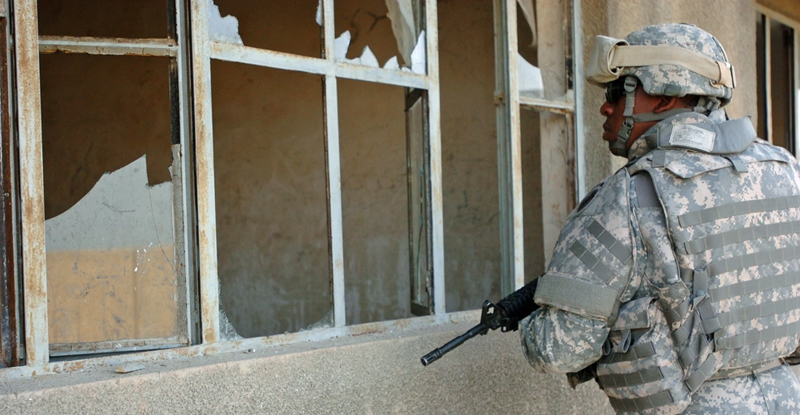
Notably, Hegseth directly invoked a forty-year-old truism known as the Broken Windows Theory.
“… At every level, from the Joint Chiefs to everyone in this room to the youngest private, leaders set the standard. And so many of you do this already, active, guard and reserve. This also means grooming standards. No more beards, long hair, superficial individual expression. We’re going to cut our hair, shave our beards, and adhere to standards.
Because it’s like the broken windows theory in policing. It’s like you let the small stuff go, the big stuff eventually goes, so you have to address the small stuff. This is on duty, in the field and in the rear. If you want a beard, you can join Special Forces. If not, then shave.
We don’t have a military full of Nordic pagans. But unfortunately, we have had leaders who either refuse to call BS and enforce standards, or leaders who felt like they were not allowed to enforce standards. Both are unacceptable. And that’s why today, at my direction, the era of unprofessional appearance is over….”
Introduced in 1982 by James Q. Wilson and George L. Kelling, an authority on public administration and a criminologist, respectively, the thesis argued that if a broken window is left unrepaired, then all the rest of the windows will soon be broken and the sequence from antisocial to criminal behavior will commence.
More pointedly, the community’s inattention to minor infractions will invariably be compounded by apathy, powerlessness, and divergent perspectives as to what is tolerable.
As community cohesiveness erodes, individuals given to illicit behavior will feel freer to commit crimes.
Accordingly, Wilson and Kelling strongly urged a return to the original function of maintaining community order via on-the-ground in-person community policing.
In the same vein, Hegseth denounced the erosion of standards and distraction from warfighting caused by DEI directives and unnecessary training.
Having already eliminated the former at the very beginning of his term, Hegseth order the reduction of mandatory training from twenty-seven to sixteen courses and rescinded 350 hours of online modules required for promotion.
In its place, the secretary promised the “ruthless, dispassionate and common sense application” of the newly mandated fitness and grooming standards.
In particular, Hegseth elaborated on his two criteria for reinstituting past standards — the E-6 and 1990 tests.
Under the former, if a proposed change enables E-6s (or O-3s) “to get back to basics”, then the change is justified.
Under the latter, if a standard was in existence in 1990 and was modified for reasons other than changes to the battlefield, then the original is reinstated.
Curiously, Hegseth acknowledged he had no specific rationale for picking 1990 – “seems to be as good a place to start as any.”
Broken Windows Theory provides a clue.
Wilson and Kelling observed that, as order breaks down, the community must increasingly rely on a police force no longer tasked with preemptively maintaining order but fighting crime after the fact.
This subtle but consequential change shifted attention from police contributions to maintaining community order to apprehending lawbreakers – officers moved from walking the beat to cruising in their vehicles and completing reports and training back at precinct headquarters.
The results were increased crime and overwhelmed police forces.
In parallel but inverse terms, the American military circa 1990 shifted from upholding American security to maintaining global order.
Coming one year after the dramatic events in Eastern Europe signaling the impending end of the Cold War and one year before the smashing victory in the Gulf War, 1990 featured the last debate between interventionists and non-interventionists over the basis for using military force.
After Iraq invaded Kuwait, President George H.W. Bush declared the aggression “would not stand”. In opposition, Patrick Buchanan and Jeane Kirkpatrick respectively argued sending Americans to maintain cheap oil and would prevent the United States from becoming a “normal country in a normal time”.
The war proceeded and the nearly bloodless triumph “laid to rest” the Vietnam Syndrome. Non-interventionist voices would be marginalized for a generation.
Bush announced the advent of a “new world order” premised on peaceful engagement and strengthened multilateralism, but lost re-election to Bill Clinton in the fall.
Into the void, more ambitious voices arose. Scholars postulated the “end of history,” a “unipolar moment,” and a “clash of civilizations.” While divergent in disposition, they all essentially bestowed a global mission on America—to pursue continued dominance, to oppose anti-Western entities, to spread democracy, and to achieve justice.
Over the next thirty-five years, American intervention would be unrelenting. The period was marked by acclamations of “indispensable nation,” “responsibility to protect,” and the benevolence of a “new kind of imperialism.”
Fatefully, the overturning of the Vietnam Syndrome led to operations other than war.
During the transition between the Bush and Clinton administrations, Colin Powell, the Chairman of the Joint Chiefs of Staff at the time and the sole individual of stature to serve in both, wrote that the reason for military successes since Vietnam resulted from the careful matching of military force to political objectives.
Nevertheless, Powell warned peacekeeping and humanitarian operations presented the same danger to service members as conventional combat.
More directly, “wars kill people… it is the scourge of God and we should be very careful how we use it. When we do use it, we should not be equivocal: we should win and win decisively.”
Instead of heeding Powell’s counsel, decision-makers dispatched the nation’s military to repair every broken window around the world.
President Trump reopened the 1990 debate and has promised a foreign policy of restraint and more judicious use of force in service of peace through strength; Hegseth’s speech laid the foundation for refurbishing the nation’s armed forces accordingly.
Hegseth is an unlikely secretary of war.
Rumsfeld was serving his second tour as secretary of defense, the only individual to ever do so. Trump’s first secretary of defense was Army General James “Mad Dog” Mattis, a legendary “monk warrior.”
Hegseth served in Afghanistan and Iraq, attained the rank of major, and became a public figure by leading a veterans organization and appearing on Fox News before being nominated. And controversy has accompanied him every step of the way.
Hegseth may be a flawed man, but his words were flawless in elocution and implication. Hegseth’s message restored the primacy of simplicity, standards, and warfighting.
Rumsfeld’s speech became notable because it occurred the day before the worst terrorist attacks on American soil in the country’s history. Mercifully, Hegseth’s speech has not been followed by similar tragedy.
Hopefully though, would-be adversaries recognize the speech has recommitted the nation to the fundamentals formulated by Sun Tzu, Clausewitz, and Sherman: wars are the extension of political objectives; wars are meant to be won; and wars are episodes of hell on earth.
Peace through strength will be accomplished by no other means.
R. Jordan Prescott is a private contractor working in defense and national security since 2002. He has been published in The American Conservative, The National Interest, Small Wars Journal, Modern War Institute, 19fortyfive, Responsible Statecraft, and RealClearDefense.
First published in Real Clear Defense



Good article, but one correction. Mattis was a retired Marine GO, not Army.