

STARRS Board of Advisors member BGen Christopher “Mookie” Walker, USAF ret, USAFA ’88 (and on the Board of Directors of the USAFA Association of Graduates) was interviewed on the Chicago’s Morning Answer radio show on his birthday, discussing his experience with DEI in the military.
Watch:
Retired Brig. Gen. Christopher “Mookie” Walker: Inside the Pentagon’s DEI Apparatus, and Why He Says It Threatened Military Readiness (Chicago’s Morning Answer)
John Anthony, filling in for Dan Proft, welcomed retired Air Force Brigadier General Christopher “Mookie” Walker to discuss his firsthand experience inside the Pentagon’s diversity, equity, and inclusion apparatus.
Anthony introduced Walker, the first Black officer to reach brigadier general rank in West Virginia’s National Guard, noting his roughly four-decade career including more than 5,200 flight hours and senior command positions within the West Virginia Air National Guard, where he oversaw more than 2,100 service members.
Walker described his upbringing in New York City to Jamaican immigrant parents who emphasized merit, discipline, and hard work, crediting that foundation with shaping his skepticism toward ideological approaches to diversity he later encountered in senior military assignments.
Walker explained that from 2021 through 2023, he served in advisory roles connected to Air Force diversity and inclusion policy, a position he said he was specifically placed into by Trump-era political appointees who trusted his judgment and wanted an internal check against what he described as ideological excess within the department.
Walker said he entered the assignment believing genuine diversity, understood broadly in terms of experience, skills, and background, could strengthen military effectiveness, but grew increasingly concerned that the prevailing framework instead treated diversity primarily as a matter of immutable characteristics like race and gender.
He cited the case of former Space Force Lieutenant Colonel Matthew Lohmeier, who was relieved of command in 2021 after publicly criticizing what he characterized as Marxist ideological trends within the military’s diversity programming, as an example of what Walker described as ideological enforcement overriding legitimate internal debate.
Walker also described a parallel oversight structure he encountered at the Air Force Academy, in which cadets participating in diversity-focused programming reported through a separate chain of command tied to the academy’s diversity office rather than through standard military leadership channels.
He compared the structure to political commissar systems historically used within Soviet and Chinese Communist Party military organizations to monitor ideological loyalty alongside conventional command structures, and said the arrangement represented a significant departure from the military’s traditionally apolitical institutional culture.
Walker described attending a training session, delivered through a Georgetown University-affiliated program, that he said characterized White service members broadly as oppressors and minority service members as oppressed, a framing he said conflicted directly with his own experience serving alongside white colleagues he considers close friends and combat partners.
He argued that continued expansion of these programs, absent a change in national political leadership, would have significantly undermined the military’s core mission of training personnel to fight and win wars.
Walker closed by expressing support for the Trump administration’s subsequent efforts to roll back diversity, equity, and inclusion programming within the military under Defense Secretary Pete Hegseth, while cautioning that he believes proponents of the prior approach remain organized and prepared to reassert similar policies given a future political opportunity.
AI Transcription
HOST: This is Chicago’s morning answer with Dan Prof on AM560. The Answer. Good morning, Chicago. This is John Anderson, host of Black and White Radio. Heard every Saturday from four to 7p.m. right here on these airwaves. And what’s great is I just finished my seventh year of radio on Black and White. Yay! I’m really happy about that.
But you know, as I told you guys, I wrote a book. I just I wrote a. This is my second book that I’ve completed called The Counterfeit Republic, and I was looking for stories to put into the book, and I found this this story of retired Brigadier General Christopher Mookie Walker.
I got to figure out how that Mookie name come up, and I found his story, and I just thought it was so fascinating, and I use it a few times in the book, and you know because personally, I think there are plenty of people willing to offer an opinion about diversity, equity, and inclusion, or as I like to call it, die in the United States military, offers something far more important than an opinion.
He offers firsthand experience. Retired Brigadier General Christopher Mookie Walker spent approximately four decades serving in the United States Air Force and Air National Guard. He graduated from the United States Air Force Academy in 1988, became a master navigator, and accumulated more than 5,200 flight hours, including over 400 combat and combat support hours.
He served in operations around the world, advised the Iraqi Ministry of Transportation, commanded at squadron and group levels, and eventually became Assistant Adjutant General and Commander of the West Virginia Air National Guard. In that position, he was responsible for more than 2,100 members and two flying units.
General Walker also brings up a certain perspective that very few military saw. In 2021 through 2023, he served as senior advisory assignments connected to the Air Force’s diversity and inclusion operation inside the Pentagon. He attended the meetings. He heard the arguments. He also saw the priorities. He watched the military wrestle the difference between equal opportunity and engineered equity.
General Walker later offered a warning that she commanded the attention of every American. Diversity is great, but you can’t sacrifice meritocracy.
This carries a particular weight coming from the first black person to become a brigadier general in West Virginia. He’s not arguing that America should close doors. His argument is that the military must open the door to every qualified American who are refusing to lower the standards required to defend the country. General Christopher ‘Mookie’ Walker, welcome to Chicago Morning Answer.
WALKER: Oh, thank you for having me. So this is today is my 61st birthday, and and so after this interview, I intend to get out there on the motorcycle and and tear up the roads, and then get to the range and do some long-range rifle shooting. But but but but thanks for having me. Hey,
HOST: you talked about getting on a motorcycle in those mountains of West Virginia. That must be in sight, right?
WALKER: Oh Lord! I tell you what. While I was in D.C. at the Pentagon for a while, I actually sold my motorcycle because it was just too dangerous. Too many people texting and driving and rear-ending you in your car, and if you rear-ended in a motorcycle, you’re done.
HOST: Yeah. Well, General, before we get into a lot of the DEI stuff, which I actually put in a book that I just recently wrote called *The Count of Privy Public* I want people to get to know you. You grew up in New York City with what you have described as strict Jamaican parents who instill hard work and patriotism in you. What do your parents teach you about America, discipline, and personal responsibility that stayed with you throughout your military career?
WALKER: So, my my father came to this country in 1957, and my mother in 1959, and from Jamaica, where there was no such thing as welfare and other things, everything was merit-based. If you work hard, then you come out on top. My father and I had actually a little headbutting for many years because he wanted me me to be a physician, a doctor, either a doctor or a dentist, and all of the people that he would have mentor me were doctors or dentists, friends of his, and I said no, I want to fly, and that was a big thing until I graduated from the Air Force Academy and he saw the Thunderbirds fly over the stadium. He saw the President addressing our class, and he said, “Okay, maybe this is something good too. And that changed his mind.
But everything about my parents was: you have to be the best. If I brought home a test that I got a 96 on. They’ll go, “What happened to the other four points? This is the kind of thing that a lot of people associate with Asian parents, but but Jamaican parents are the same.
HOST: General, as you look at how you were raised, not to see America as this oppressive country or as a country in which you would have to overcome obstacles, but still could achieve something extraordinary. When you look at how a lot of people who are who come into this country and they hate America, when you look at how even some Americans are teaching their children to hate America, that’s not how you were raised. And why is it important for people who are listening to this program to understand the greatness and just how great this country really is?
WALKER: Oh my goodness! If it weren’t for this country, I would never be anywhere near near where I am now. And and and quite honestly, I I talk to some of these folks and say, if this country is so oppressive. Why are people risking their lives to get here?
They they have so they are being indoctrinated with with a sort of mindset that that to hate this country when okay no country is perfect, but we, because of our Constitution, we have learned by our mistakes, and we and we get better each time. It it irked me to no end when I saw things happening in the last 10 years.
For instance, I don’t know if you remember this clip, this video that went around for a while of this this woman looked like the Michelin Man in spandex with with a lot of wild hair, and her name was Ashley Shackelford, and I think she goes by Hunter Shackleford now, but she was talking to this mostly white progressive audience, and and she she stood next to this flip chart that read in large letters, “All white people are racist, and then right under that, she had a PayPal handle underneath asking for money, and then in the video, she tells the room there will be no coddling of white tears, or white people are always going to be racist, and white people are born into not being human, and they’re taught to be demons.
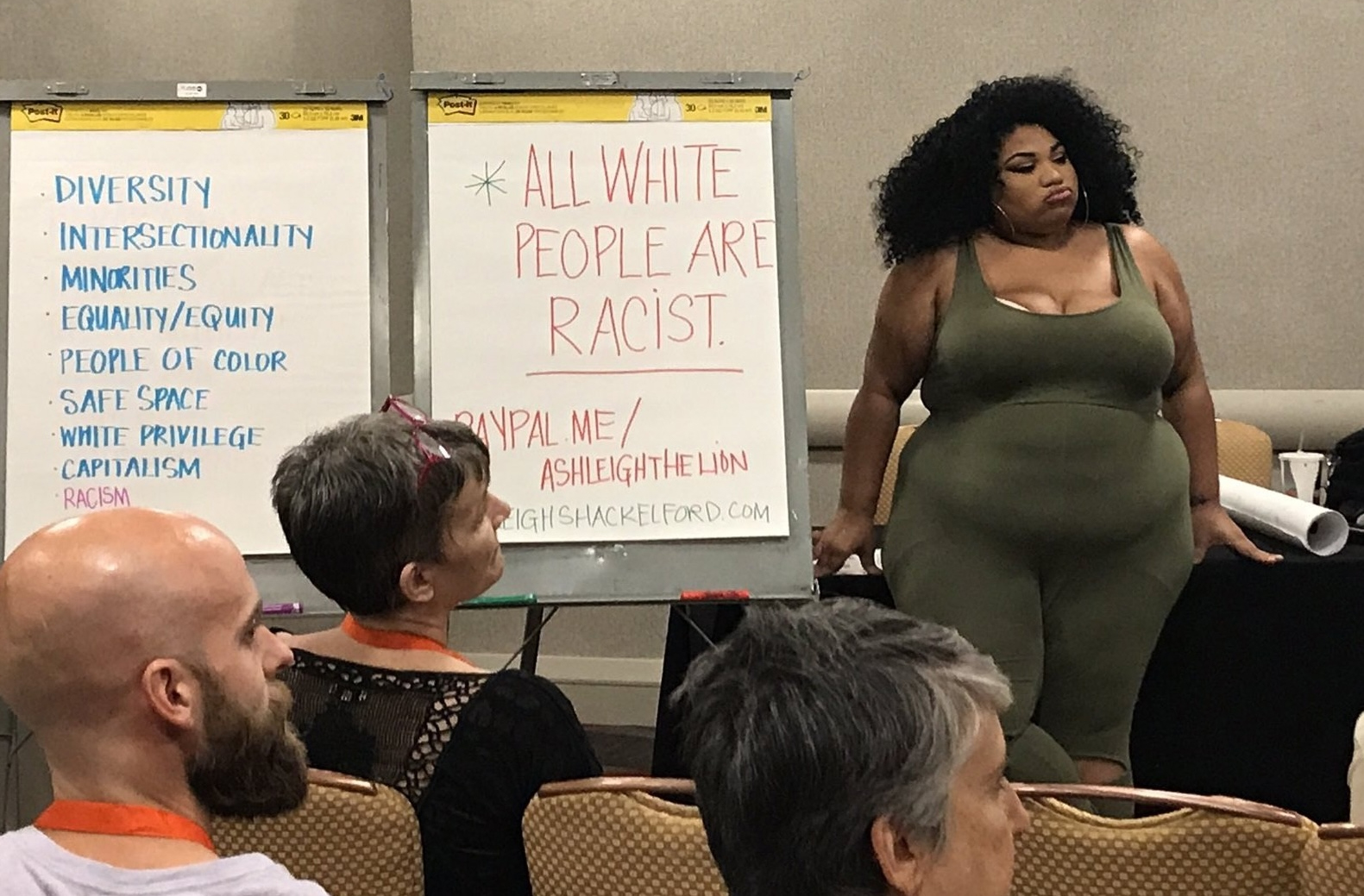
And I said, “What the hell? Sorry, sorry if that’s a all right, all right, and and me as I came up as an operational person within the Air Force, an air crew in combat, I have white people who I would call my brothers and sisters who would die for me, and I would die for them, and that insulted me. That that to me was her spitting in my face, and and and I I can’t take that.
HOST: Yeah. Well, General, I now want to turn to the portion of your career that I believe makes your voice especially important in this current debate. Your your official military biography states that from February through September 2021, you were dual. Is it dual added as the Air National Guard assistant for diversity and inclusion? And from October 21 through September 23, you were served as a you served as a special assistant to the director of the Air National Guard to connect with the Air Force main power reserve affairs and diversity and inclusion. Man, that’s a lot of words. Right, right, right. Okay, so so how were you selected that for that assignment you requested? No. Or were you told that this was where the Air Force needed you?
WALKER: Here here’s the inside baseball on that. So I was I was serving as the assistant adjutant general for the West Virginia National Guard, for the Air National Guard side, being the commander of the West Virginia National Guard, but then at that time in 2021, there were still some Trump appointees in control there at the at the top in the in the Department of the Air Force, whom I’d worked for before as as dual-hatted as the assistant to the assistant secretary of the Air Force of Manpower and Reserve Affairs, and they knew me and they knew the way I thought, and they helped me into that slot in the office of diversity inclusion because they knew that I would be a speed bump or even a bulwark to the crazy.
So and I went in there saying, “Let’s see what happens with this, because in my mind, diversity in itself is not a bad thing, but the left had determined that diversity is only for immutable characteristics, and in their mind, that all black people, all women, and all lesbians, bisexuals, and gays thought the same, and so let’s fill, let’s let’s do our best to get those people minorities in, so that we can win the ideological war.
And in my mind, diversity should be about your experiences, your ideas, your language skills, your cultural skills, your technical skills, but for them, diversity meant just your skin color. And I said, “Okay, this is going to be bad. But let’s see. I was put in there for a reason. So I said, “Let’s see what happens, and because I was reporting back to certain people what was going on, and so that’s how I got put into that position.
HOST: Well, well, General, what did you find once you entered the meetings and began hearing the proposals? At what point did you recognize that the operation might be moving beyond equal opportunity and then and then into something ideological?
WALKER: Holy smokes! Oh, so so here’s here’s one. I’ll give you a few examples. One for your listeners, I encourage them to go on if they if they have the Angel Studios app, or if not, get it and and watch a movie, the documentary called Call Sign Courage. It is about a friend of mine named who was former Lieutenant Colonel Matt Lohmeier. Okay, so he was he flew F-15s and then he went into the Space Force and he was a Space Force commander and he was discharged in 2021 after publicly criticizing DEI ideology in the military.
Everything he said was true, but they and he he was not he was not advocating for Republicans or Democrats. He was just stating that hey, this Marxist ideology is getting in here, and and we ought to stop it. And they they railroaded him, the the Department of the Air Force, which the Space Force falls under, did him dirty.
So he he he identified some things that were going on that I knew about as well. For instance, at the Air Force Academy, which is where I graduated from and he graduated from, and it is supposed to be the elite commissioning source in the Air Force. It costs about $650 to $670,000 to educate each cadet and bring them to the to a second lieutenant, which is about which is about four to five times the cost of ROTC and nine times the cost of officer training school.
The Air Force Academy had these cadets who were DEI cadets who wore these what we we call them the purple robes, but they had these purple robes on their uniforms, and and they reported through a separate chain of command, not not to the commandant, but to the head of DEI at the Air Force Academy on diversity issues, and so this was an ideological enforcement layer in inserted alongside our operational chain of command.
It’s sort of I don’t know if you read any Tom Clancy books, but yeah, these are what we call the political commissars. They represent they resembled the Soviet political commissars and and similar systems in the. Chinese Communist Party, who monitored loyalty to the party rather than purely military competence in the chain of command.
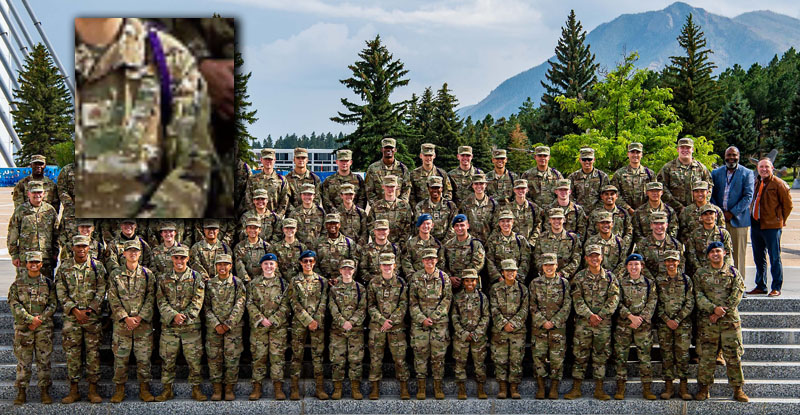
Cadets pose for a photo after graduating from the Cadet Wing Diversity and Inclusion Program this summer, allowing them to advise students on diversity at the U.S. Air Force Academy. Each cadet wears a purple rope across their left shoulder symbolizing their position as a diversity representative. (U.S. Air Force Academy photo and caption)
HOST: Brigadier General, wait, wait, we got about a minute and 30 seconds left. Okay. I want to get this out as it relates to when you look at your time in that position. If President Trump had not won, Pete Hegseth is not there at the Department of War now. How detrimental were these policies to the military?
WALKER: Oh Lord of mercy! Okay, they they would have tore us to pieces. All right, we we are supposed to be future officers are supposed to be taught war and how to win wars. Instead they were being taught to tiptoe around DEI issues. It was the erosion of the apolitical military ideal.
The military is supposed to be nonpartisan and loyal to the Constitution and chain of command. When senior leaders treat DEI and criticism of DEI as a political offense, while embedding ideological enforcers, they politicize the force and undermine the professional ethic.
The military’s job is to win wars under the Constitution, not enforce progressive orthodoxy through parallel chains of command and informant networks.
Matter of fact, I tell you, I even attended a course by Georgetown that was given to senior leaders, and they were trying to tell us that white people are the oppressors and minorities are the oppressed. And I was sitting there going, “What in the hell are they telling us? But it was all indoctrination instead of talking about war and teaching about war and how to win wars. And that’s why I said, okay, enough is enough.
But I was reporting all of this up through certain channels so that they would know what’s going on and how to battle it in case President Trump won, and he did, and they are stomping it out now. But they, I’m telling you, these these leftists are hiding, and they’re waiting for that opportunity to pop up again.
HOST: All right. Well, he’s Brigadier General Christopher Walker. I hope you do decide to don’t give up on running for politics. I think your voice is needed, especially there over there in West Virginia. And I want to say happy birthday, happy 61st birthday. 60 is a new what?
WALKER: Well, well, for me because I’ve been ignoring my shape after retirement. 60s new 50 right now, but I’m gonna get back to the 40s soon.
HOST: General Christopher Wookie Walker, thank you so much for joining us on Chicago Morning After today.
WALKER: All right, take good care.
Related:
A Conversation with USAF Brigadier General Christopher “Mookie” Walker





Leave a Comment