

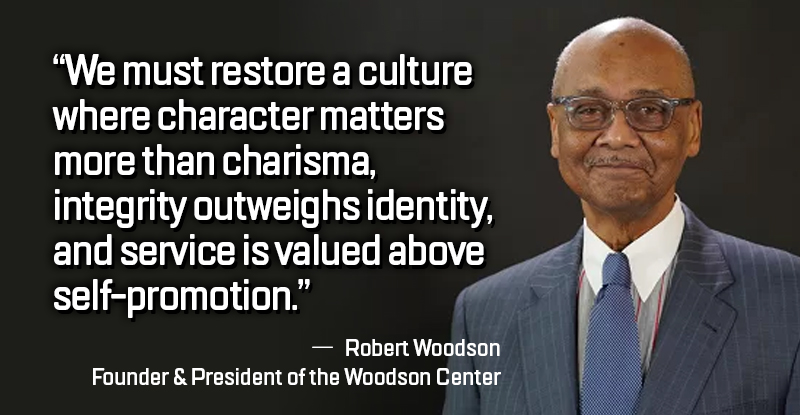
STARRS encouraged the Air Force Academy to have Robert Woodson as one the speakers at their National Character and Leadership Symposium in 2022. You can watch his speech here (also linked below). In 2020, his Woodson Center launched 1776 Unites campaign to counter The 1619 Project. While we are accustomed to Bob Woodson telling it the “way it is” powerfully, with bold, insightful, incisive, common sense driven messages, the op-ed from the Washington Examiner may be one of his best expressions of principled, courageous leadership. UPDATE: This was his last article as he died in his sleep on May 19, 2026. More info
By Bob Woodson, Air Force veteran
Founder and President of the Woodson Center
The recent legal actions involving the Southern Poverty Law Center only sharpen a truth some of us have witnessed for decades: Too many institutions have turned civil rights suffering into a business model.
Let me be clear. The cause of civil rights remains one of the noblest defenses of human dignity in American history. But the movement has, more often than we admit, been commodified.
What began as a mission rooted in sacrifice has, in some quarters, hardened into an industry rooted in exploitation.
When the suffering of a people becomes a fundraising hook, the incentive shifts from solving problems to sustaining grievances.
Our communities are being exploited from multiple directions. By outsiders who turn our pain into their profits. By self-proclaimed leaders who monetize resentment instead of producing results. And by the enemy within, who perpetuates violence and corruption, we’re too eager to ignore because it wears a black face.
We must stop being the “product” for these groups and start being the “judges” of their integrity.
To my brothers and sisters,
We have never suffered from a lack of excellence.
From the genius of our music to the brilliance of our scientists, from the discipline of our athletes to the vision of our entrepreneurs, black Americans have shaped this nation at every level.
We gave America the agricultural brilliance of George Washington Carver, the medical innovation of Alice Ball and Dr. Daniel Hale Williams, the engineering genius of Elijah McCoy, the mathematical precision of Katherine Johnson, and the business leadership of Madam C.J. Walker. In every arena where opportunity met preparation, we proved that our capacity was never the question.
But there is one area where our standard of excellence has not merely stalled, but dangerously receded: the moral accountability of our leadership and of those within our own ranks who prey on our people.
I have lived long enough to watch an alarming pattern take root in our public life. Repeatedly, black elected officials who engage in corruption, self-dealing, or moral failure are shielded from the level of scrutiny we claim to demand elsewhere. Not because the evidence is unclear, but because celebrity has replaced character. The image of shared identity has become more important than the substance of shared responsibility.
That is not solidarity. That is surrender.
We have created an environment where criticism is silenced, standards are lowered, and wrongdoing is excused not because it is just, but because confronting it might embarrass someone who “looks like us.”
We have seen it in politicians such as Gus Savage, Mel Reynolds, Jesse Jackson Jr., Charles Diggs, and Corrine Brown. These are what I call black robber barons: public figures who leveraged identity and symbolism while betraying the very people they claimed to represent.
Jackson Jr. admitted to misusing roughly $750,000 in campaign funds for personal purchases. Brown was convicted in a charity fraud scheme involving money meant for underprivileged students.
Time and again, we have watched officials misuse funds meant for the poor, exploit offices entrusted to them, and then return to the ballot as though a familiar name and a shared grievance should wipe the slate clean.
This is not empowerment. This is erosion.
History shows us a better way. Every movement that truly advanced our people was rooted in integrity, discipline, and moral courage.
The abolitionists understood it. The early civil rights movement understood it. Their strength was not merely political power. It was moral authority.
In many ways, we showed greater resilience and higher standards 50 years after slavery than we are willing to demand of one another today. Under far harsher conditions, black Americans built strong families, flourishing schools, vibrant churches, and successful businesses. Yet now, with more access and more resources, too many of our communities are weaker.
Over the past 50 years, many of the deepest problems confronting low-income blacks have taken root in cities governed by black political leadership. The tragic and most obvious of these problems is crime. But these leaders selectively elevate certain narratives while silencing others, quick to summon national outrage when the offender is white and the victim is black. But when both the victim and the perpetrator wear a black face, the outrage, with troubling frequency, goes quiet.
Poor women abused in silence. Employees exploited by powerful insiders. Communities robbed by the very representatives elected to serve them. These stories rarely become national causes when they disrupt the preferred script. That is a moral failure.
And when corruption is exposed, what happens?
Too often, nothing.
Indicted. Convicted. Rebranded. Reelected.
The greatest threat to our communities is not external hostility but internal apathy.
It is our willingness to overlook corruption, excuse misconduct, normalize betrayal, and return dishonest men to office after they have already violated the public trust.
What message does this send to our children? How can we preach honesty, discipline, and responsibility while rewarding leaders who model the opposite?
The lesson becomes devastatingly clear: you can lie, you can steal, you can betray the people and still be celebrated if you have the right connections and spout the right slogans.
No healthy people can survive on those terms.
There cannot be one standard for crime in the streets and another for crime in the suites. If the black man on the corner must answer for his wrongdoing, then so must the black man in the office. We must remove the racial exemptions. Moral consistency is not optional. It is the foundation of justice.
I believe in redemption. But redemption does not mean being rewarded with a second chance at the very office that was abused. A man who embezzles from a bank is not restored by being handed the keys to the vault. Likewise, when a public official steals from the people, violates public trust, or exploits power, the community — not the party, not the press, not the machine, but we the people — must be the court of public opinion that says: You may be forgiven, but you will not be trusted with this office again.
The answer is not going to come from Washington. It begins with us.
We must restore a culture where character matters more than charisma, integrity outweighs identity, and service is valued above self-promotion.
That requires commitment, not sentiment.
We must insist that theft of public funds, abuse of power, and serious ethical violations should permanently disqualify a person from returning to the same office that was abused.
We must redirect resources away from corrupt political personalities and bloated institutions and toward grassroots leaders who are actually rebuilding communities from the ground up.
Every dollar wasted on political theater is a dollar stolen from neighborhood mentors, local entrepreneurs, faith leaders, mothers, fathers, and community builders doing the real work of restoration.
We must recover something our culture has nearly lost: moral shame. Not the kind that strips people of dignity, but the kind that protects dignity by reminding us that leadership is sacred and betrayal has consequences. A healthy conscience is what stops a people from celebrating what should grieve them.
Wake up, black America. Excellence is our inheritance. But excellence is not only what we achieve. It is also what we refuse to tolerate.
Our future depends not simply on who represents us, but on what we are willing to require of them.
And that standard must never fall below excellence.
Sincerely,
Bob Woodson
First published in the Washington Examiner
_
Robert L. Woodson, Sr. is Founder and President of the Woodson Center. He is an influential leader on issues of poverty alleviation and empowering disadvantaged communities to become agents of their own uplift. Woodson is a frequent advisor to local, state and federal government officials as well as business and philanthropic organizations. Woodson is the author of several books, including On the Road to Economic Freedom, The Triumphs of Joseph: How Today’s Community Healers are Reviving Our Streets and Neighborhood, Lessons From the Least of These: The Woodson Principles, #1 best seller, Red, White and Black: Rescuing American History from Revisionists and Race Hustlers, and the newly released A Pathway to American Renewal: Red, White, and Black Volume II.
Red, White, and Black: Rescuing American History from Revisionists and Race Hustlers
by Robert L. Woodson Sr. (Editor)
An indispensable corrective to the falsified version of black history presented by The 1619 Project, radical activists, and money-hungry “diversity consultants.”
In the rush to redefine the place of black Americans in contemporary society, many radical activists and academics have mounted a campaign to destroy traditional American history and replace it with a politicized version that few would recognize. According to the new radical orthodoxy, the United States was founded as a racist nation—and everything that has happened throughout our history must be viewed through the lens of the systemic oppression of black people.
Rejecting this false narrative, a collection of the most prominent and respected black scholars and thinkers has come together to correct the record and tell the true story of black Americans in all its complexity, diversity of experience, and poignancy.
Collectively, they paint a vivid picture of black people living the grand American experience, however bumpy the road may be along the way. But rather than a people apart, blacks are woven into the united whole that makes this nation unique in history.
A Pathway to American Renewal: Red, White, and Black Volume II
by Robert L. Woodson Sr. (Editor)
A celebration of resilience: the inspiring story of how Black America survived unimaginable odds and an examination of the real challenges it faces today.
This challenging and inspiring collection of essays constructively frames the story of Black America—not as a tragedy involving helpless victims, but as a model for the nation. Scholars and grassroots leaders recount the history—the gritty, painful, but often triumphant account of what blacks accomplished after slavery was ended. Denied access to the institutions of white America, they built their own churches, schools, hotels, and a host of other successful enterprises. Their resilience produced amazing increases in literacy, family formation, and income.
Today’s unsung grassroots leaders are the living evidence of the power of resilience. They use their stories of overcoming adversity and their own fallibility to help others. The organizations they create heal their communities.
This volume presents the insights of scholars who warn of the dangerous forces that threaten to shackle the ability of blacks to succeed today. They warn that, by accepting the notion that black adversity continues to be the product of systemic racism and is therefore unchangeable, no one would need to step up to the realities of a responsible life. This kind of thinking has led to lowering standards in education and even in the judicial system. The scholars outline positive paths to the future.
More than chapters to be passively read, A Pathway to American Renewal is an invitation and a promissory note that points directly to what American renewal might really involve.
The Woodson Center Mourns the Passing of Founder and President Robert L. Woodson, Sr. – A visionary leader whose life’s work transformed communities from the inside out.
Read the full statement here: https://t.co/qkCExpOiJh pic.twitter.com/dUtdH4vjBu
— Bob Woodson (@BobWoodson) May 20, 2026





Leave a Comment