


By Major General Joe Arbuckle, US Army ret
STARRS Board of Directors Vice Chairman Emeritus
I recently saw a doctor whose last name was obviously Vietnamese so I asked him if his parents were “boat people” and he said yes. His dad was a MD in the South Vietnamese Army (ARVN) and when Saigon fell his dad was imprisoned for years. He finally got out and managed to get his family (including my doctor at 5 yrs old), on a boat and to the States.
Working hard through multiple jobs he got through med school in a surgery specialty. I told my doc I was an advisor embedded with the ARVN during the war so we struck up a friendship.
His dad is still alive in CA; the above encounter prompted me to write the attached story which I’ll provide to his dad.
I’m sending it as a reminder that wartime political decisions often have huge consequences in lost lives, destruction, domestic politics, and the reputation/credibility of America.
A Story of Political Betrayal
The story begins in 1972 while assigned as an advisor on Team 22, in II Corps Vietnam.
At that point, all the U.S. ground combat forces had been pulled out of the field; the only U.S. ground troops engaged in combat were advisors. Due to the drawdown, the number of advisors was also drastically reduced from previous years.
For years the North Vietnamese Army (NVA) had been watching, planning, and waiting for the U.S. combat forces to be withdrawn so they could launch the largest enemy offensive of the war with the objective of defeating the South Vietnamese military and winning the war.
On 31 March 1972, the NVA launched their offensive operation with ~120,000 NVA regulars invading the South on 3 axis of approach: one in I Corps, one in II Corps, and one toward Saigon. It was called the Spring or Easter Offensive. They attacked with tanks, heavy artillery, anti-aircraft weapons, mortars, rockets, etc., and were joined by many thousands of Viet Cong.
The NVA plan was to quickly over-power the ARVN causing them to panic and pull back toward the coast; this succeeded to a large degree. In a few weeks the ARVN forces in II Corps had been overrun in places and pushed back. Advisory Team 22 supported the ARVN 22d Infantry Division which was scattered over II Corps.
Fortunately, there was an abundance of U.S. airpower coming from carriers and land bases that was available. This abundance was due to no competition for air strikes coming from U.S. combat units that were no longer engaged in the fight. Weather dependent, we had beaucoup air power which was effectively applied by using air force Forward Air Controllers (FACs).
After successfully stemming the enemy advance, a counter offensive operation was launched by the combined ARVN and U.S. forces This operation lasted several months and succeeded in stopping the NVA assault and pushing most of them back, or at least fixing them in place.
The success was mostly due to the application of U.S. airpower with air strikes directed by advisors and enabled by FACs flying countless missions in support.
During this time, there were normally 3 advisors on a team in my area, one LTC, one Major and me as a 1Lt. We slept with them, frequently ate with them, maneuvered with them, and fought with them. Consequently, we developed close relationships with our ARVN counterparts.
Things were very fluid so we moved to different fire bases and other locations several times based on enemy activity and the counter offensive advances.
Typically, the ARVN would get engaged with the enemy, fix them in place and call for advisors to direct U.S. airstrikes on the enemy. Such battles sometimes lasted 4-5 days. Thereafter, the ARVN would move in and police up the battle area. Large numbers of enemy were killed and wounded using this tactic.
Late summer and early fall in 1972, the ARVN began to learn that due to the Paris Peace Accords, advisors would be leaving the field and returning to the States. Our ARVN counterparts began asking us if this was really true—would we be leaving them to fight alone against the NVA and Viet Cong?
Our response was difficult but we had to confirm that was the plan but we added the U.S. would be leaving them with equipment and the agreement was to continue to support them with supplies and equipment after we departed.
This was a hard discussion to have for they seemed to suspect and fear the outcome.
During the last 2 months of my tour, I was transferred away from the ARVN and became the Assistant District Senior Advisor to a District Chief who controlled the local Regional Forces Popular Forces (RFPF) militia. He was responsible for security of his District which meant using RFPF to counter the Viet Cong.
An army major was the Senior Advisor, a position normally filled by a LTC. He and I were the only advisors in the district; it appeared that in previous years there had been ~15 advisors on such a district team.
In January 1973 I returned to the U.S.
In 1975 I was a captain attending the Army Advanced Course. There were some foreign army officers in the class, including a few ARVN captains.
Because I had been an advisor, I was assigned to sponsor an ARVN officer, Captain Nguyen Tan Tai. We became friends and socialized together to include a couple of dinners at our quarters. I learned that Tai was married and had 4-5 kids in South Vietnam; he was not wealthy but was financially sound.
In 1974 and 1975, the U.S. Congress voted to ignore the Paris Peace Accord by discontinuing funding to support the South Vietnamese military which knocked the legs out from under them resulting in Saigon falling to the communist on 30 April 1975.
At that point, there was no longer a South Vietnam and an ARVN; the impact on the ARVN officers in our advanced course was immediate. The State Department took charge of their future; the ARVN officers were assembled and given options to choose.
As I recall, one was remaining in the United States without their families, one was going to some kind of a refugee camp in the Philippines; one was going to another country such as Canada and finally one was returning to South Vietnam where they would be greeted with a repatriation camp or death. It was a Hobbs choice.
Tai wanted to get back to his family and I’m not certain which option he chose as the time we had together before he departed was short.
What I do know is that within 24 hours Tai no longer had a country, an Army, nor a uniform.
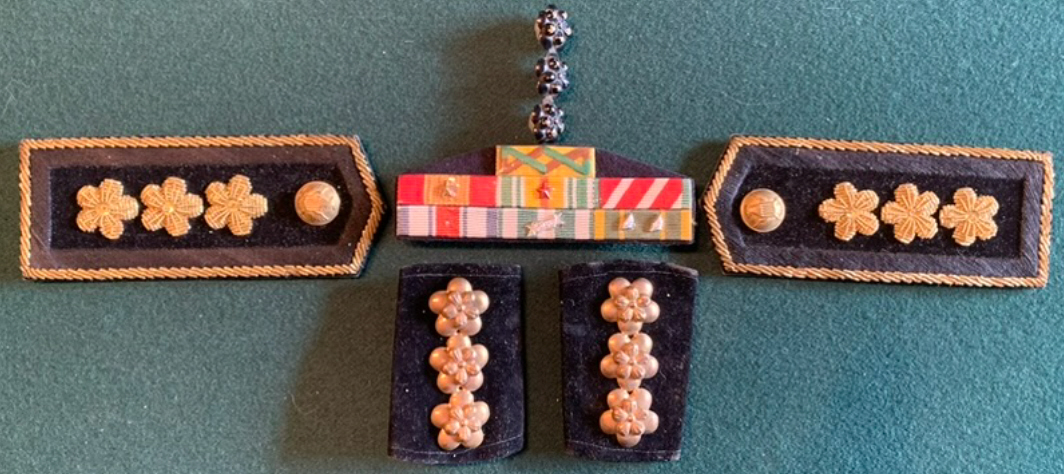
He took his rank insignia and his ribbons off his uniform and he gave them to me with a handshake during a brief emotional departure. I had the feeling he would be dead in a few months. My recent photo of his various rank insignia and ribbons follow.
In 1981, I was surprised to receive a letter addressed to me and it was from Tai; I had no idea how he found my address. He said that over many months and through a serendipitous route, he got back to Vietnam and found his family.
Somehow he was able to get them out of the country and he was writing me from Paris, France where he was working in an automobile factory. He asked me for my assistance in getting him and his family into the United States.
That started a long saga over several months of me trying to find a way to help Tai.
The State Department was a problem; they said unless he had family in the United States that was willing to sponsor him, he could not enter. I checked with church groups that were sponsoring Vietnamese and they could not help.
Along the way I had offered to sponsor Tai and his family to get them into the United States and that was not allowed; I was not family.
During this time I exchanged several letters with Tai explaining what was happening but in the end I had to tell him I could not make it happen. After that, I lost touch with him and have not heard since.
Fast forward to Afghanistan.
After fighting in Afghanistan for ~20 years, a condition-based plan was established by the administration in 2020 to systematically withdraw from Afghanistan, ultimately leaving ~3500 troops in country and keep control of Bagram Air Base.
That plan was ignored by the next administration which decided to pull all of our troops out on 30 August of 2021, resulting in the greatest military debacle in our lifetimes and the repercussions from that still resonate today.
In addition to the 13 deaths of U.S. service members, there were unknown numbers of Afghans left behind who supported the U.S. that were tortured and/or killed after our humiliating withdrawal.
Billions of dollars of U.S. military equipment was left with the Taliban to distribute widely to various terrorist groups. Around 120,000 Afghans were allowed to enter the U.S. but almost all were unvetted with their allegiance unknown.
There is a common political denominator between the fall of Saigon in 1975 and the defeat in Afghanistan in 2021—that is Joe Biden.
Betrayal 1: As a junior senator he voted against proposals for funding support of South Vietnam including “The Vietnam Contingency Act of 1975”.
Regarding refugees, he said on 23 April 1975, “I do not believe the United States has an obligation, moral or otherwise, to evacuate foreign nationals. … The United States has no obligation to evacuate one, or 100,001, South Vietnamese.”
Betrayal 2: It was his decision to ignore the tactical and strategic conditions in Afghanistan and instead pick a date on the calendar to be out of country resulting in the debacle.
His decisions and actions involving both Vietnam and Afghanistan had long term strategic consequences both domestically and internationally which still reverberate today and have a major long term impact on the geopolitical environment.
We won the war in Vietnam militarily, but lost it politically. Again in Afghanistan, our military performed magnificently but politically it was lost.
This is the story of political betrayal.
Joe Arbuckle
Major General
U.S. Army (retired)

Leave a Comment