
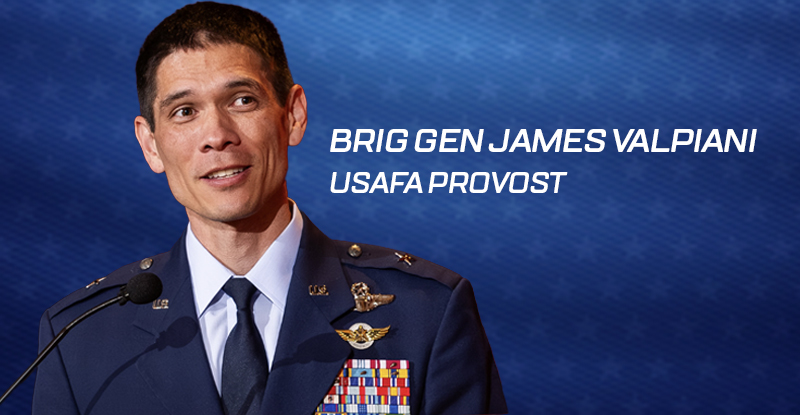
Remarks given by USAFA Provost/Chief Academic Officer Brig. General James Valpiani at today’s BOV meeting:
Good afternoon, Chairman and Representative Pfluger and the members of the Board of Visitors, as well as the ladies and gentlemen attending virtually from the public.
My name is General James Valpiani, and it’s a pleasure to serve here at the Air Force Academy as the Chief Academic Officer.
On this slide are two new phrases since the last time that I had an opportunity to brief you all. The first is academic wing, and the other is provost. Those are unusual terms here at the Air Force Academy, so the first update I’d like to provide you is where those terms come from and why.
This slide shows you the new organizational structure that we’ve put in place since the last Board of Visitors meeting. The academic wing structure really comes from what the senior leadership of the Air Force Academy identified as an opportunity to enhance the education that we provide here and drive it towards the integrated multidisciplinary focus that we need in order to tackle increasingly complex problems of modern war and peace.
Rep. Pfluger, you mentioned some of those in your opening remarks, and I’ll talk a little bit more about that as we get into the superintelligence portion of the briefing.
But the key point here is that it was necessary from a structural perspective to bring together a number of our different disciplines so that they work together, they live together, and most importantly, teach the cadets how to think together across the different boundaries, which in general are artificial boundaries that exist in higher education.
Previously, we had 20-plus departments that were individual direct reports to the formerly known as the Dean of the Faculty. The opportunity that we identified was to create schools of integrated studies. You’ve got the School of Integrated Engineering Sciences, the School of Integrated Basic Sciences, and the School of Integrated Humanities, Arts, and Social Sciences, each of which is led by a dean, and underneath which are the departments that pertain to those different domains of study.
Then most importantly, we have a School of Integrated General Studies, and that’s the one that’s near and dear to my heart. That’s where we have placed responsibility for the entire core curriculum we provide here. on the order of 90 to 100 core credit hours, which is the common education of all officers that graduate from this institution.
Much like basic training, much like boxing and other elements of, you know, jumping off the 10-meter here, these are the iconic elements of our 47-month education that every cadet undergoes.
Previously, the core curriculum was really distributed across these 20 departments in such a way that there was very little harmony very little coordination across. So cadets would routinely jump from one course to another without a whole lot of understanding of why they were taking these courses or how one related to another.
We think it’s—especially in this modern era of rapidly accelerating technological change—incredible complexity of modern warfighting, that they be able to habitually think across disciplines.
So the School of Integrated General Studies is our visible commitment to providing that kind of integrated, mission-aligned education. We’re very excited as we’ve built this structure to now move towards the curriculum that will form our future officers, which is what the next slide is about.
So on the next slide, you’ll see three main lanes that constitute our core curriculum: humanities, arts, and social sciences; STEM; and a very strong thread of superintelligence; and then warfighting.
In general, our humanities, arts, and social sciences focus as we rebuild the core curriculum will be oriented on helping the cadets to understand where it is that the commitment that they have made to the Constitution comes from, grounded in our Western civilization.
And moving forward to the modern day, and what it means to defend the Constitution, why it’s worth defending, the fragility that our Constitution has, and the renewal that we must make in every generation to be a self-governing republic.
That entire education is designed to give them that focus, but also to then turn that same attention to detail and holistic way of thinking towards other nations, whether allies or potential competitors, so that we understand, you know, the environment that we’re operating in, ideally to prevent war and to sustain peace, but if necessary, to utterly dominate in conflict.
Humanities, arts, and social sciences focus will now be a deeply integrated education focused on preparing them for the humanistic elements of warfare. In the STEM and SI components, historically, cadets have taken about 5 engineering courses and 4 science courses, and they look— they’re fairly conventional as it looks or as it appears at other colleges and universities.
But our objective is not necessarily to make our cadets excellent in aeronautical engineering, astronautical engineering, mechanical engineering. The vast majority of them are not going to serve or even major in those domains. What we really want them to understand is how those elements come together in order to design, develop, operate, maintain, and employ the world’s finest technologies, the world’s most capable warfighting machines and technologies.
We are reforming the STEM and SI component around an integrated engineering and an integrated science program so that they work through the scientific process, they work through the engineering process hands-on in air domain, in the space domain, in the cyber domain.
They really get a hands-on understanding of what engineering and science is rather than piecemeal introductions, 101 courses to a bunch of relatively unconnected disciplines. And then finally, in the warfighting domain, we’re moving from one course focused on trying to bring together aerospace and cyber at the tactical, operational, strategic level into a sequence of courses.
We’re expanding the warfighting education so that this institution, where we have the privilege of 47 months with these cadets, really provides them a mental model in which they can see how air, space, and cyber effects work together to achieve national strategic objectives in a way that is very difficult in other commissioning sources just due to the lack of time and focus of those other institutions.
We are looking to build out a robust warfighting sequence deeply focused on hands-on education using modern simulation tools drones, Rep. Pfluger, to your previous discussion, in order to ensure that our cadets leave here air-minded, cyber-minded, space-minded, and not just in a theoretical way, not just on paper, but in a way that they’re getting real feedback in high-fidelity simulation and live practice. Very excited to bring that core curriculum together. We’re targeting next fall to roll out the first year of that education.
The next slide shows a focus that I think is of particular interest to the Department of War and to the Department of the Air Force. That’s how it is that we are preparing our officers to be prepared for a world in which superintelligence touches everything that we do.
My objective and the objective I’ve set for the faculty is to be the world leaders in developing curriculum and preparing our graduates for that future, to be masters of superintelligence, even as we focus on academic excellence policies that ensure that they have really solid foundational grasp of the concepts that we’re teaching here without the aid of superintelligence, both-and proposition.
Here’s an example of how we’ve made progress just in the last several months on threading through what we believe to be leading curriculum, leading focus on how superintelligence comes to bear on the profession of arms. So, on the left-hand side, you see an aerodynamics spreadsheet. This has been the state of the art here at the institution for a number of years. It’s how cadets in our core class, as well as in some of the design classes, think about taking commander intent and turning it into an aircraft, a design that they can ultimately either 3D print or in in the Air Force contract with performers to develop.
That process is slow. It relies on a lot of rules of thumb that are not perfect, and it involves multiple different disciplines working back and forth in a sequential fashion. It’s what accounts for why the equipment that we purchase today, which is truly exquisite, is also extremely expensive and takes forever to develop because we are trying to do so many different things in the minds of many different people in sequence.
Superintelligence allows us to go much faster, to bring together high-fidelity tools rather than low-fidelity tools, and to bring them into conversation with each other across disciplines. We worked with a couple of teammates across industry this summer, and in the middle picture you’re looking at, it’s the same underlying logic, but elevated to a higher degree of fidelity and turned into an environment in which cadets can design an aircraft from commander’s intent in 10 minutes.
In what used to take an entire month, and that has now been deployed in the curriculum as of this semester. At the same time, those tools now that allow us to develop high-fidelity solutions, we can apply superintelligence to, and we can do it across domains.
So the 3rd picture you’re seeing there is the design of the outer mold line of an aircraft to optimize its radar cross-section. And normally that’s a very complex task, and it’s done in a silo relative to aerodynamics. We’ve brought those 2 things together and employed superintelligence techniques so that the cadets are designing not only the outer mold line to solve aerodynamic problems, but at the same time optimizing its stealth characteristics.
Again, this is just the beginning of what we see as a transformation that will allow us to go further developing agentic solutions to control these aircraft in simulated environments and really showing our cadets what it looks like to develop design for the future fight at, you know, using the latest capabilities that superintelligence provides us.
This was a question that came up from the Board of Visitors in the last visit. I just wanted to provide a quick update. In FY20, the NDAA amended the U.S. Code to allow civilian faculty at military schools, including USAFA, to own copyright and scholarly work. There was an inquiry from the Board of Visitors previously, but I just want to highlight that we are postured to move forward with that capability.
There are a number of intermediate guidance documents that need to be published at the Department of War and Department of the Air Force level in order for us to finalize that capability. We’re a little bit farther behind inasmuch as it concerns military faculty and their ability to own copyright and scholarly work. But in any case, I’m happy to answer questions after, but I just wanted to provide an update that we are ready to move forward with that capability.
There’s some intervening policy that needs to be developed within the department first. So with that, it’s a pleasure to have had a chance to give you a quick update on the academic wing and where we are headed.






Leave a Comment