

By Major Donald E. Vandergriff, USA ret | From his Substack
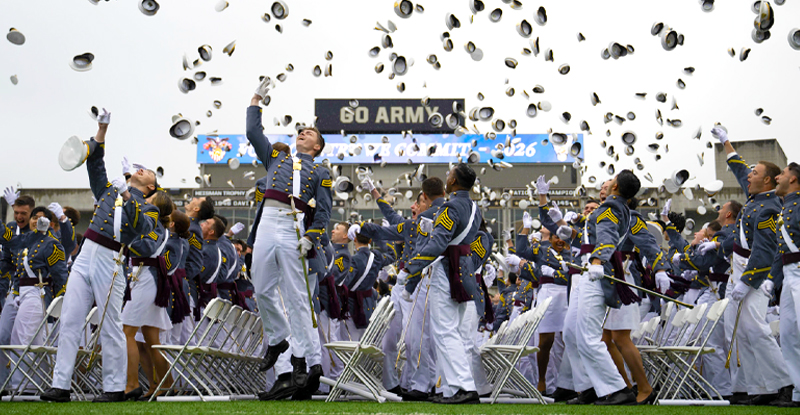
I watched Secretary of War Pete Hegseth’s May 23, 2026, commencement address to the United States Military Academy Class of 2026 at Michie Stadium with great appreciation.
Delivered in pouring rain to future Army leaders, the speech was a powerful, unapologetic call to restore the warrior ethos, merit, unity, and combat readiness.
It aligns closely with the reforms I have advocated for over three decades in my writings on Maneuver Warfare, Mission Command, and the framework of Generations of War.
Secretary Hegseth congratulated the graduates and told them: “We’re sending you to lead, we’re sending you to forge warriors, and we’re sending you, perhaps, to war—and you are ready.”
He celebrated the U.S. Army surpassing its FY2026 recruiting goal of over 61,500 soldiers four months early for the second consecutive record year.
He emphasized high physical standards (“You are fit, not fat”), accountability, and a battlefield where “the battlefield does not grade on a curve, and you can’t throw your pronouns at the enemy.”
He declared, “Diversity is not our strength. Unity is our strength,” and rejected efforts to turn West Point into “woke Princeton.”
He affirmed that the “woke era is over” and promised “top cover” for leaders who prioritize lethality and mission over bureaucracy or likability.
The speech closed with a stirring invocation of “Duty, Honor, Country.”
The Rejection of Cultural Marxism: Restoring Organizational Health
A key underlying strength of Secretary Hegseth’s address is its implicit and explicit dismissal of Cultural Marxism—the ideological framework that has infiltrated institutions, including the military, through identity-based division, equity-over-merit policies, and critical theories derived from the Frankfurt School and related thinkers.
Both Secretary Hegseth and President Donald J. Trump have actively opposed and worked to dismiss these influences, recognizing them as corrosive to American institutions.
Cultural Marxism, in practice, destroys organizations by prioritizing group identity and grievance narratives over shared purpose, individual excellence, and objective standards.
It fragments cohesion by framing people as perpetual oppressors or oppressed, eroding trust, mutual respect, and the willingness to take risks.
Most of all it diminishes or eliminates accountability for standards, as well as taking responsibility or ownership for decisions. This directly undermines Mission Command, which depends on decentralized execution grounded in deep trust between leaders and subordinates.
When identity politics and compliance with ideological checklists replace merit and character, initiative atrophies, risk aversion increases, and the psychological safety required for subordinates to act aggressively within commander’s intent evaporates.
Similarly, it cripples Maneuver Warfare, which relies on rapid tempo, surprise, and the shattering of enemy cohesion through adaptive, decentralized actions.
A force divided by internal identity factions cannot generate the shared understanding, unity of effort, or moral cohesion needed to operate inside an adversary’s OODA Loop.
Cultural Marxism substitutes political loyalty and narrative control for combat effectiveness, turning units into bureaucratic entities focused on internal signaling rather than external victory.
By rejecting these practices, Hegseth and the Trump administration are clearing the path for genuine reform—restoring the human-centered foundations essential for success in 3rd and 4th Generation Warfare.
Why This Speech Matters for Maneuver Warfare and Mission Command
As someone who has long pushed for a cultural and doctrinal shift away from Industrial Age, centralized, attrition-based models (2nd Generation Warfare), I see Hegseth’s address as a strong endorsement of the human-centered approach required for success in modern conflict.
Maneuver Warfare focuses on generating superior tempo, exploiting enemy weaknesses, and shattering their cohesion through decentralized action, surprise, and rapid decision-making rather than sheer firepower or mass. Hegseth’s call to forge adaptable warriors who can operate in ambiguity directly supports this.
Mission Command (Auftragstaktik) is the command philosophy that enables Maneuver Warfare. It rests on clear commander’s intent paired with trust in subordinates to execute aggressively within that intent. Hegseth’s rejection of risk-averse, compliance-driven culture creates the conditions for true Mission Command.
In the Generations of War framework, victory increasingly depends on mental agility, cultural cohesion, and leaders who can operate inside the enemy’s OODA Loop. Hegseth’s emphasis on unity, merit, and lethality helps rebuild the moral and intellectual capital essential for these higher generations of conflict.
Recommended Reading from My Substack
For those seeking deeper practical guidance, I recommend these pieces:
- “Parallel Evolution” to move DoD to Maneuver Warfare and Mission Command — This series outlines concrete steps to evolve our institutions, personnel systems, and training toward adaptive, human-focused doctrines.
- Donald E. Vandergriff, Adopting Mission Command: Developing Leaders for a Superior Command Culture (Annapolis, MD: Naval Institute Press, 2019).
- Donald E. Vandergriff, “‘Parallel Evolution’ to move DoD to Maneuver Warfare and Mission Command,” Donald Vandergriff Substack, May 5, 2025,
- Donald E. Vandergriff, “From Attrition to Adaptation: Reforming U.S. Military Culture for the Generations of Modern War,” Donald Vandergriff Substack, October 28, 2025, https://donvandergriff.substack.com/p/from-attrition-to-adaptation-reforming.
- Donald E. Vandergriff, “Answering SES Stuart Scheller’s First Question in Social Media,” Donald Vandergriff Substack, May 2, 2025,
- Donald E. Vandergriff, “Vandergriff Analysis of LTC Darrell Fawley’s ‘Battle in the Fog’,” Donald Vandergriff Substack.
My broader body of work, including Adopting Mission Command: Developing Leaders for a Superior Command Culture (Naval Institute Press, 2019) and contributions to The New Maneuver Warfare Handbook, provides the intellectual foundation for the kind of force Hegseth is helping to rebuild.
ENDNOTES
- Pete Hegseth, “Commencement Address at the United States Military Academy,” West Point, NY, May 23, 2026. Video available at
Key themes include warrior forging, merit, unity over diversity initiatives, and battlefield realities.
- Donald E. Vandergriff, Adopting Mission Command: Developing Leaders for a Superior Command Culture (Annapolis, MD: Naval Institute Press, 2019). This book details the philosophical roots and practical implementation of decentralized command culture.
- Donald E. Vandergriff, “‘Parallel Evolution’ to move DoD to Maneuver Warfare and Mission Command,” Donald Vandergriff Substack, May 5, 2025, Discusses systemic transformation beyond technology to human and cultural factors.
- Donald E. Vandergriff, analysis linking personnel reform to support for Maneuver Warfare and Mission Command cultures, Donald Vandergriff Substack, May 2, 2025.
- William S. Lind and Donald E. Vandergriff, frameworks on Generations of War, as applied in various Substack analyses of contemporary conflicts.
- Hegseth address, May 23, 2026, noting Army recruiting successes and rejection of ideological distractions in favor of lethality and cohesion.
- Pete Hegseth, remarks on Cultural Marxism and its impact on military institutions, as detailed in Heritage Foundation addresses and his book The War on Warriors (2024), linking identity-based ideologies to eroded cohesion and standards.
- Donald E. Vandergriff, discussions on DEI and Cultural Marxism’s influence on military readiness, The Sentinel podcast with LTC Asad “Genghis” Khan (Ret.), 2025, and Substack posts addressing how such ideologies undermine trust essential to Mission Command.
- President Donald J. Trump, speeches and executive actions opposing Cultural Marxism and related “woke” policies in government and military, 2019–2026, including critiques of identity politics as divisive and contrary to American unity.
- Michael Gonzalez, “How Cultural Marxism Threatens the United States—and How Americans Can Fight It,” Heritage Foundation Special Report, 2023 (updated analyses through 2025), explaining mechanisms of institutional division through oppressor/oppressed frameworks.
- William S. Lind, contributions to understanding Cultural Marxism as a form of 4GW aimed at internal societal disruption, applied to military contexts in joint works with Vandergriff.
- Hegseth, West Point speech, May 23, 2026, explicitly rejecting “woke” transformations and affirming merit and unity, consistent with broader administration dismissal of Cultural Marxist influences.
This speech represents a positive, overdue reorientation toward what truly wins wars: cohesive, competent, adaptable leaders empowered by trust and focused on mission.
By confronting divisive ideologies head-on, Secretary Hegseth and President Trump are enabling the doctrinal and cultural evolution I have long championed.
I am encouraged by this direction and stand ready to support the continued evolution of our force through the principles of Maneuver Warfare and Mission Command.
Duty, Honor, Country.
Donald E. Vandergriff
Major (Retired), U.S. Army
Author, educator, and advocate for military reform.




Leave a Comment