
Another reason not to have transgenders in the military.
(Health & Human Services) The U.S. Department of Health and Human Services (HHS) today released a commissioned study that found individuals who believed in radical gender ideology were more likely to hold left-wing authoritarian beliefs and believe political violence is justified.
The same study found individuals who held left-wing authoritarian views were more likely to justify political violence.
The preregistered survey of 1,208 U.S. adults found that stronger endorsement of so-called “gender-affirming” clinical positions was substantially associated with higher levels of left-wing authoritarianism, including after accounting for political identity and age. Both measures were also associated with greater justification of political violence across six scenarios.
“This study raises important questions about what happens when ideology is given the authority of medicine,” said Admiral Brian Christine. “The association between sex-rejecting clinical beliefs, authoritarian attitudes, and the justification of political violence warrant serious scientific scrutiny. HHS will continue to pursue rigorous research that examines these relationships and gives the American people the evidence they deserve.”
To conduct the HHS-commissioned study, researchers from Rutgers University, the Manhattan Institute, and the Network Contagion Research Institute developed a Clinical Gender Affirmation Scale (CGAS) based on positions derived from guidance issued by the American Psychological Association, American Psychiatric Association, World Professional Association for Transgender Health, and American Academy of Pediatrics.
The scale measured endorsement of five positions related to “transgender identity,” names and pronouns, and parental support.
According to the study, people who scored higher on left-wing authoritarianism were substantially more likely to consider political violence justified. That relationship remained after researchers accounted for how politically left-wing respondents identified.
The study also found that people who more strongly endorsed the sex-rejecting positions measured by the CGAS were more likely to justify political violence, even after accounting for political identity. That association was generally weaker than the relationship between left-wing authoritarianism and justification of political violence.
The authors propose that sex-rejecting beliefs may function as an ideological framework through which left-wing authoritarian tendencies become focused on specific perceived threats, outgroups, and forms of institutional action. They further propose that clinical and professional institutions may lend authority to a framework that identifies victims, sources of harm and responses to that harm, potentially providing people already disposed toward authoritarianism with moral justification for coercive or punitive action.
This study does not determine whether belief in radical gender ideology contributes to authoritarian attitudes or vice versa, nor whether an outside factor may contribute to both predispositions. The authors call for experimental research to test the proposed relationship.
The study also did not measure whether respondents committed or intended to commit political violence. It measured how justified respondents considered six hypothetical or described acts of political violence. The findings therefore establish associations with the justification of political violence, not violent behavior.
The full study, Where the Clinic Meets the Movement: Does Gender Ideology Arm Left-Wing Authoritarian Psychology? is available here.
REPORT: Does Gender Ideology Arm Left Wing Authoritarian Psychology? (pdf)
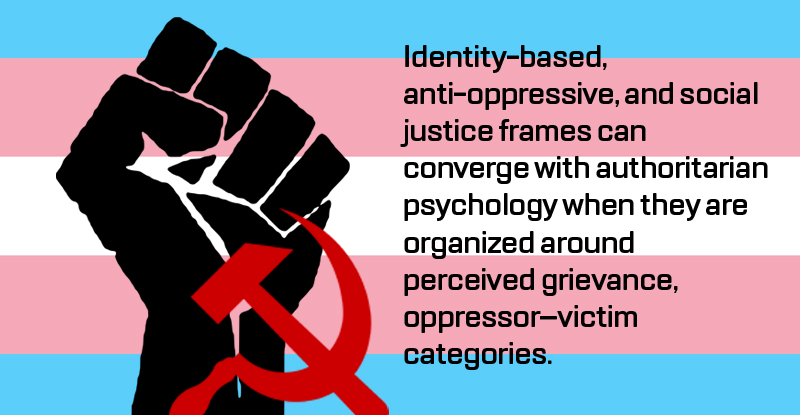
. . . . A growing body of research suggests that identity-based, anti-oppressive, and social justice frames can converge with authoritarian psychology when they are organized around perceived grievance, oppressor–victim categories, prejudice toward “privileged” groups, restrictive speech norms, or punitive justice-seeking.
Studies of left-wing identity politics find that perceived grievance, identity-based ideology, prejudice toward groups perceived as privileged, and social justice attitudes are positively associated with LWA (Fasce & Avendaño, 2025; Love & Sharman, 2025).
Previous research documents evidence that anti-oppressive ideological framing (critical theory) can sometimes serve this content-package function.
Related work finds that postmodern or critical-social-justice-adjacent beliefs predict left-wing authoritarianism (LWA) and general, and that high-LWA individuals show greater support for restrictive political-correctness norms even after controlling for ideology (Conway et al., 2023; Deverson et al., 2025).
Finally, broader research on perceived victimhood, moralization, and political violence suggests that identities organized around grievance, perceived victimization, and injustice, when paired with authoritarian or punitive dispositions, can predict support for anti-democratic or violent political action (Armaly & Enders, 2022; Mooijman et al., 2018; Nguyen et al., 2026).
Taken together, these literatures suggest a common mechanism: ideological content that names an oppressor class, certifies ongoing victimization, and locates remedy in coercive institutional or social action which may supply authoritarian psychology with morally justified targets. . . . .
Who could have possibly guessed?!?! 🤯 https://t.co/YT3DtcXypz pic.twitter.com/RbEmNSM4Vw
— Libs of TikTok (@libsoftiktok) August 26, 2026
Self mutilation and experimental hormones. What could go wrong? pic.twitter.com/6ewjS15sjo
— Overflow (@MoonLotion) August 27, 2026






Leave a Comment