
By Col. Bill Connor, USA ret
The Citadel, ’90
Chairman of the STARRS Board of Advisors
In 2017, November was declared “Veterans and Military Families Month.” Then, VA Secretary David Shulkin celebrated this milestone by explaining the importance of the declaration:
“Our Veterans and military families are an important part of our lives throughout the year, and by focusing (on it) …. we can more fully celebrate and recognize their contributions to the nation.”
Having grown up in a military family, and now a parent of an active-duty son, I want to give a personal perspective on why honoring particularly military families is so important.
Being from a fourth-generation military family, I had the experience of growing up on and around military bases during the 1960s, 70s and 80s.
In 1979, the movie “Great Santini” was released, and highlighted so many unique aspects of the military family life. At the start of the movie, the family woke up early to make a long road-trip to a new duty station. This brought back so many memories of the car trips with my family to new duty stations.
The movie showed the family singing in the car to pass the time, something I think all military families can remember. When the kids arrive at the new location, they had to quickly integrate themselves into an alien environment and make new friends.
In the movie, the servicemember father dies in an aircraft accident and the family must grit teeth and move on. Like the mother told her children “no tears” in public, as they were to do the crying in private. In my own case, my father deployed to Vietnam twice, with the family knowing the potential for life altering news. By God’s grace he returned, though severely wounded.
“Generation X” military kids had an even more unique experience. I remember my father and his fellow service members as primarily Vietnam veterans in the “new” all-volunteer military (starting 1973). Veterans and military families were, unfortunately, unpopular after Vietnam and poorly depicted by society.
This dynamic changed during the early 1980s under the Reagan administration. Ronald Reagan, similar to Trump, prioritized rebuilding the military throughout his two terms. The negative depictions of vets from First Blood and Deer Hunter were overturned by movies like “Top Gun” (1986). Military families were more honored.
Having been commissioned as an Infantry Officer in 1990, married in 1991 and deploying to the Middle East, I experienced the turnaround firsthand. Returning from deployments in uniform meant hearing the ubiquitous refrain of “thank you for your service.”
During the post 9-11 wars in Iraq and Afghanistan, America continued the more laudatory treatment of the military and veterans and military families. I can still remember returning from Afghanistan in fatigue uniform in the Atlanta Airport and someone announcing our return to cheers of civilians. Unlike with the negative public sentiment directed at the military after the withdrawal from Vietnam, the public did not turn on veterans or families even after the catastrophically botched withdrawal from Afghanistan. The nation properly blamed the administration.
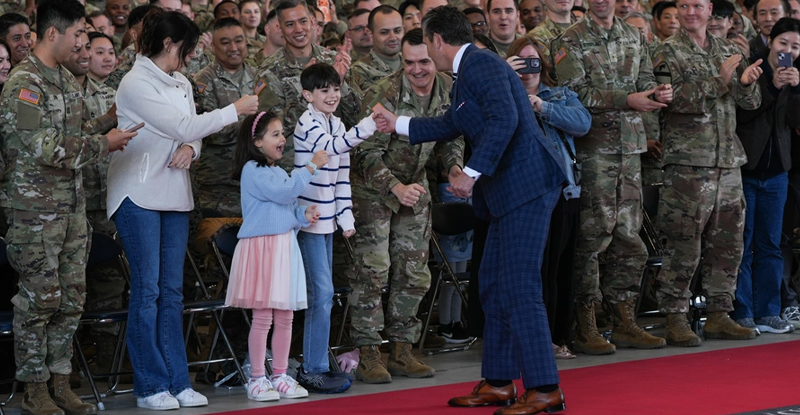
America owes military families for their sacrifices of moving around the nation (and world), going through long separation from military family members, and living with the daily anxiety of catastrophic news.
Beyond what we owe for altruistic reasons, honoring military families is in our national interest. The United States military truly is a “family business.”
Most potential recruits, officers and enlisted, come from military families in our all-volunteer military. Many military families are like mine, in which service goes back over a century, and the children are predisposed to do their part.
Most of our great military leaders were from military families and then raised future recruits. For example, General Patton’s grandfather was a Civil War hero, and his son became a Major General and hero of Korea and Vietnam.
During the Biden Administration, recruiting sunk to catastrophically low numbers and the worst recruiting numbers since 1973.
The reason is clear to all of us from the military “family business”: Military families saw the “woke” ideology being forced on the military by ideological progressives pushing a political agenda under Biden.
They saw the undermining of the traditional military meritocracy, leaders demanding racial and sexual quotas, the “extremist stand down” after Biden took office (to search for non-existent white supremacists).
Military families saw the administration pushing transsexual service and demanding sexual deviance, like drag queen shows, be accepted on bases and ships.
They saw leaders like General Mark Milley advocate for Critical Race theory being taught at West Point and voicing a desire to know about “white rage.”
All this while suppressing the Warrior Ethos.
Under Trump, this has all been reversed. The result is that recruitment has flipped to historically high levels. Military families have gone back to encouraging service by their children again.
Joshua was God’s ultimate warrior leader when the Hebrew people came into the promised land.
At one point, Joshua saw his people begin to veer off the wrong path they had been on during military victories. Joshua told the Hebrews they must choose between going off course with foreign “gods” or following the one true God, Yahweh and what brought victory. Joshua described the rock solid unity of family (house) to following the right direction “As for me and my house, we will serve the Lord.” Joshua 24:15
While military families support America, let us honor them.
_
Colonel Bill Connor (U.S. Army, ret.) served for three decades as an Infantry officer, including service as the Senior U.S. Military Adviser to Afghan Forces in Helmand Province, Afghanistan. A Distinguished Graduate of the U.S. Army War College, Bill is a book author who has published numerous defense related articles nationally and internationally. He is now an attorney and law firm owner and the recipient of South Carolina’s highest award, the Order of the Palmetto
First published in Real Clear Defense



Leave a Comment