
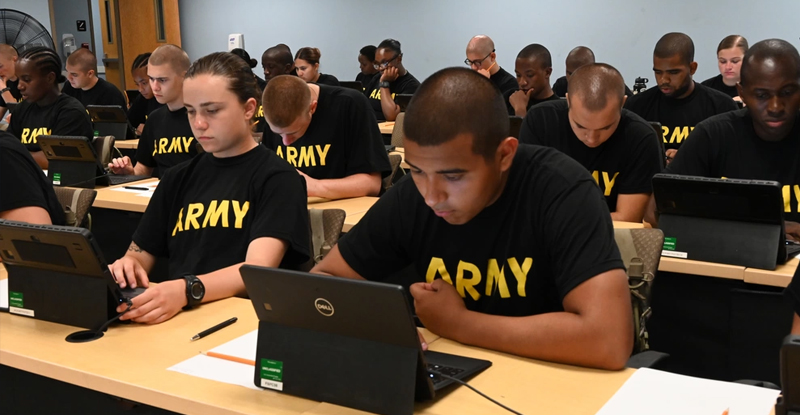
A number of STARRS Directors and Advisors weighed in on an article on Military.com originally published in March 2025:
U.S. Army losing roughly 25% of soldiers before completing their 2 year term
The Army is grappling with a staggering attrition rate among newly enlisted troops, even as recent recruiting figures suggest the service is clawing its way out of a yearslong enlistment crisis. Nearly one-quarter of soldiers recruited since 2022 have failed to complete their initial contracts, according to internal Army data reviewed by Military.com. While the Army’s recruiting totals look solid on paper, a high dropout rate raises serious doubts about whether those numbers are an accurate portrayal of how well the service is manned. . . . (read article)
STARRS Vice Chairman-at-Large Maj General Joe Arbuckle, USA ret:
I don’t see how this is sustainable. Only 23% of the eligible population can meet basic qualification standards and only 9% of the 23% show any interest in enlisting in the military.
Of those who do enlist, only 8% have “clean enlistments” without waivers. Roughly 25% go to pre-boot camp to enable them to qualify for the real boot camp. In total, 20-25% of enlistees leave the Army within the first 2 years before they ever get firmly planted in their first unit to undergo unit training to become productive, fully capable team members.
The article rightly says this is a reflection of the condition of our society. What is does not talk about is the tremendous dollar cost of this turbulence plus the leadership and readiness implications. The pre-boot camps add greatly to the normal staffing levels required by a normal boot as the both the pre and regular boot camps must be staffed by NCOs and officers taking them away from other assignments. Add to that, when a marginal graduate from basic and AIT reports into his (generic) unit they fill a TOE slot in the unit; 25% of them bail out at 2 yrs or less before they are trained to proficiency, leaving an open slot in the unit that must be then filled by another newbie that must be trained by NCOs. That kind of turmoil has a direct readiness impact and leadership challenges, not to mention opportunity costs.
The Vietnam draft was for 2 yrs-—2 months boot camp, 2 months AIT, 1 month leave, ~6 months in a unit, 12 months likely in Vietnam, 1 month on leave and then out. The turbulence was bad but at least the draftees were physically capable and it did not require pre-boot camp staffing to make it work. That situation was more tolerable than what we are experiencing today.
Aside: I came into the Army as a private E nothing and we had a big mix of draftees and volunteers in Basic/boot and AIT. There were many college grads like me and others just out of high school from all races and backgrounds. It was not pretty, but it worked for the need at the time. A draft today would not work the same way with only 23% of the population able to meet very easy entry standards.
We are in trouble, this is not sustainable in my view.
STARRS Board of Advisors member Drew Dix, US Army MOH
Joe, I may have missed something but what is the primary reason new recruits leave the service before two years?
Are there consequences for leaving? Do they receive benefits? Seems odd to me.
We have two issues:
One is recruiting from a soft, unfit pool of recruits that aren’t fit for the rigor’s of military service. We don’t develop young men and women to deal with adversity.
The other is keeping them in once recruited. We need to a better job motivating them to accept the challenge. That’s leadership. Current leaders must work harder at bringing them in to the true “warrior” fold. Once they do that, they’re in to stay. What ever they are doing now is not working. We’ve got to change soon. Every recruit that leaves the service early makes it even more difficult to overcome the negativity back home.
My guess is we’re giving them too much up front. We call them warriors before they are warriors. Then make it easy for them to go home.
You’re right Joe, it’s not sustainable as it is but it can change with leadership.
STARRS Board of Directors member former Chief Master Sergeant of the Air Force Rod McKinley:
This is a real problem.
— Are we recruiting the wrong people
— Is our leadership failing to mold them into our military way of life
—is it drugs
—Minor disciplinary infractions
—Committing crimes
—Failure to make and maintain standards
—Medical issues
These are some of the issues I see for getting out before completing two years of service.
No matter the reason, it is very costly. By the time we recruit them, send them through MEPS, Basic Training, and then their technical schools, we already have a couple hundred thousand dollars invested in them. This is before they complete any work in their jobs. Losing them creates a bathtub effect in the recruiting and retention efforts.
Hopefully they get this figured out and soldiers can at least finish their first term of service honorably.
STARRS Board of Advisors member Dr. Lani Kass:
All good questions. Even when recruiting is good, it’s like pouring water into a leaking bucket.
Joe, agree 1000%. That’s why merely looking at enlistment rates in a bad economy is meaningless. I’d add that during the Vietnam War, 99% of the draftees were single. Today’s volunteers are married with children.
I remember our son telling us that he was spending more time on domestic violence and child neglect than on training in his first Armored Cavalry command at Ft Stewart. Of course, this fact had second and third order implications—from soldiers on food stamps, facing food insecurity, to expenses for child care, housing, health care, etc. etc. Lots of single mothers in uniform are unable to deploy because they don’t have childcare arrangements. That obviously adds to the turbulence.
Totally unsustainable.
STARRS Vice Chairman-at-Large Maj General Joe Arbuckle, USA ret:
Excellent points Lani. Young married families and single parents create serious leadership issues for commanders at the 03 and 05 levels—especially when deployed on long or even short tours.
The all volunteer military works well as long as our society can produce a viable number of recruits, but we know that is not happening. Two possible solutions: one is a draft which would still produce the fat, physically unfit, unmotivated, members of society. The other is continuing what is being done with the pre-boot camp type training but beefing it up with adequate budgets and cadre end strength increases approved by congress to support this added mission to the Army/DOW.
Perhaps add a robust/expanded Jr ROTC program in high schools to attract the kind of young people needed to enlist—start earlier upstream to help fix the problem. Perhaps recall to active duty adequate numbers of retirees (who still fit into normal uniforms) to help lead such programs in high schools as stepping stones into the military.
Draft or not, congress needs to face this problem and resource what is needed to get new troops spun up to a physical and education level needed to succeed. Also, the military needs to challenge and motivate them to remain in the military. Maybe there are other solutions—in any case this is not easy and the solution begins with addressing the problem.
During our STARRS staff meeting today, we discussed developing a position paper to address the unsustainable recruiting and retention issue. Use that paper as a start point to put a spotlight on the problem. Bottomline: this is unsustainable and the military cannot fix society’s problems (education and physical fitness)—help is needed at least with budgets and staffing levels.
STARRS Board of Advisors member Dr. Lani Kass:
I’m all for the JROTC idea. Somehow we need to reverse the notion that children of the elites don’t serve in the military.
I think reinstating the draft is a non-starter—short of WWIII.
It’s a national security issue of the first order.
STARRS Board of Directors member former Chief Master Sergeant of the Air Force Rod McKinley:
We have the largest JrROTC in America where we live. Clover high school has 450 students in JrROTC. I a huge fan of it and have spoken at several different schools.
One huge problem is we underfund them and they struggle. They are a tremendous pipeline but also keep kids on a great track and out of trouble. They also teach the cadets to fly and get a pilots license. They have won marksmanship and drill awards also.
Imagine this in many more high schools.
STARRS Board of Advisors member Dr. Lani Kass:
There’s a single high school in Arlington with Space Force JROTC. It’s definitely not the best school in Arlington County.
There are a few high schools with Air Force and Army JROTC in the much larger Fairfax county—all in disadvantaged areas, with underperforming high schools. Meaning, the kids of the elites—those running the government and elected/appointed officials—don’t ever get a chance to taste JROTC—even indirectly, by interacting with someone who is in it. Why are we only targeting underperforming/ failing high schools? That almost by definition (and intent?) makes the military the employer of last resort and skews minority representation.
Who decides which high school would get the program and based on what criteria? Who tracks the ROI—how many JROTC graduates actually volunteer to serve? I found nothing on line, but will dig deeper.
I’m thinking JROTC should be available in every single high school across the country. Our military must represent society—not in the idiotic DEI sense of race, but real demographics: urban, suburban, rural, rich and poor, high performing and not.
I also know ROTC programs have been severely cut over the past few decades—especially in the Northeast. Even when our middle son was in college, there was a consortium of ROTC in the metropolitan area: Howard University had Air Force, GW had USN, Georgetown had Army, etc. Since he transferred from JMU to American University in his junior year, the only option to continue USAF ROTC was at Howard. He didn’t last long as the only white kid.
Something is broken here and we need to fix it.
The Army Is Losing Nearly One-Quarter of Soldiers in the First 2 Years of Enlistment
By Steve Beynon | Military.com | March 7, 2025
The Army is grappling with a staggering attrition rate among newly enlisted troops, even as recent recruiting figures suggest the service is clawing its way out of a yearslong enlistment crisis.
Nearly one-quarter of soldiers recruited since 2022 have failed to complete their initial contracts, according to internal Army data reviewed by Military.com. While the Army’s recruiting totals look solid on paper, a high dropout rate raises serious doubts about whether those numbers are an accurate portrayal of how well the service is manned.
It remains unclear why the Army is losing so many soldiers, but one explanation could be the declining quality of its recruiting pool. One-quarter of all enlistees last year had to go through at least one of the Future Soldier Preparatory Courses, which were set up as a sort of silver bullet for recruiting woes — getting applicants up to snuff with academic or body fat enlistment standards before they ship out to basic training.
The military’s recruiting challenges have largely centered around finding young Americans eligible to serve, a pool that the Pentagon has estimated at only about 23% of 17- to 24-year-olds. One senior Army official with direct knowledge of the service’s recruiting efforts said only about 8% are eligible for a so-called “clean enlistment,” meaning the recruit didn’t need any waivers or have to attend a prep course.
“If this is the new normal, we’re taking in a whole quarter of the Army that isn’t hitting the standard,” Gil Barndollar, a senior research fellow at the Center for the Study of Statesmanship, said in an interview with Military.com. “The bigger question, though, is a human capital problem. If we have a crisis and we need a lot of people, what is the state of the nation? We’re looking at a country which by a lot of metrics — physical ability, cognitive ability — all those numbers are going in the wrong direction.”
According to service data, roughly 25% of prep course soldiers do not make it through their first contract and wash out of the Army within the first two years of their enlistment. But even more strikingly, soldiers who do not attend the prep courses aren’t that much different — they have a 20% attrition rate.
The numbers give the first public glance at the prep courses’ success. Some service officials interviewed by Military.com noted the Army is in a difficult position and would come nowhere near meeting manning standards without those courses.
Here are the rates at which soldiers wash out of basic training:
- Soldiers who did not attend any prep course: 11.3%
- Academic track prep course: 15.3%
- Fitness track prep course: 16%
- Soldiers who attended both prep courses: 18.7%
“I don’t know what an acceptable attrition rate is, but we have to meet people where they are,” the senior Army official told Military.com. “The quality of new soldiers is an enormous problem we’re paying for. But that’s just where the country is.”
Moreover, the Army has more than doubled the number of waivers it grants to new recruits, from 8,400 in 2022 to 17,900 last year. Many of those are medical waivers.
That increase is largely attributed to MHS Genesis, a new centralized medical records system that gives the military unprecedented access to applicants’ health histories. Some recruiters say the system is disqualifying applicants over minor injuries or past treatments, while others note a dramatic rise in teenage medication use and diagnoses for conditions like attention-deficit hyperactivity disorder, or ADHD.
The Army has also loosened restrictions on criminal backgrounds. Last year, the service granted 1,045 waivers for misdemeanor offenses, up from 895 in 2022. More strikingly, it approved 401 felony waivers — quadrupling the 98 granted in 2022. The Army prohibits waivers for crimes related to sexual violence.
“U.S. Army Recruiting Command remains committed to recruiting young men and women into our Army that are ready and qualified to join the most lethal fighting force in the world to ensure our nation’s security,” Madison Bonzo, a service spokesperson, said in a statement when asked about whether the Army is concerned that the quality of recruits is worsening.
On paper, the service started turning around its recruiting woes last year, bringing in 55,300 new active-duty troops against a goal of 55,000.
Additionally, it ended the year with a healthy surplus of 11,000 in the so-called delayed-entry pool, which will be counted in this year’s numbers. The significant pool of delayed enlistees is largely due to the Army having such a healthy recruiting year that it ran out of space in basic training units. The service is set to dramatically expand its capacity for basic trainees this spring.
“We’ve seen record numbers across the country,” Defense Secretary Pete Hegseth told Fox News on Wednesday, touting recent recruitment gains.
But the exodus of new enlistees begs the question: Does the extremely short turnaround make those recruiting wins meaningless?
The active-duty Army counts someone as a new recruit once they ship off to the Future Soldier Preparatory Course or basic training, meaning dropouts may not be reflected in data briefed to senior leadership or Congress.
In February, Military.com reported on Defense Department inspector general findings that the service might be skirting its own rules on recruiting, sending applicants to the prep course designed to help them meet body fat standards even though they were too overweight to even qualify.
The inspector general found about 300 applicants were turned away at the prep course for being too overweight — a figure that would nearly nullify the Army’s recruiting victory last year.
First published on Military.com



Leave a Comment