

By Buck Torske, retired Navy Chief Petty Officer
May 1st marked fifty-one years since I stood on the signal bridge of the USS Anchorage watching the coastline of South Vietnam recede as we steamed East. It was dusk and the sun was setting in the West on the final day of our war there.
It was called Operation Frequent Wind, the evacuation of the last of those who could, escape the victorious communist North Vietnamese Army. It was over and no longer a warring north and south, just Vietnam.
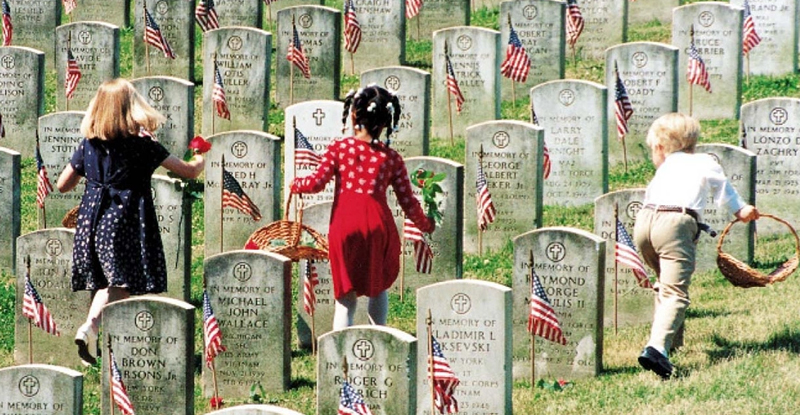
May 25th is Memorial Day friends and neighbors. It’s our day to commemorate the lost lives of the men and women who’ve given us their “last full measure” in service in that war; and all our wars and struggles against our enemies.
There’s a book, “No One Wants to be the Last to Die” about our most unfortunate conflict, our own Civil War, by Chris Calkins. The title tells us something we all ought to appreciate. Because for our soldiers, sailors, Marines, and airmen every war big or small; win, lose, or draw ends with one last sacrifice. Warriors who fade into obscurity, lost in the stark statistics of death to most everyone but their families.
Since the Revolutionary War 1,339,813+ Americans have given their all as tribute for our nation. That’s sobering if we give it any thought.
For readers in Jones County, Mississippi, keep this in mind: we’re a population of about 67,000 people. That means it’d take 209 Jones Counties to equal our combat losses. So I’d say this one day rates our thinking about it and acknowledging this day’s not about backyard BBQs, trips to the beach, or sales at department stores and car lots. Those are only the benefits we enjoy in our country for the security and safety the service and bravery our war dead have given us.
I think we take this day—and the long weekend it includes—pretty cavalierly as a celebration and not a commemoration. And that’s ok I think, because I’m sure in my heart those brave Americans would want us to enjoy our lives.
But keep this in mind: our country fought 36 major wars, conducted 469 military interventions since our founding (not including our current conflict with Iran). But up to this one, we’ve been “at war” somewhere, 229 of our 250 years, or roughly 93% of our existence. And there’ll be more, because that’s what it sometimes requires.
So this year I’m introducing you to a few of the warriors who fought for us. These were the last to die:
23-year-old PVT Henry Gunther was charging a German machine gun at 10:59 a.m. on Nov. 11, 1918, when a bullet struck the 23-year-old Army soldier and he died instantly. Less than sixty seconds later, the guns fell silent across the Western Front in France, and WW1, “The War to End all Wars”, was exactly that for Henry.
WW2 spanned the globe and 31-year-old Army PFC Charles Havlat was the last soldier killed in the European Theater on May 7, 1945. His recon patrol was near Volary, Czech Republic and ambushed by German troops. Havlat was killed by small arms fire only ten minutes before the Germans were to obey a ceasefire, lay down their arms: and just six hours before the Nazis unconditionally surrendered.
Thousands of miles away in the Pacific, on August 18, 1945, U.S. Army Air Force Staff Sergeant Anthony J. Marchione bled to death in the clear, bright sky above Tokyo, one month shy of his 20th birthday. He was an aerial photographer and died three days after the August 15 ceasefire between the Allies and Japan flying as a crewman in a B-32 Dominator heavy bomber. It was supposed be a routine photo-recon mission over Tokyo and should’ve been because Japan had unconditionally surrendered four days earlier, and the U.S. had suspended offensive operations. A ceasefire order by Japan’s Emperor was ignored and his plane was jumped by enemy fighter pilots disobeying their emperor. Just routine.
In Korea the last were two men dying side-by-side as Army anti-aircraft artillerymen on Cho-do Island, killed during a “Bed Check Charlie” harassment bombing raid the night of April 15, 1953. Armistice talks were underway, but the ceasefire didn’t come until 27 July 1953. They were PFC Herbert Tucker of Ocean, New Jersey, and Corporal William Walsh of Queens, New York.
For my war, Charles McMahon and Darwin Judge were the last two servicemen killed in Vietnam. It was April 29, 1975. The two Marines fell together in a rocket attack one day before the Fall of Saigon. Charles was a 21-year-old corporal from Massachusetts. Darwin was nineteen, a lance corporal and an Eagle Scout from Iowa. I was off the beach with the Navy that day picking fleeing refugees out of the South China Sea.
Desert Storm’s last deaths were a four man helicopter crew of Marines on February 3, 1991. They flew with HMLA-36, part of the 5th Marine Expeditionary Brigade. They were crewmen corporals Albert Haddad and Allen Benz. The pilots were captains David Herr, Jr and Kevin Thorpe.
Our long Global War on Terror ended with the deaths of thirteen all at once at the Kabul Airport, Afghanistan; done in by a suicide bomber as we evacuated that country. They were Navy Corpsman PO2 “Max” Soviak, 22, of Berlin Heights, Ohio, a high school football standout before enlisting. Army Staff Sergeant Ryan Knauss, 23, of Corryton, Tennessee. He died a paratrooper in the 82nd Airborne Division. Now he’s in Arlington National Cemetery.
They met their ends alongside USMC Staff Sergeant Darin Hoover Jr., 31, of Salt Lake City, Utah. Darin was on his third tour in the war; and Marine Sergeant Johanny Rosario Pichardo, 25, of Massachusetts was killed that day too. She was screening women and children at Abbey gate when the attack took her. She’s resting where her family lives now. Another Marine Corps Sergeant, Nicole Gee, 23, of Sacramento, CA. died with Johanny. You might remember her for the photo of her cradling and comforting an Afghan child just days before her death. She’d posted a photo of her and that baby on Instagram: “I love my job,” she wrote.
Marine Corporal Hunter Lopez, 22, of Indio, California was another. His folks are Riverside County, CA Deputy Sheriff Alicia Lopez and Sheriff’s Captain Herman Lopez. He wanted to be a deputy too when he left the Corps. And there was Marine Corps CPL Daegan Page, a twenty-three year-old from Omaha who’d been a Boy Scout, played hockey and loved hunting and the outdoors who’d planned on being an electrical lineman when he left the Marines.
And Marine Corporal Humberto Sanchez, 22, of Logansport, Indiana; CPL Sanchez had played varsity soccer at school. His town Mayor said this about him, “This young man had not yet even turned 30 and still had his entire life ahead of him. Any plans he may have had for his post-military life were given in sacrifice due to the heart he exhibited in putting himself into harm’s way to safeguard the lives of others.”
And Marine Lance Corporal David Espinoza, 20, a Texas kid. His Congressman told us he, “… embodied the values of America: grit, dedication, service, and valor.” And still more Marines; Lance Corporal Jared Schmitz, 20, of St. Charles, Missouri. His father’s voice broke and tears flowed during an interview about his boy’s death, “I’m very honored that I could call him my son — his life meant so much more. I’m so incredibly devastated that I won’t be able to see the man that he was very quickly growing into becoming.”
LCPL Schmitz was in good company with another Lance Corporal, Rylee McCollum, also 20 of Wyoming, a young husband and expectant father who’d never see or hold his child. And finally, Marine Corps Lance Corporals Dylan R. Merola, 20, of Rancho Cucamonga, California and Kareem M. Nikoui, another twenty year-old from Norco, California.
It’s a little more real when we know their names, isn’t it? Each had stories and a life, and like us, dreams of the future.
Parents, how about teaching your kids about this day, share it with them; take them to a memorial or a ceremony. Maybe hear Taps played before you have that picnic. Because it’ll make it all the better.
God’s blessed the USA.
More from the author:
He’s the right man, in the right place, right time and just in the nick of time


Leave a Comment