

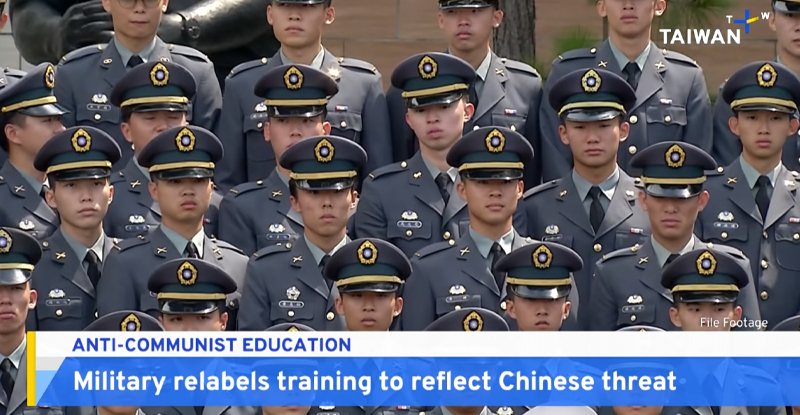
Well look at that, good idea! Kids don’t get taught about the Cold War and the miserable reality of Communism in school. The information in STARRS presentation, “The American Creed Threatened by Radical Indoctrination” would be a good start for everyone in the military to know.
Taiwan’s military has resumed “anti-communist” patriotic classes for its graduates after a quarter-century gap, the defence ministry said on Sunday, citing a rising threat from China as a senior official reported another rise in Chinese naval activity.
During the Cold War, campaigns in Taiwan warning against the dangers of the “communist bandits” in China, whose government views the island as its own territory, were widespread.
But the formal “anti-communist patriotic education” for military graduates ended in 2002, being renamed “patriotic education”.
Taiwan’s defence ministry said in a statement that the classes for its military academy graduates had been restored due to rising military and infiltration danger from China.
“It is necessary for them to clearly understand national security threats and recognise the military mission of ‘why we fight, and for whom we fight’,” the statement said. . . . (read the rest)
Screenshot from our What Happened to Our Military? video:
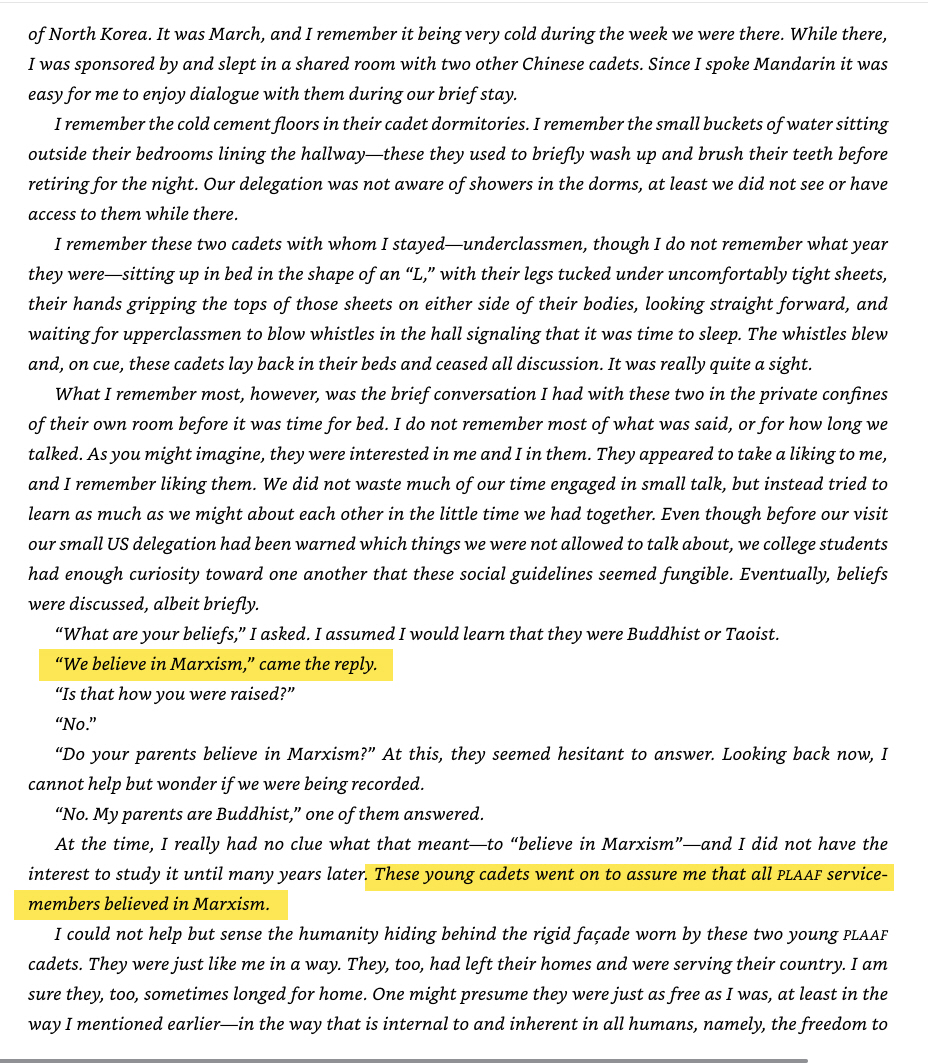
In Matthew Lohmeier’s book, Irresistible Revolution: Marxism’s Goal of Conquest & the Unmaking of the American Military, he and other USAFA cadets were exchange students for a short time with PRC Air Force Academy cadets. He asked his Chinese roommates what they believed in. They replied, “We believe in Marxism”.
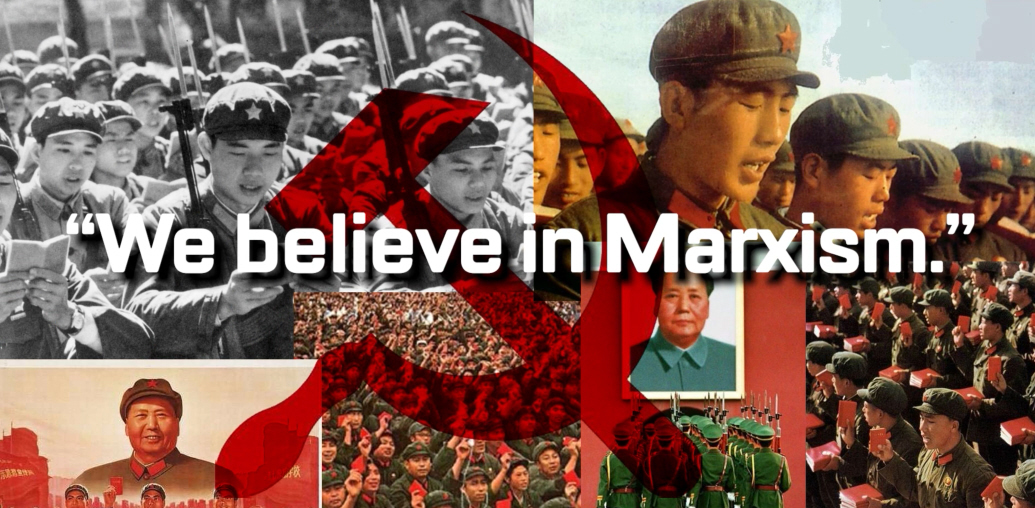
From his book. Click to enlarge:
Soldiers should know the enemy
By Teng Hon-yuan | Taipei Times
After 24 years, the Ministry of National Defense has quietly made a major revision: It has restored anti-communism education as a required part of the curriculum for military academy graduates. The change was in response to mounting pressure from the other side of the Taiwan Strait.
Older generations of conscripts served under slogans painted across military bases, such as “oppose communism and resist Russia, rescue our compatriots.”
In 2002, when cross-strait relations briefly thawed, the mandatory ideological training was renamed to the more politically neutral “patriotic education.”
Two decades later, the Chinese Communist Party (CCP) has not only failed to restrain itself in response to Taiwan’s goodwill, but has instead come to treat Taiwan as its own backyard, with military aircraft and naval vessels circling it on an almost daily basis.
Meanwhile, disinformation and cognitive warfare are employed relentlessly, causing some active-duty and retired military personnel to develop a confused sense of national identity and even collaborate with the CCP.
Under the mounting pressure, the ministry has concluded that it can not play semantic games. Patriotism is too vague a term on its own. At the very least, service members need to understand whom they are fighting for — and why. The change reflects a concern that soldiers might not understand who their enemy is.
Former general and minister of veterans affairs Hsu Li-nung, who died last year at 106, spent decades instructing troops to oppose the CCP and resist the Soviet Union. Yet after his retirement, he became one of the most outspoken advocates for cross-strait unification — a reversal of his life’s work to that point. What is the point of living for more than a century if you ultimately abandon your principles?
The ministry has adopted a straightforward approach, bringing in officials from the Mainland Affairs Council, the National Security Council and the Ministry of Justice Investigation Bureau, along with academics from Academia Sinica, to instruct enlisted troops and officers.
Rather than relying on dry, formulaic lectures, the curriculum examines the CCP’s cognitive warfare against Taiwan, its methods of infiltration and recruitment and the tactics it employs for authoritarian expansion.
The goal is to equip the minds of newly graduated officers who are about to join their units and lead troops with “antivirus software.” They are the officers leading the military’s foundational formations. If the officers do not understand why they fight and who they fight for, how can they be expected to boost the morale of their troops?
Rather than making vague calls for patriotism, it is better to write the enemy’s name on the blackboard. Clearly defining the adversary is the most basic first step to ready the military for a potential conflict. Otherwise, like some members of the Chinese Nationalist Party (KMT), they might fail to distinguish friend from foe, dooming our nation.
Moreover, the anthems across all branches of Taiwan’s military, as well as the Republic of China (ROC) national anthem, should be changed.
If soldiers continue singing military songs that blur the distinction between party and state or confuse national identity, how can they understand why and for whom they fight?
The lyrics of the ROC army academy anthem include the phrase “party flag flying,” the naval academy anthem says: “For the Chinese nation,” the air force academy anthem contains the phrase “recover our lost territories” and the national anthem includes the line “what our party upholds.”
Which party’s flag is being referred to? Is this the Chinese nation or the Taiwanese nation? What “lost territories” are soldiers expected to recover? Does “our party” refer to the KMT or the people?
To facilitate understand among military personnel as to why and for whom they fight, the party-state ideology must be changed. Otherwise, relying solely on instruction from superiors and academics would have limited effect.
_
Teng Hon-yuan is a university professor.
First published in Taipei Times
STARRS can give this presentation to your organization for free. Contact Us.
STARRS Presentation: The American Creed Threatened by Radical Indoctrination




Leave a Comment