
From Brian Nelson, USAFA ’69: On Monday last the Class of ‘69 hosted a lunch for the 9 first class soccer cadets who were denied graduation in 2025 on spurious, ridiculous charges. After the lunch Karl Bruce summarized his feelings in an email and a document and I have received his permission to pass them on. I think everyone will appreciate reading his heartfelt thoughts.
By Karl Bruce, USAFA ’69
Yesterday’s luncheon at the Polaris Hotel was, for me, a deeply meaningful experience—one that has stayed with me and prompted this reflection. I want to capture not only what happened, but why it affected me as deeply as it did.
From the moment we arrived, there was a sense that this was more than a routine gathering. The setting, at the north entrance to the Academy, felt appropriate—a place connected to the long blue line and to all that the Academy represents. The room was warm and relational.
Classmates, spouses, cadets, and families were present, and there was a shared awareness of why we were there. This was not a meeting to discover facts or debate outcomes. The situation had already been resolved. The nine cadets had been vindicated, their honor restored, and their path forward secured. What remained was to recognize what had happened and what it meant.
As the time unfolded, I found myself increasingly aware that I was not simply observing the event—I was being drawn into it.
There were moments when I felt a deep sense of gratitude that I was present, part of a group that shared not only a history, but a set of convictions about truth, responsibility, and what it means to stand with one another.
Brian’s opening framing captured that immediately. His question—who would you want in the foxhole with you—was simple but powerful. His answer was equally clear: someone who has your back. As I listened, I realized how much that resonated with me. It was not just a metaphor. It reflected something real about the relationships in that room and about the kind of commitment we value. There was a quiet but unmistakable sense that we were affirming that commitment to one another.
Mike Rose’s remarks added another dimension. His work in uncovering what had actually happened represented a disciplined pursuit of truth. What struck me was not just the outcome, but the process—the willingness to stay with the facts, to seek clarity, and to do so at personal cost. As I listened, I felt a deep respect for that kind of integrity. It reminded me that truth does not simply emerge; it is often pursued, patiently and at times sacrificially.
When Connor Krookham spoke, the tone shifted in a subtle but important way. His words were measured, even understated, but the weight of what he described was evident. As he spoke about the difficulty of the experience and the way they had chosen to stay together, I found myself connecting it to moments in my own life—times when I believed I was doing what was right, yet the outcome was not what I expected. Connor referenced a thought often attributed to Stephen Colbert—that we learn, over time, to “love the thing we most wish had not happened.” Whether fully understood or not, that idea seemed to reflect what they had lived through.
As I listened, I realized that part of what was affecting me was not just their story, but what their story represented. It pointed to something deeper about how life works.
There are experiences we would never choose, and yet over time they become the very experiences that shape us most profoundly.
They force us to examine who we are, what we believe, and what we value when circumstances are not in our control.
Dan Clark brought that dimension into clear focus. What made his remarks so compelling was that he spoke from his own life. His stories were not theoretical; they were lived. He spoke about adversity, about loss, about learning to live in the present moment rather than being defined by the past or consumed by the future. As he spoke, I could feel the room connecting—not because of the specifics of his experience, but because of the universal nature of what he was describing.
For me, this is where the experience became especially personal. I found myself reflecting on my own journey—on times of disappointment, confusion, and unexpected outcomes—and recognizing that those were often the very moments where something deeper was being formed. There was a quiet sense of hope in that realization. Not a superficial optimism, but a deeper confidence that even in the midst of difficulty, something meaningful is taking place, even when it is not yet fully understood.
What made the luncheon so powerful was that this recognition was shared. It was not something I was experiencing alone. There was a collective understanding in the room that life includes moments of adversity, and that how we respond to those moments matters. There was an affirmation—not spoken explicitly, but clearly present—that perseverance, integrity, and mutual support are essential, especially when circumstances are difficult.
As the luncheon came to a close, the return to the idea of the “foxhole” brought everything together. It was more than a metaphor; it was a statement of identity. We were affirming that we stand with one another, that we have each other’s backs, and that this commitment extends beyond any single event.
As I reflect on the day, I find myself coming back to a question: what does it mean to be a “warrior” in this context? The answer that emerges for me is not defined by role or title, but by character.
A warrior is someone who is committed to truth, who is willing to act when something is wrong, who endures difficulty without losing direction, and who stands with others in the process of setting things right.
In that sense, what we experienced yesterday was more than a celebration. It was an affirmation of who we are and who we aspire to be. It reflected our class motto—Esse Non Videri, to be and not to seem to be.
What I witnessed felt authentic. It was not about appearance or performance, but about something real—truth pursued, adversity endured, relationships strengthened, and meaning discovered.
I am grateful to have been there. It was a moment that not only honored what had happened, but also reminded me of how life works at a deeper level—and why those lessons matter.
From Ron Scott, USAFA ’73 (STARRS President):
Monday and Tuesday represented an important milestone for nine members of the Class of 2025. Mary Shinn reported on it in today’s Gazette: Air Force Academy soccer players graduate after nearly yearlong delay
The Class of 1969 hosted the Monday luncheon, essentially in support of the work by their classmate Mike Rose to resolve the situation.
Below photos:
1) a picture of Dan Clark, a member of the USAFA Board of Visitors and featured speaker for the luncheon and banquet–had just returned from a Pacific trip with our CSAF;
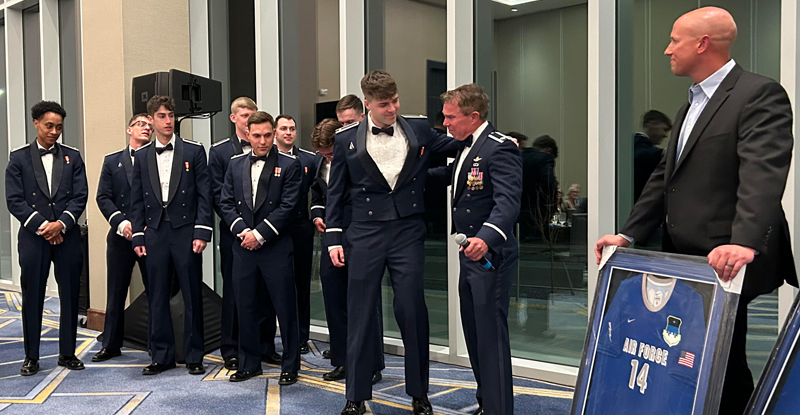
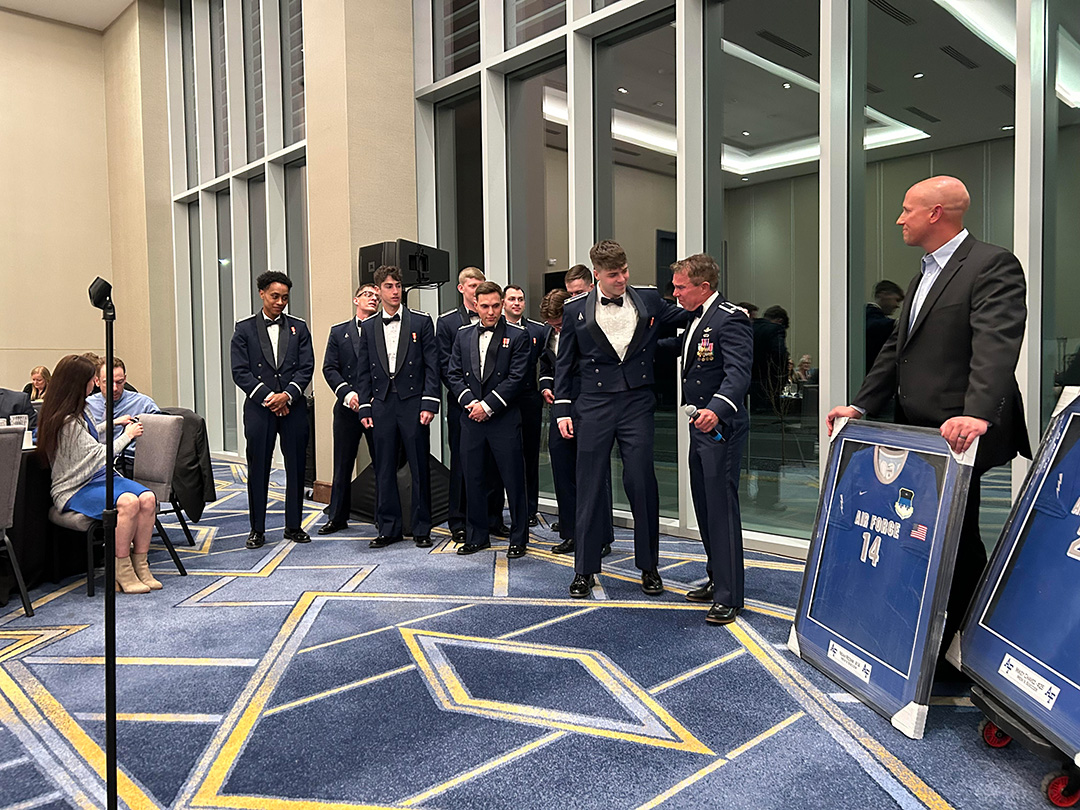
2) a picture of the nine newly minted 2Lts receiving a jersey at the banquet; and
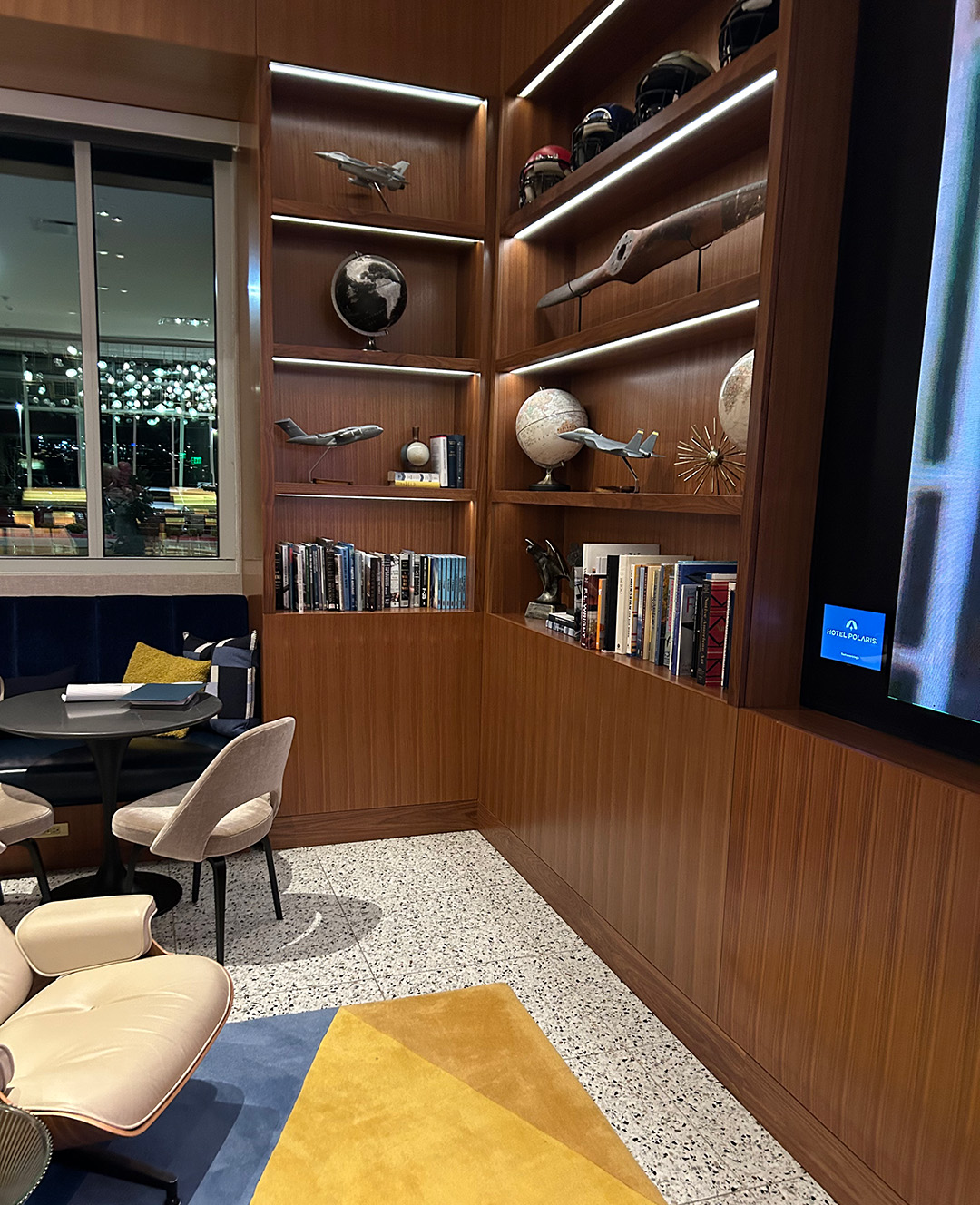
3) pictures of our Class book now displayed in the Polaris Hotel library.
Chris Taravella, Dale Birch, and I presented a copy of our class book to each of the 2Lts at the banquet. (Becoming Leaders of Character : Conversations with the U.S. Air Force Academy Class Of 1973)
One of the servers at the banquet was so impressed with the book that she asked for a copy. When I delivered a copy to her supervisor at the Hotel, I was also asked for one for the Polaris Hotel Library. Pictures below.
There was a solid turnout for the events. It was especially gratifying to visit with General Ed Eberhart at the events–I had the privilege of working for him at the Pentagon, Yokota, and then with the Futures Group under the new US Northern Command.
All in all, this was an important two-day experience for the nine members of the Class of 2025 and their family and friends–a tremendous example of the importance of character and the role we play in promoting and preserving it!!
Cheers,
Ron



Do a Google search for “Becoming Leaders of Character : Conversations with the U.S. Air Force Academy Class Of 1973”
LEADERSHIP IS A JOURNEY, NOT A DESTINATION — Becoming Leaders of Character is story of the Class of 1973, from their entry as young Air Force Academy cadets in the turbulent era of late-1960s America, to their service at the highest levels of government business, and service organizations in the 21st Century.
Organized around the three Core Values that define service in the Air and Space Forces- integrity, service, and excellence-Becoming Leaders of Character using a story-telling methodology to impart hard-earned lessons of character, experienced in a wide range of disciplines, career fields, and circumstances.
Some stories were contributed by well-known class members, such as former Air Force Chief of Staff Norton A. Schwartz and Captain Chesley “Sully” Sullenberger of “Miracle on the Hudson” fame.
Others were contributed by lesser-known class members, but relate equally powerful tests of character, such as a perilous rescue of helpless survivors of a burning ship in the Gulf of Alaska, a series of dangerous missions in East Germany during the Cold War, a harrowing emergency at the edge of space, and a complex effort to rescue an Afghani family from the hands of the Taliban following the U.S. withdrawal from Afghanistan.
As applicable in the boardroom as they are in the cockpit, the leadership lessons chronicled here paint a vivid and colorful portrait of the Class of 19735 journey toward Becoming Leaders of Character.




Leave a Comment