

Key quote: “What has been visible in recent times is the intellectual sludge left by 20 plus years of forced social engineering and the liberalization within the totality of the military academic environment. The consequences of diversity, equity, and inclusion, where social engineering has been much more important than producing officers who are not risk adverse and who are fluent in the hard realities of warfare.”
By Chuck de Caro
Upon watching the myriad active and former military officers seen on television or on social media in the wake of the U.S. effort in Iran, it becomes very apparent that our educational system for the professional development of those officers is inadequate to the needs of 21st century.
In almost every case the overwhelming majority of those officers and former officers, regardless of service, are entirely tactically focused.
Each can go on about the circular error probable of the Tomahawk missile, the closed quarter battle tactics of SEAL Teams, the engagement range of JDAM bombs, but with the possible exception of General Jack Keane, who can discuss operational and strategic moves fluently as seen through the eyes of an Army ground commander, the perspective this points out is the major flaw in the way we educate our entire military officer corps.
This flaw manifests itself as a truly superficial understanding of American history, American military history, and the history of the United States in the world during and after WWII.
For example, many young officers did not know that Iran was aligned with U.S. in World War II. That with the Brits we installed the Shah of Iran back into power in 1948 and at the fumbling behest of Jimmy Carter we helped uninstall the Shah in 1979. The U.S. (Ollie North) toyed with the Iranian government in the 1980s. And then Barrack Obama and Joe Biden tried and failed at nuclear deals and. In between there were tit for tat kinetic exchanges in the last decade and a half.
What we see is a problem of the lack of general situational awareness of any given contemporary politico-military problem.
This is manifested in the inability for most of the mid-level officers to think of anything but the tactical or possibly the operational modality but certainly not in the strategic regime or even understand the principles of grand strategy, one more accurately, war policy.
Without that kind of understanding, it is difficult for military officers, as they reach general officer rank to a be able to accurately provide advice to POTUS or his staff, who, in turn, may not have had any military experience.
The other problem created by this lack of precise historical knowledge is the lack of appreciation of the passage of time before, during and after military major combat operations have been initiated.
The time that it takes to understand all the implications of a given wartime environment If officers making decisions have no idea about the history of that environment, it means that opportunities that could be taken to save lives and treasure are lost.
This author has lectured for years at various military colleges such as the U.S. Air Force Academy, the National Defense University, and the National Intelligence University.
What has been visible in recent times is the intellectual sludge left by 20 plus years of forced social engineering and the liberalization within the totality of the military academic environment.
The consequences of diversity, equity, and inclusion, where social engineering has been much more important than producing officers who are not risk adverse and who are fluent in the hard realities of warfare. The realities that involve utter destruction and death in a way that minimizes our casualties and maximizes those of our enemies. Brutal but absolutely true and best expressed in the words of General Curtis E. LeMay: “I don’t mind being called tough, cause in this racket, it’s the tough guys who lead the survivors.”
There is hope on the horizon, at least as far as the Air Force is concerned: Through some deus ex machina circumstance, the U.S. Air Force Academy has instantly and fundamentally changed its command structure, installing a new superintendent, commandant and dean, a faculty, all at once. And the new dean, BG Jim Valpiani, has a resume whose contents that is best visualized as Clark Kent in blue uniform.
In addition, USAFA has dumped the overly civilianized faculty and has begun replacing them with USAF officers with the appropriate degrees.
At this writing, it is hoped that in light of these major changes, U.S. history, U.S. military history, and U.S. Air Force history from World War II forward should become an integral part of the core curriculum of every graduate of that institution. In this manner, those young officers will be oriented to the goals of United States and will understand the strategic rationale for those goals.
It should be noted that such a change in understanding of the Airmen who went before, will help to reinstate the concept of a military meritocracy, where the smartest and the most aggressive get to lead our future forces with great effectiveness.
Two last thoughts:
Mark Twain once said that “History doesn’t repeat itself. But it often rhymes.”
General George Patton said, “A good plan violently executed now is better than a perfect plan next week.”
That kind of good plan depends on the intimate knowledge of history embedded in the commander’s soul. I would sure like to help plant it there.
_
Chuck de Caro was hired by Ted Turner as CNN’s 1st Special Assignments Correspondent. In 1986, he started AEROBUREAU a huge flying newsroom. He also advised TV’s JAG and NCIS. Since 1991 he taught at the National Defence and National Intelligence Universities and for 24 years served as outside consultant to the War Department’s secretive Office of Net Assessment and progenitor of the 1st Joint SOFTWAR Unit (Virtual).
First published on Real Clear Defense
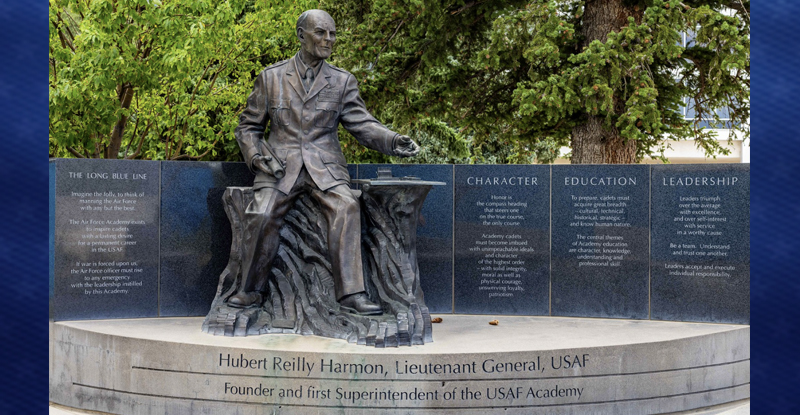
Recent photo from USAFA photo gallery (click to enlarge) of Lt. General Hubert Reilly Harmon, USAFA founder and first Superintendent:

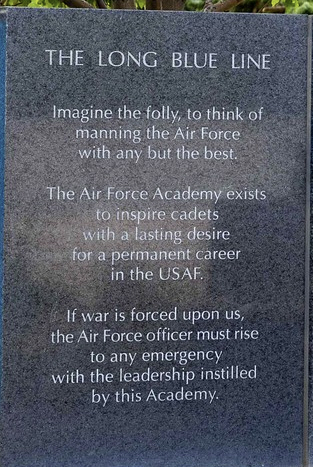 THE LONG BLUE LINE
Imagine the folly, to think of manning the Air Force with any but the best.
The Air Force Academy exists to inspire cadets with a lasting desire for a permanent career in the USAF.
If war is forced upon us, the Air Force officer must rise to any emergency with the leadership instilled by this Academy.
 CHARACTER
Honor is the compass heading that steers one on the true course, the only course.
Academy cadets must become imbued with unimpeachable ideals and character of the highest order–with solid integrity, moral as well as physical courage, unswerving loyalty, patriotism.
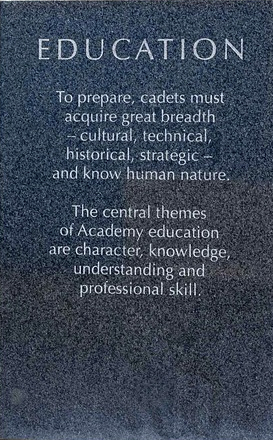 EDUCATION
To prepare, cadets must acquire great breadth–cultural, technical, historical, strategic–and know human nature.
The central themes of Academy education are character, knowledge, understanding and professional skill.
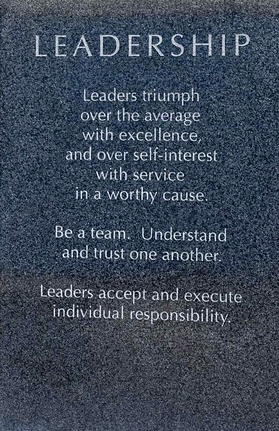 LEADERSHIP
Leaders triumph over the average with excellence, and over self-interest with service in a worthy cause.
Be a team. Understand and trust one another.
Leaders accept and execute individual responsibility.


Leave a Comment