
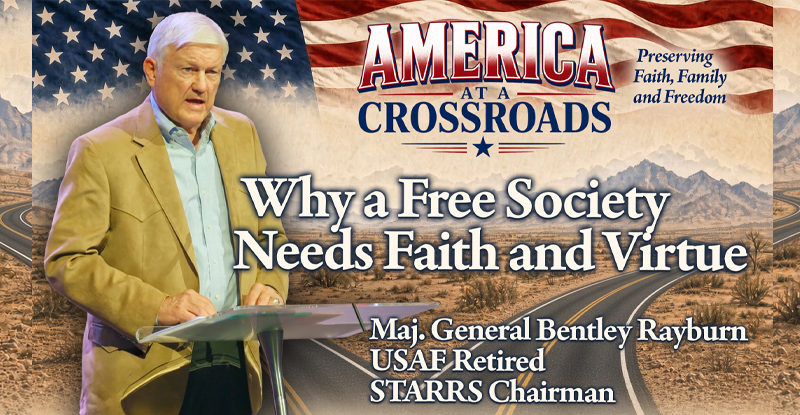
America doesn’t lose freedom all at once, it loses it inch by inch when truth gets replaced by feelings and self-government gets replaced by someone else governing for us. At the STARRS “America at a Crossroads” event in Scottsdale, Arizona, Major General Bentley Rayburn, a veteran Air Force command pilot and chairman of the STARRS Board of Directors, delivers a blunt, values-driven talk on what keeps a republic standing when the culture feels unstable and the stakes feel existential.
Rayburn explains why he believes the country is at a crossroads, then move straight into his central claim: faith, family, and freedom are not separate talking points, they’re connected supports. He explains why faith must be anchored in facts, not emotion, and why rights can’t be treated as favors granted by government. From the Declaration of Independence to the practical meaning of freedom of conscience, the conversation keeps circling back to one question: what makes liberty sustainable over generations?
Rayburn also unpacks Os Guinness’ “golden triangle of freedom,” the idea that freedom requires virtue, virtue requires faith, and faith requires freedom, like a three-legged stool that collapses if any leg is removed. The most actionable moment comes when we bring it home: virtue is taught, first and best, around the kitchen table. If families stop forming character, the state grows to fill the vacuum, and the bill eventually comes due in lost liberty.
Watch:
Listen:
Find and Listen to “STARRS Podcasts” on your favorite podcast platform, such as: Apple Podcasts, Spotify, Amazon Music, Audible, iHeart, Podbean, and more
 Maj General Bentley Rayburn, USAF (Ret.) is a 1975 graduate of the US Air Force Academy and was cadet wing commander his senior year. He was a command pilot with over 3,000 hours in aircraft that include the F-4, F-16, and AT-38. General Rayburn commanded at multiple levels and led combat missions over southern Iraq, enforcing U.N. sanctions on the Saddam Hussein regime, and was the senior battle staff director during Operation Allied Force, directing joint operations over Serbia and Kosovo. His distinguished career culminated as the Commander of the Air Force Doctrine Center at Maxwell Air Force Base, Alabama. USAF Bio
AI TRANSCRIPTION:
On behalf of STARRS, I want to welcome and thank all of you here this morning. And for those of you who are joining online, I want to especially thank Dr. Martha Ostrom for the introduction and for the vision and hard work that she and Amy Shepherd and many of their friends and co-workers did to put this uh event together.
Maj. General Bentley Rayburn: 02:51
As the conference title states, our country is at a crossroads. And while all of us here and online believe that that to be true, we also believe that our country, as our founding fathers envisioned, is worth defending. And as the tagline suggests, it if we want to go in the right directions at this crossroad, it must be in the direction of faith, family, and freedom. Many of us in STARRS leadership positions have in the past few days received powerful briefings on the internal threats posed by the Muslim Brotherhood and their subordinate front groups.
Ladies and gentlemen, at this very moment there are American citizens, members of this backward and barbaric ideology, whose stated and published goal is the destruction of the United States and the establishment of an Islamic caliphate. They have partnered with an unholy alliance with radical socialists and actual communists, who likewise want to destroy the political and economic freedoms that we enjoy and replace it with a socialist or and communist totalitarian government.
Our country definitely stands at a defining crossroads. And the question is, which way will we take? We say in the title of this conference that we are about preserving faith, family, and freedom. And I think that’s the right order to think about these concepts and ideas. But faith can’t be just a faith in anything. It must be a faith in what’s real and true. The jihadi believes that if he dies a martyr, he will go to paradise. And I know that that’s not true.
The navigators have an illustration of a short train with fact as the engine, faith as the boxcar, followed by the caboose labeled feelings. True faith is based on facts. Our feelings and emotions should flow from what is true and right and what we can place our faith in. When we get the order turned around and lead with feelings, we most often get in trouble with the facts.
If we are going to preserve faith, true faith, it has to be based on facts. A number of years ago, a senior leader at the Air Force Academy, while describing the unique characteristics of the architectural structure of this new Center for Character and Leadership, described how this oblique pyramid that dominates the structure pointed to Polaris. And in her words, to remind us of our moral compass.
Ladies and gentlemen, if our moral compass is represented by a star that’s 445 light years out in space, that’s going to move over time, we’re in big trouble. No, our moral compass must be rooted and grounded in the foundations built on the sacred writings of the Jewish and Christian scriptures that will not move over time. We must continually remind our countrymen that rights are not bestowed by government, because if they were, government could take them away.
No, our rights are given by God as stated clearly enough in the Declaration of Independence that we hold these truths to be self-evident, that all men are created equal, that they are endowed by their Creator with certain unalienable rights, that among these are life, liberty, and the pursuit of happiness. That creator is the God of the Jewish and Christian scriptures, not a small g god who would take away our liberty and make us subject to barbaric ideology or a tyrannical government.
As an outsider, Dr. Guinness was British, or is British, he has analyzed our American democracy and presents us with an analogy using this concept of what he calls the golden triangle of freedom. Guinness argues that sustainable free societies cannot stand without three mutually reinforcing, equally essential legs on a three-legged stool.
The first leg is the truth that freedom requires virtue. He says true freedom is not the license to do whatever you want, but the moral capacity to do what you ought. Well, what is virtue? Virtue is a moral excellence and righteousness, goodness, morally good behavior. Besides its positive effects, virtue has the impact of restraining improper and morally deficient behavior. Freedom requires virtue. Without virtue, Guinness would say, freedom degenerates into chaos.
James Madison, often called the father of the Constitution, was no naive optimist about the human nature. Yet at the Virginia Ratifying Convention, he said, to suppose that any form of government will secure liberty or happiness without any virtue in the people is a chimerical idea.
Benjamin Franklin wrote, only a virtuous people are capable of freedom. As nations become corrupt and vicious, they have more no more need of masters. They have more need of masters. Notice the logic. If we cannot govern ourselves, someone else will. Self-government begins with self-control.
Samuel Adams cautioned, while the people are virtuous, they cannot be subdued. But once they lose their virtue, then they will be ready to surrender their liberties to the first external or internal invader. So it doesn’t take much examination to see that the forces who are trying to undermine our nation, our constitution, and beyond that, Western civilization do not display any degree of moral excellence and therefore will not seek to protect our cherished freedoms.
Well, what does virtue require? Well, virtue requires faith. For a society to sustain virtue across generations, it requires a grounding in a higher objective truth or faith. The American founders, even those who weren’t particularly orthodox, believe that religious faith provided the best moral foundation for public citizenship. And why did so many of the founders tie virtue to faith? Because they rightly believe that our rights come from something higher than the state.
Thomas Jefferson asked, can the liberties of a nation be thought secure when we have removed from their only firm basis a convection, a conviction in the minds of the people that these liberties are the gift of God?
We’ve all seen the stats on the precipitous decline in church attendance and the dramatic rise of the “nones”. Those are the people who answer the question, what is your religious affiliation with “none”? That doesn’t bode well for the future. And to complete the stool and come back to the beginning, Guinness argues that faith requires freedom. Authentic, genuine faith cannot be imposed. It must be appropriated freely. That requires the government to protect freedom of conscience and religion and not force of state, religion, or no religion on the people.
The French political philosopher Alexis de Tocqueville traveled in the country in the 1830s trying to understand what made America work. He noted that their religion must be regarded as the first of their political institutions. He noted also that Americans combined the notion of Christianity and liberty so intimately in their minds that it is impossible to make them conceive of one without the other. He went on to say something that we should all remember. Despotism may govern without faith, but liberty cannot.
So, what was Dr. Guinness getting to? He is arguing that just like a three-legged stool, if you remove any of the single legs, whether it’s freedom, virtue, or faith, the entire structure of the self-governing free society collapses. And we see the danger in our culture today, don’t we? And that is why we must fight to advance virtue, true faith, and freedom.
Virtue is taught, and it is taught first around the kitchen table. Before there is a citizen, there’s a child. Before a child can understand the Constitution, he must learn honesty, work ethic, forgiveness, sacrifice, and loyalty from the daily life in a home. The family is the first school of virtue, the first church, the first government. It is where we learn that we are not the center of the universe, and that other people have claims on us, and that love means obligation as well as feeling.
John Adams understood this in his own household, writing to his wife Abigail during the revolution. He said, I must study politics and war that my sons may have the liberty to study mathematics and philosophy. I don’t know if he got the mathematics part right, but the rest that you understand. He wanted his children and grandchildren to inherit not just a country, but the cultivated life that a free country makes possible.
Notice, too, that what that tells us. The founders were not building a nation for its own sake. They were building it for families and for the next generation. Washington, Adams, Madison, Franklin, and Jefferson didn’t agree on everything, but they agree on this. A republic depends on a people who can govern themselves, and that begins in the soul and in the home.
And when the family weakens, the state grows to fill the vacuum. When parents no longer teach restraint, courts and prisons must enforce it. Where neighbors no longer care for one another’s, bureaucracies step in. Every duty a family abandons, a government is eager to assume, and it comes with a price, our liberty. Thank you.





Leave a Comment