
By @ZeroDEIUSA on X
Former executive, business owner and conservative university professor
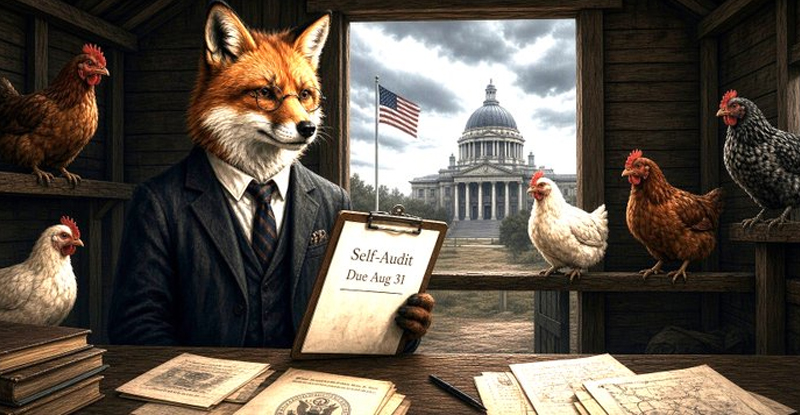
The Foxes Are Guarding the Henhouse Again
The Department of War’s notification to 30 institutions about an “audit” is the right instinct: stop treating American taxpayer-funded research as an open buffet for foreign entities of concern, rebranded Confucius Institutes, and talent programs designed for systematic technology transfer and IP theft.
The problem is the execution model—handing the fox the keys to the henhouse and demanding a self-report by August 31. The same academic culture that hollowed out the war colleges is now being asked to police itself on foreign research ties. To quote Admiral Ackbar in Return of the Jedi: “It’s a Trap!”
We’ve seen this movie before. The same academic class that hollowed out the war colleges is now being trusted to police its own foreign entanglements.
War colleges once taught how to prevail in combat through superior competence, cohesion, and disciplined lethality. That mission was replaced by ideology, and the soft careerism of people who never had to live with the consequences of their theories.
Civilian professors with no uniform time, no combat experience, and no visceral understanding of what happens when doctrine meets steel; were elevated into positions of influence. They lectured battle-hardened officers on wars they had only ever read about.
The map became more important than the disputed territory. The lecture hall was treated as the line of fire. And the institutions paid the price in readiness and focus. The colleges’ core purpose eventually failed the society they were charged to protect. A weakened, distracted force shaped by professors whose bias overrode the mission was not reform—it was a dangerous game.
I watched, from within, the identical dynamic in civilian universities for years. The people running the show are not primarily motivated by truth, national security, or the hard work of protecting American advantage. They are motivated by grants, prestige, tenure, international partnerships, and the protection of their own comfortable positions. When those incentives collide with a security requirement, the security requirement loses. Quietly. Professionally. With carefully worded reports.
That is exactly what is about to happen with these audits.
Why self-audits by the current administrators and professors “will” fail
The same people who approved, expanded, and defended these foreign partnerships now sit in judgment of them. Many built careers, prestige, and funding streams on “global collaboration.” Admitting the depth of the problem means admitting their own judgment was compromised or negligent. Self-preservation is a powerful incentive. Expect minimized findings, creative re-definitions of “foreign entity of concern,” and heavy emphasis on “already mitigated” partnerships that somehow still exist.
Universities are hooked on foreign money—Chinese contracts, Qatari gifts, and corporate research partnerships with dual-use implications. Federal research funding is also on the line. When both revenue streams are threatened, the audit becomes a negotiation exercise rather than a security one. Mitigation plans will be written to preserve as much of the money as possible while checking the compliance box.
Large parts of the academy still treat national security concerns about China as borderline xenophobia or “Cold War thinking.” The same administrative class that spent years expanding Confucius Institutes, hosting Thousand Talents participants, and celebrating joint research now has to suddenly treat those relationships as threats. Cultural and ideological priors do not reverse on a short deadline. Soft-pedaling, contextualizing, and “nuance” will dominate the reports.
The people inside the system know where the sensitive work actually sits—export-controlled projects, dual-use labs, graduate students with access, informal collaborations that never appear in official databases. Outsiders do not. When the auditors are also the custodians of the records, incomplete disclosure is easy to accomplish and hard to detect.
The August 31 deadline is aggressive to say the least; to the point of feeling perfunctory. Comprehensive audits of academic, financial, and research ties across an entire research university are not two-week projects. The pressure produces the predictable result: rapid paperwork, narrow scoping, and plans that look rigorous on paper while leaving the highest-risk relationships largely intact.
Most university administrators and faculty have never had to live with the consequences of technology leakage. They do not design systems that must survive contact with a peer adversary. Their professional incentives reward publication, grants, and international prestige. The warfighter’s incentives on the other hand reward keeping the other side from acquiring the capability. Those two mindsets are not the same, and the former is currently running the audit.
Even if some partnerships are terminated on paper, the people, the data, the graduate students, and the informal networks often remain. A paper termination does not automatically remove the exposure. Without aggressive, independent verification and follow-up, the Department of War will receive reassuring reports while the underlying transfer risk continues.
The people who were examples of the disease
Tom Nichols spent 25 years at the Naval War College lecturing battle-hardened officers on the very chaos he never tasted. He guarded the gates of “expertise” on ancient wars and grand strategy. He was the purest form of armchair general—unscarred by combat, all theory with no experience of the clash of steel against flesh.
Civilians like him wield PhDs and nuclear hypotheticals like talismans. But they remain spectators to the raw, unforgiving truth that only those who’ve bled can know. The untried sage speaks loudest when the stakes are highest—and pays no price when he’s wrong. Like most in the academy, they have never actually had to do what they teach.
Brad Duplessis, was an assistant professor at the Army Command and General Staff College, and Ryan Evans a former Defense Dept. civil servant showed the institutional response when the system is challenged.
When Cynical Publius called for real reform at the War Colleges, Duplessis and Evans did not debate. They doxxed him and sicced the mob on him. That was not scholarship. It was cowardly gatekeeping by insiders terrified their sinecures were at risk. Together they proved the point: these institutions are captured, and the wrong people hold the reins.
These were not isolated cases. They were and are symptoms of a broader culture that rewards conformity over competence, protects its own, and treats criticism of ideological capture as a threat rather than a necessary course correction. The same mindset that subordinated lethality to woke identity frameworks and policy theory in the war colleges; is the same mindset now being asked to examine foreign research partnerships with honesty.
Many of the loudest defenders of the old order remain active and influential even if individual titles have changed. Nichols is now professor emeritus and a staff writer at The Atlantic (yeah that Atlantic). He continues to speak and write from the same perspective.
Duplessis remains publicly active defending the institutions and criticizing those who demand deeper change. The broader civilian faculty culture that prioritized “diversity of thought” when it meant progressive orthodoxy, while treating lethality-focused criticism as dangerous, has not evaporated simply because of an administration change. The personnel rotate. The incentives and the worldview often do not.
People who have already diagnosed the disease
Several voices with real credentials have spent years documenting the capture of military and academic institutions by pointing out the substitution of ideology over mission. Their writings and observations make them far more qualified to scrutinize research security than the administrators and faculty who created or tolerated the problem in the first place.
Cynical Publius @CynicalPublius, a retired Army colonel with staff experience in Iraq and Afghanistan, has written extensively on the war colleges becoming Ivy League clones in uniform. He has called out civilian faculty with zero combat experience dominating key billets, the displacement of warfighting focus by globalist and neo-Marxist frameworks, and the need to fire most of the policy-fluff professors and restore lethality as the central purpose. His piece “Making the War Colleges Great Again” directly targeted the rot and drew the predictable response: doxxing and institutional defense rather than substantive engagement.
Chase Spears @DrchaseSpears, a 20-year Army public affairs officer and combat veteran who turned down promotion to leave the service, has consistently highlighted how military education has absorbed the same Frankfurt School-derived ideologies that destroyed civilian universities. He has pointed to the persistence of these frameworks from the service academies through the war colleges and argued that military academia must be rebuilt around producing warriors rather than managing them with the language of equity and inclusion.
Rob Maness @RobManess, a retired Air Force colonel with 32 years of service (enlisted EOD to wing commander, Pentagon on 9/11, Naval War College graduate), has been blunt: professional military education has been poisoned by DEI orthodoxy and civilian academics contemptuous of military culture. He has called for top-to-bottom curriculum reviews at the war colleges, staff colleges, and service academies, the removal of faculty pushing critical theory and identity frameworks, and a return to Clausewitz, logistics, combined arms, and great-power competition. He has repeatedly argued that the same people who implemented the indoctrination should not remain in positions to shape the next generation of leaders.
These are not outsiders inventing a crisis. They are officers who lived inside the system, saw the shift from warfighting to ideology, and then used their post-service freedom to document it without fear of promotion boards or faculty lounge consensus. People like Eric Schwalm, @Schwalm5132 a retired Green Beret CW4 with deep counterinsurgency and intelligence background, bring the same hard-earned understanding of infiltration tactics and adversarial methods. These are the types that should be involved in an audit.
How to make the audits thorough and less biased
Self-reporting by the institutions that created the exposure will produce compliance theater. The Department of War needs independent teams that treat these universities the way any serious organization treats entities with both vulnerability and incentive to minimize findings.
First, the audit teams can’t be drawn primarily from the academic community being examined. Can you spell conflict of interest?
Instead, bring in outsiders who have already left the system and no longer need its approval—retired officers with lengthy leadership experience who have written and spoken honestly about institutional capture. They understand operational security, adversarial methods, and the difference between a partnership and a collection vector. They are not competing for the next grant or protecting a faculty lounge consensus.
Second, include current enlisted personnel and junior officers (think @infantrydort) with relevant technical or intelligence backgrounds on the teams. The people closest to the actual work often see the informal collaborations, the graduate students with access, and the quiet data flows that never appear in official partnership lists. Senior administrators and tenured faculty have every reason to smooth those edges. Enlisted technical specialists and operators do not.
Third, make the visits unannounced. Advance notice turns an audit into a staged performance. Records get cleaned, sensitive projects get temporarily reclassified or moved, and the right people are suddenly unavailable. Unannounced access to labs, data systems, graduate student records, and financial trails is the only way to see the institution as it actually operates rather than as it wants to be seen.
Fourth, require the teams to produce two products: a classified risk assessment that goes directly to the Department of War, and an unclassified summary that still names the concerns and issues without compromising sources and methods. The universities should not be allowed to write or edit the final judgment on their own exposure.
This is not about punishing higher education. It is about refusing to keep subsidizing a culture that has repeatedly subordinated the mission to its own comfort and ideology. The same people who turned war colleges into venues for policy theory and identity frameworks should not be trusted to decide which foreign research relationships are safe. The Department of War has the authority and the obligation to demand better.
Root the foxes out of the henhouse. Bring in people who still remember what the chickens are for.
Image by Grok, Written word by @zeroDEIUSA
References
Cynical Publius. (2026, February 16). Making the war colleges great again. American Greatness. https://amgreatness.com/2026/02/16/making-the-war-colleges-great-again/
Department of War. (2026, August 17). Department of War orders research security audits at 30 academic institutions. https://www.defense.gov/News/Releases/Release/Article/4575019/department-of-war-orders-research-security-audits-at-30-academic-institutions/
Duplessis, B. (2026, March 13). Military senior service colleges require reform, but there sure are some bad ideas out there. War on the Rocks. https://warontherocks.com/military-senior-service-colleges-require-reform-but-there-sure-are-some-bad-ideas-out-there/
Maness, R. [@RobManess]. (n.d.). Commentary on professional military education reform [X posts]. X. https://x.com/RobManess
Nichols, T. (n.d.). Tom Nichols. The Atlantic. https://www.theatlantic.com/author/tom-nichols/
Spears, C. [@DrchaseSpears]. (n.d.). Commentary on ideological frameworks in military education [X posts]. X. https://x.com/DrchaseSpears
zeroDEIUSA. [@zeroDEIUSA]. (2026, March 14). Post on the doxxing of Cynical Publius by Brad Duplessis and Ryan Evans [X post]. X. https://x.com/zeroDEIUSA/status/2032851503682064563
zeroDEIUSA. [@zeroDEIUSA]. (2026, May 3). Posts describing Tom Nichols as an armchair general who spent 25 years at the Naval War College lecturing battle-hardened officers without combat experience [X posts]. X. https://x.com/zeroDEIUSA/status/2050791244565987695 and related posts
zeroDEIUSA. [@zeroDEIUSA]. (2026, May 6). Extended commentary on Tom Nichols and academic instructors who teach what they have never practiced [X post]. X. https://x.com/zeroDEIUSA/status/2051841122465362224
zeroDEIUSA. [@zeroDEIUSA]. (2026, June 2–3). Series of posts on Tom Nichols as the purest form of armchair general and the difference between the lecture hall and the line of fire [X posts]. X. https://x.com/zeroDEIUSA/status/2061616284098244958 and related
zeroDEIUSA. [@zeroDEIUSA]. (2026, July 5). Post on Tom Nichols lecturing from the Naval War College without firsthand experience [X post]. X. https://x.com/zeroDEIUSA/status/2073568140215390228
zeroDEIUSA. [@zeroDEIUSA]. (2026, July 29). Post on the capture of the war colleges by ideology and the role of civilian professors such as Tom Nichols [X post]. X. https://x.com/zeroDEIUSA/status/2082401650379997676
The information in this post should have everyone concerned!
The Dept. of War has issued a notice to 30 academic institutions, directing them to immediately review their comprehensive review of their academic, financial, and research collaborations with foreign entities, of… https://t.co/57kyDwrCmK
— ZeroDEIUSA (@zeroDEIUSA) August 18, 2026
Department of War Orders Research Security Audits at 30 Academic Institutions (Dept of War)
The Department of War has issued formal notifications to 30 domestic academic institutions, directing them to initiate immediate and comprehensive reviews of their academic, financial and research collaborations with foreign entities of concern.
These notifications address active institutional ties and collaborations with foreign entities identified under Section 1286 of the FY19 NDAA, as well as organizations associated with rebranded Confucius Institutes. Executed by the Office of the Under Secretary of War for Research and Engineering, this action is designed to protect American taxpayer-funded research investments from unauthorized technology transfer, intellectual property theft and adversarial exploitation.
“The Department of War has zero tolerance for academic partnerships that compromise our national security,” said Emil Michael, Under Secretary of War for Research and Engineering. “Institutions that receive funding from American taxpayers must uphold the highest standards of research security, and these mandated audits will ensure accountability across the board.”
To maintain eligibility for future federal research funding, the notified universities must complete a comprehensive audit of all identified foreign collaborations, assess the exposure of sensitive or export-controlled research, and implement strict mitigation plans, including the termination of problematic partnerships. Institutions are required to report their findings and actions directly to the Department no later than August 31, 2026.
“Universities are critical partners in executing a wide range of Department of War research programs, and the Department must therefore ensure that our research investments are well protected from foreign exploitation,” said Dr. Joseph Jewell, Assistant Secretary of War for Science and Technology.
Through these audits, the Department of War will better anticipate emerging threats, adapt to evolving adversarial tactics and maintain America’s position as a global leader in innovation. The Department is pursuing this effort alongside partners in Congress. Together with the House and Senate Armed Services Committees, the House and Senate Appropriations Committees and the House Select Committee on the Chinese Communist Party, the Department continues to build a robust research ecosystem that protects critical discoveries from exploitation.






Leave a Comment