
By Col. Rob Maness, USAF ret
STARRS Board of Advisors
I read Matthew Woessner’s piece “In Defense of War Colleges” in RealClearDefense with the same disappointment I feel watching senior leaders defend a broken system instead of fixing it.
As a Naval War College graduate, a 32-year combat veteran who rose from enlisted EOD tech to wing commander, and someone who’s seen the downstream effects of what these institutions are producing, let me be blunt:
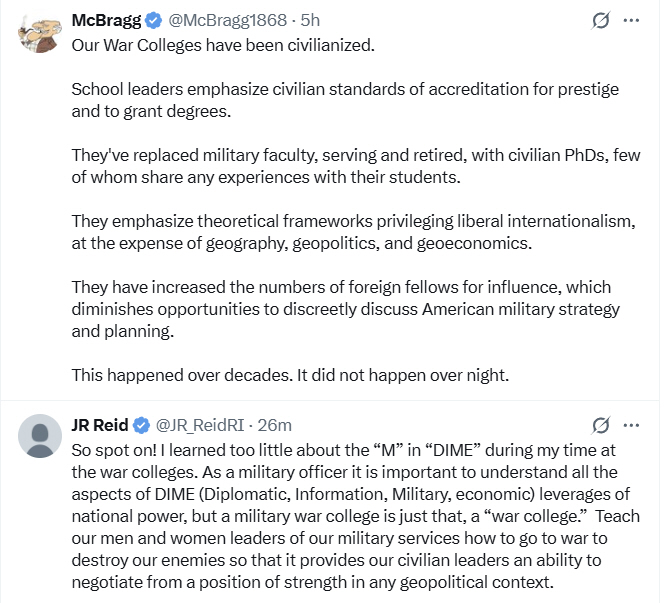
The war colleges aren’t “remaining focused on educating military leaders to fight and win the nation’s wars.”
They’re producing too many political generals like Mark Milley and too few Pattons, Bradleys, Eisenhowers, MacArthurs, Nimitzs, LeMays, or Marshalls.
Woessner, a civilian dean at NDU with a background in civilian academia, paints a rosy picture of intellectual impartiality, diverse perspectives, and a noble military-civilian partnership. He contrasts the war colleges favorably against “politicized” civilian universities.
But from the inside—where actual warfighters attend these schools—the reality is different.
The curriculum has been diluted with interagency harmony sessions, climate security modules, and enough “strategic” soft skills to make officers think like State Department diplomats or contractors rather than killers who close with and destroy the enemy.
The anonymous American Greatness piece by @CynicalPublius Woessner responds to (“Making the War Colleges Great Again“) hit the nail on the head: these institutions have become Ivy League clones in uniform.
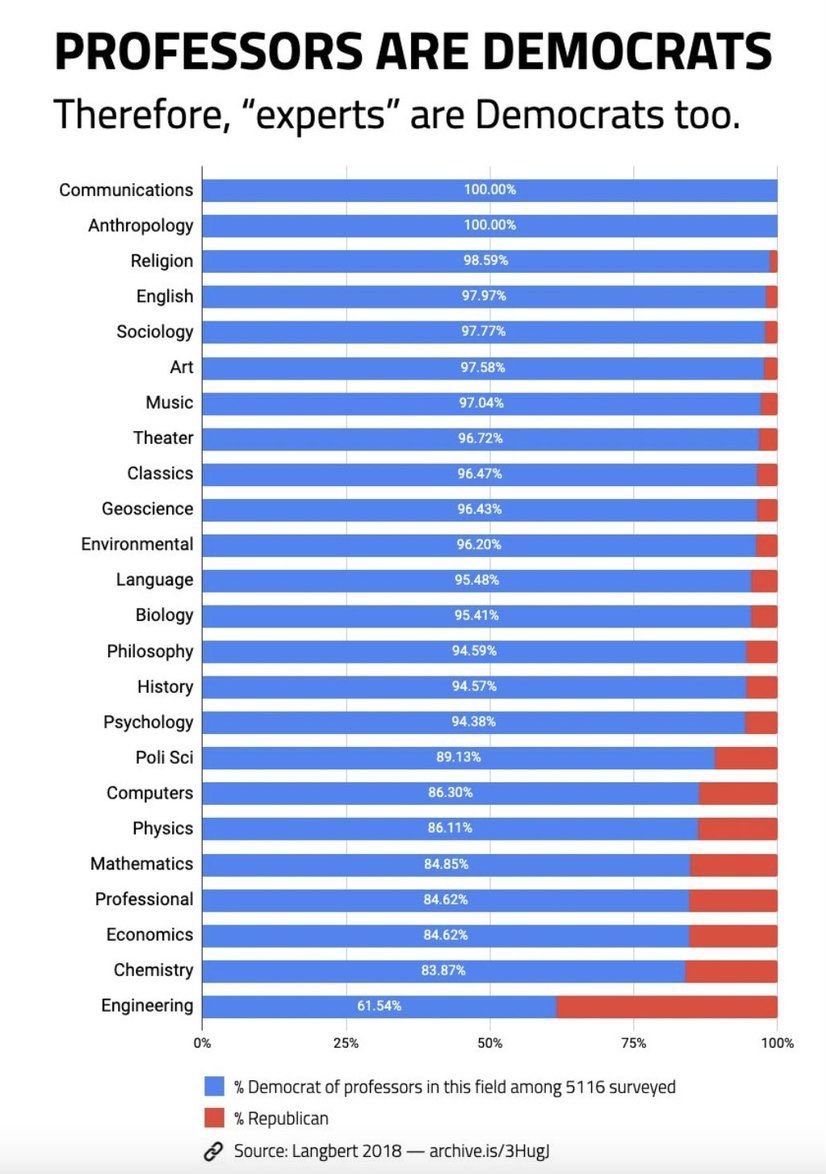
Civilian faculty—many with zero combat experience and some openly contemptuous of the military culture—dominate key billets. They push globalist, neo-Marxist, and yes, “woke” doctrines that prioritize equity over lethality, inclusion over merit, and “whole-of-government” coordination over decisive victory.
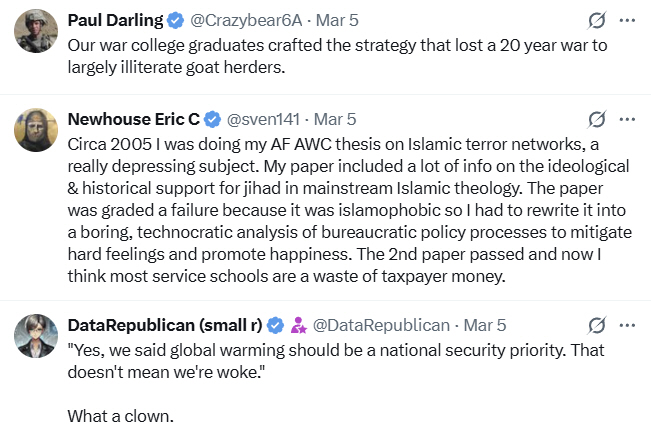
Woessner dismisses isolated papers on climate or bias as non-representative. Fine. But when graduates oversee debacles in Iraq and Afghanistan—nation-building fantasies instead of clear wins—that’s not coincidence. It’s curriculum.
Woessner celebrates the “small number” of civilian students fostering understanding. In practice, it fosters groupthink: military officers learn to defer to civilian agencies, prioritize “harmonization” over unilateral action, and avoid hard calls that might offend allies or bureaucrats.
We need officers who can tell political leaders, “No, sir, we cannot turn an 8th-century culture into a liberal democracy with more troops.” Instead, we get compliance.
The defense of civilian faculty as stable, expert partners rings hollow. Many are long-term DOW lifers because civilian academia views military service suspiciously—yet they bring the same biases that tanked public trust in universities.
Woessner resigned tenure to join; respect for that. But one anecdote doesn’t refute the pattern. We’ve seen anti-American sentiment from war college faculty on social media, contempt for the very officers they teach, and blocks issued to combat experienced veteran war college graduates calling for reform.
True impartiality would mean ruthless focus on warfighting: logistics vulnerabilities (as recent critiques highlight), peer competition with China, sealift shortfalls, and attrition-based failure for underperformers.
War College should be as grueling as EOD school—over 50% attrition when I went through as a 17-year-old enlisted man, while officers washed out. Make it hard. Make failure possible. Produce leaders who win wars, not manage them into stalemates or worse.
Woessner welcomes dialogue and shares goals with critics. Good. But dialogue without action is theater.
Secretary Hegseth is already moving on this in the Deoartment and services—rooting out DEI poison, refocusing on lethality. The war colleges need the same: top-to-bottom curriculum review, purge of ideological capture, more uniforms, fewer permanent civilians in key roles, and boards that prioritize combat-proven leaders.
America’s military remains the greatest fighting force because of its people—not despite them. But when senior service college education produces more bureaucrats than warriors, we risk losing the next war before it starts. Denial won’t fix that. Reform will.
The time for polite defenses is over. Put the “war” back in war colleges—before it’s too late.
First published on X:
— Rob Maness (@RobManess) March 6, 2026

Well, looks like I touched a nerve.
Nothing quite fails to defeat my argument that the War Colleges have lost sight of warfighting in favor of civilian credentialism like an opening sentence of:
“As an academic who spent the first eighteen years of my career in civilian higher… pic.twitter.com/NNE5MrqCTW
— Cynical Publius (@CynicalPublius) March 5, 2026
FULL TEXT:
Well, looks like I touched a nerve.
Nothing quite fails to defeat my argument that the War Colleges have lost sight of warfighting in favor of civilian credentialism like an opening sentence of:
“As an academic who spent the first eighteen years of my career in civilian higher education, I have a unique perspective on the nation’s war colleges and the value they bring to America’s national defense.”
How can an academic who has never heard a shot fired in anger gauge the value the failed status quo brings to national defense when all he knows about national defense comes from a book?
______________________
(The author also seems troubled by my use of a pseudonym. Don’t worry Matthew, you’ll know who I am soon enough.)
It’s not just the War Colleges. There’s other DoD-owned universities that officers attend for graduate studies to satisfy their ILE. As a SNCO, I attended one in DC, and I can say they’re all infected with career academics (civ and mil) that preach the globalist agenda.
— bourbonius amantis (@G_T_III) March 5, 2026
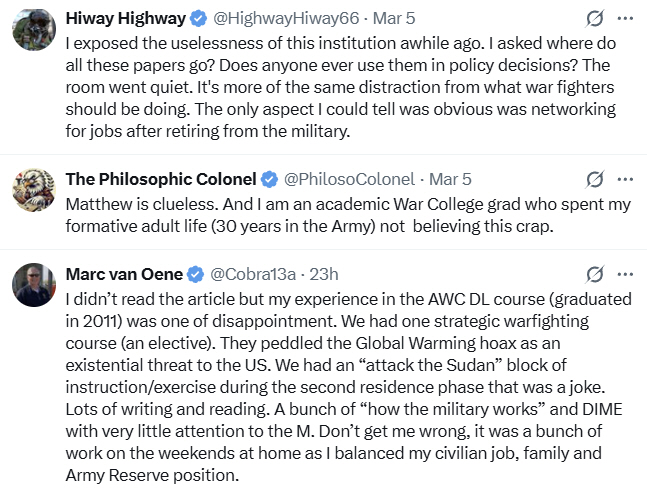
It’s Time to Purge the Poison from All Professional Military Education


Leave a Comment