
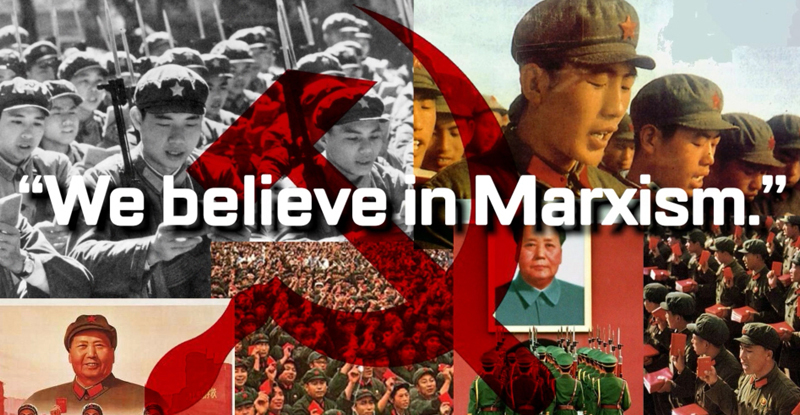
STARRS President Col Ron Scott, PhD, USAF ret, recommends the 1966 book, Dedication and Leadership by former Communist Douglas Hyde that shows, as one reviewer put is, “how adept the Communists are at motivating, organizing, inspiring dedication, and converting others to their agenda. He reveals the strategies and tactics of the Party leadership throughout the world.”
We are seeing a rise in young people supporting Communism and Marxist candidates getting elected to office. Why are they winning the hearts and minds of people of a miserable ideology? This book helps explain it (links to the PDF to read it right now or paperback to order below).
“Beliefs are important to Communists,” Hyde says surprisingly, because most would think atheists don’t believe in anything. Their religion is Communism and they fervently believe in it–it has replaced the belief in God.
“Communism becomes the dominant thing in the life of the Communist. It is something to which he gives himself completely.”
Here is another excerpt from the book:
. . . This, then, is the Communist approach to the question of leadership. You must believe in the human material you have at your disposal. You must not be afraid to make big demands upon it and you must skillfully and intelligently call for sacrifices, following up each such call with another.
To zeal and enthusiasm must be added understanding. In other words, the Communists recognize that if you are going to be equipped to lead in the modern world you must learn as much as possible about the things in which you believe. And you must use what you learn.
But none of these things just ‘happen’. The average, ordinary adult (in so far as there is such a person) is not easily enthused, does not automatically and without prompting submerge himself in a cause, sacrificing his interests to a greater one. And he does not willingly go back to school.
To get all this from him, he must be inspired. And that inspiration, the Communists recognize, must come from outside. The onus is on them to create it.
For this reason, what I shall call the ‘inspirational’ element in the Communist approach is always very strong. This has been so from the start.
Frederick Engels, Karl Marx’s friend and collaborator, finished his book Ludwig Feuerbach with the words, ‘The philosophers have only tried to explain the world; the job, however, is to change it’.
That slogan of ‘change the world’ has proved to be one of the most dynamic of the past 120 years. Many years after Frederick Engels was dead and buried, Communist parties throughout the world made it a slogan.
Some of the most sensitive men of their generation associated themselves with the Communist Party within Popular Fronts in the days of the Great Depression in the 1930s, in the belief that by so doing they were helping to ‘change the world’—a world which at that moment appeared to offer nothing but unemployment, poverty, fascism and war. . . .
Is this where “Hope and Change” and “We are five days away from fundamentally transforming the United States of America” came from? Change demands action—DEI, as a CRT praxis, involves action.
Book description:
On March 14, 1948, Douglas Hyde handed in his resignation as the news editor of the London Daily Worker and wrote “the end” to twenty years of his life as a member of the Communist Party. A week later, in a written statement, Hyde announced that he had renounced Communism and, with his wife and children, was joining the Catholic Church.
The long pilgrimage from Communism to Christ carried Douglas Hyde from complete commitment to Marxism, to a questioning uneasiness about Soviet Russia’s glaring contradictions of ideology and action, to a final rejection of the Party.
In Dedication and Leadership, Hyde advances the theory that although the goals and aims of Communism are antithetical to human dignity and the rights of the individual, there is much to be learned from communist methods, cadres and psychological motivation.
Hyde describes the Communist mechanics of instilling dedication, the first prerequisite for leadership. Here is the complete rationale of party technique:
- how to stimulate the willingness to sacrifice;
- the advisability of making big demands to insure a big response;
- the inspirational indoctrination; and
- the subtle conversion methods.
In this small book, so large with implications, Douglas Hyde comments on both Communist and Catholic potential and their lack of maximum effectiveness. He advocates positive Catholic action, not just a negative anti-Communism, and he points out that the guidelines are now down for a decisive choice between total Communism and a total Christianity.
Here is a realistic approach to an acute problem uncolored by emotional propaganda, and here is a realistic answer on how to inspire dedication for leadership.
Here is the book in PDF format
Here is his 1956 autobiography, I Believed
From the report Re-Remembering the Mis-Remembered Left: The Left’s Strategy and Tactics To Transform America by Army intelligence officers Stephen Coughlin and Rich Higgins:
. . . The dialectic brings a mood-altering, thought process changing, transformation typically associated with intense ideological conviction or religious zeal. Marx recognized that Hegel’s dialectic does not advance cultures under its sway but rather nihilizes them.
“It is my life, my business, my religion, my hobby, my sweetheart, my wife and mistress, my bread and meat. I work at it in the daytime and dream of it at night. Its hold on me grows, not lessens as time goes on. Therefore I cannot carry on a friendship, a love affair, or even a conversation without relating to this force which both drives and guides my life. I evaluate people, books, ideas and actions according to how they affect the Communist cause and by their attitude toward it. I’ve already been in jail because of my ideas and if necessary, I’m ready to go before a firing squad.”
—Letter from an American college student who had been converted to Communism in Mexico
Marx envisioned a critical philosophy to tear down Western culture and a proletariat of middle-class nihilists to do so. From Marx to Alinsky, a dark, destructive nihilist strain runs through the Left, as characterized by numerous homages to Satan, et al. (You don’t have to be religious to recognize these people adopted Satanic imagery.) . . .






Leave a Comment