
By Lt Col Eric Vogel, USAF ret, USAFA ’73
STARRS Connecticut State Leader
Book lovers, how to you decide which book to read?
During your years of reading—or, even going back to your time as a student of an old-school English teacher—you may have picked up some helpful habits.
Perhaps a book is recommended by a fellow lectiophile. Maybe the subject or genre is one that interests you. An intriguing title could draw you in. Finally, you may have read other books by the same author.
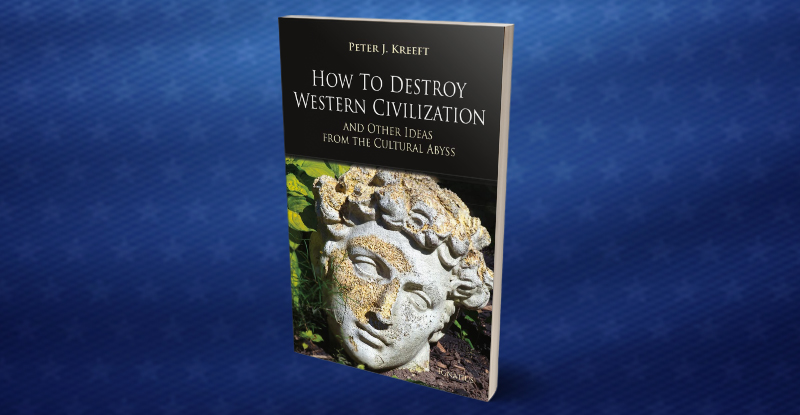
Peter J. Kreeft’s How to Destroy Western Civilization could very well fit the bill for one or all of these reasons. If so, your choice will offer the reward of a thoughtful book to be read with interest, even passion.
There is yet another means of helping you in your decision, a method which must be taken with a grain of salt: book jacket recommendations. They can often be somewhat meaningless. For this book, however, they provide a summary of the book’s main points and an accurate assessment of its quality and thought.
“In describing how to destroy the West, which we’re doing a pretty good job of just now, Peter Kreeft also indicates how to save it, if what’s left is savable.” (1)
“Dr. Kreeft [makes an] explosive call for a renewal of family life, of a culture aware of what it is worshipping , and of a freedom that allows humans to embrace the fullness of life for which they have been created in Christ.” (2)
“A pithy, often very funny book, with a serious underlying purpose…Kreeft…our very own C. S. Lewis, is a keen diagnostician of our our moral and spiritual disorders…He doesn’t flinch or coddle. Truth is hard on those who deny it. (3) (Emphasis mine.)
“Dr. Kreeft shows that the diseases destroying Western civilization are indeed deadly, but need not be fatal.” (4)
There it is, in a nutshell: Kreeft’s analysis of our civilization’s destruction and possibilities of hope aptly summarized on the book jacket. We are destroying ourselves, we can recover, but we must rely on—and return to—Truth.
Dr. Peter J. Kreeft, Ph.D., is Professor of Philosophy at Boston College, where he has taught for over 60 years. He is the author of over 80 books on Christian philosophy and theology. (5)
If one is still undecided about selecting this book, or any book, take a look at the table of contents. In this case, the list of eclectic chapter titles presents a variety of ideas. Whether it’s “The Paradox of Poverty” or “C. S. Lewis, J. R. R. Tolkien, and the Culture Wars,” all focus on our destruction and, as the subtitle describes, Other Ideas from the Cultural Abyss. Most are essays; some are taken from talks by Kreeft.
Perhaps, as part of your decision, you might want to skim a chapter. In that case, don’t miss Chapter 3, “The Unmentionable Elephant in the Living Room of the Liberty Debate.” That would be sex—and yes, “[w]e are at war.” The roots of this war stem from the Obama Administration’s push for “sexual ‘liberty’ vs. religious liberty, which includes liberty of conscience.”
Or Chapter 5, “The Logic of Liberalism,” featuring pithy statements such as:
“You may worship any God but God.”;
“I love all human beings. I hate only conservatives.”; and
“We hate censorship. We love speech codes.”
Or Chapter 7, “Twelve Core Values” of the Lumen Institute. (6)
Should you decide to read the entire work of philosophy, morality and logic, you will be well-pleased. In fact, for Kreeft fans, you might just find that this is one of his best works, if not the best you have read. His writing is structured, logical and always thought-provoking. Wit and sarcasm make appearances in appropriate places.
Several main points of the book are of particularly interest to STARRS readers.
As in most books addressing the destruction of Western Civilization, Marx is mentioned in several chapters. So are Darwin and Freud. These are the “three most influential modern thinkers…all atheists, materialists, naturalists and immoralists.” For good measure, Nietzsche is mentioned for his “will to power that fascinated intellectuals, because intellectuals are usually physically weaker than ordinary people and need to compensate or cover this up.” (Yes, Kreeft expertly blends humor with truth.)
In a talk on the “Twelve Core Values” to the Lumen Institute, Kreeft describes three which echo the USAF core values of Integrity First, Service Before Self and Excellence in All We Do.
For Kreeft, these are clearly “leadership values” and are all related to Christ. Kreeft quotes the Lumen Institute Handbook: “Christ is your criterion of integrity.” Regarding Service Before Self, Kreeft states that “[M]agnanimity is…the very nature of God. The ultimate reason for giving yourself to other is that that is the nature of human reality.” Finally, “[E]xcellence in all things is Christocentric.”
The flip side of these, and other noble values discussed in the book, is demonstrated by Kreeft’s skewering of Supreme Court Justice Anthony Kennedy’s famous (or, for some—infamous) writing in Casey vs. Planned Parenthood.
Kennedy wrote: “At the heart of liberty is the right to define one’s own concept of existence, of meaning, of the universe, and of the mystery of human life.” Kreeft finds Kennedy’s words the “most foolish, idiotic, and even insane thing ever written by a Supreme Court Justice.
In his signature sarcasm, Kreeft visualizes Kennedy saying to God, “Move over, you’re sitting in my seat.”
Although this is a work of classic Kreeft logic, he contradicts himself in discussing Islam. He dedicates an entire chapter to “A Word about Islam, and a Defense of My Controversial Book about It.”
Elsewhere in the book, he admits that “there is much not to envy in Islam: terrorism, lack of respect for human life, for women, to reason and for freedom.” And yet, in the very next sentence, he states “But Muslims are almost always genuinely moral, though narrow.”
One might think that basic violations of morality are being overlooked here.
Nevertheless, as Kreeft emphasizes in his chapter on Islam, there are certain qualities of Islam which those of a Judeo-Christian faith are lacking. Kreeft respects and praises Islam for its “bare, simple essence” that is the “core of all authentic religion: total surrender, total submission, total conformity to the Will of God.”
Europe will become a Muslim continent because the “sophisticated, cultured, sensitive, advanced, compassionate continent…is dying because it has repudiated its ‘primitive’ roots.”
The qualities of Islam admired by Kreeft underscore deficiencies in Christianity, a subject which has been discussed in both an article and a book featured during STARRS Zoom meetings.
In “How ‘wet noodle Christians’ surrendered American to Marxists” (7), Gwen Anderson describes how many of today’s Christians are failing to publicly oppose evil and support a moral direction of society. She cites a “successful Marxist strategy” as a large part of this attitude; “Marxists understood the wet noodle instinct long before many Christians did.”
Contrast this thinking and attitude with the devotion, fervor and total dedication of Islam as described by Kreeft.
Furthermore, Eric Metaxas, in his Letter to the American Church, (8) echoes Anderson’s thoughts on the weakness of today’s church. He compares today’s church leaders’ lack of force is pushing back against immorality with the failure of church leaders to resist Hitler, as encouraged by Dietrich Bonhoeffer. The American church “has cheapened the ideas of belief and real faith.” Metaxas also cites the lies of Cultural Marxism as a factor in the weakness of today’s American church.
Again, contrast these weaknesses with the strengths of Islam.
While acknowledging that he admires aspects of Islam, Kreeft is clearly a devout Christian, and his beliefs permeate all pages of his book. The following key points address the strengths we need to build on in order to combat further destruction of Western Civilization.
In his first chapter, with the same title as the book, he emphatically states that the “one weapon that will infallibly win the future [is] children.” Having children is the “single most necessary thing to we can possible do to save our civilization.”
Regarding society, “the moral quality of individuals is the single most important cause of a good or bad society.”
And the most important influence on the quality of those members of society?
No surprise here, for many, but an influence that is not always recognized—and lived—by the general population: families…[s]table, loving families.” In addition, “religion has always been the strongest moral indicator in the world.”
Kreefts describes three classical types of freedom: political freedom, free will, and teleological freedom. Unfortunately, the most important freedom is one that is too often denied: “the freedom to become what we are designed to be and are supposed to be.”
In this denial, we live a fourth freedom, the “freedom to be God. That is the root of our insanity.” (Emphasis mine.) There is no longer objective truth, we are our own gods.
Enjoy this thought-provoking book. And, in doing so, introduce yourself to the logic, morality, philosophy and yes, even occasional humor, of Peter Kreeft.
Then keep the book on your bookshelf for future reference and as a reminder that your countercultural thinking—like his—is on the right track while we live in a “cultural abyss.”
__
(1) Robert Royal, Ph.D., Author, A Deeper Vision: The Catholic Intellectual Tradition in the Twentieth Century
(2) Fr. David Meconi, S.J. , Director, Catholic Studies Centre, Saint Louis University
(3) Robert Reilly, Author, America on Trial: A Defense of the Founding
(4) Fr. Robert McTeigue, S.J., Author, Real Philosophy for Real People: Tools for Truthful Living
(5) https://www.peterkreeft.com/
(6) https://lumeninstitute.org/
(7) https://www.theblaze.com/columns/opinion/how-wet-noodle-christians-surrendered-america-to-marxists
(8) https://www.amazon.com/dp/1684513898?lv=shuf&channelId=500&plpRedirect=mhFallback
How to Destroy Western Civilization and Other Ideas from the Cultural Abyss
by Peter Kreeft
Book Description:
Peter Kreeft presents a series of brilliant essays about many of the problems that undermine our Western civilization, along with ways to address them. “These essays are not new proposals or solutions to today’s problems,” he says. “They are old. They have been tried, and have worked. They have made people happy and good. That is what makes them so radical and so unusual today.”
In his witty, readable style, Kreeft implores us to gather wisdom and preserve it, as the monks did in the Middle Ages. He offers relevant philosophical precepts, divided into various categories, that can be collected and remembered in order to guide us and future generations in the days ahead.
Kreeft emphasizes that the most necessary thing to save our civilization is to have children. If we don’t have children, our civilization will cease to exist. The “unmentionable elephant in the room”, he tells us, is sex, properly understood. Religious liberty is being attacked in the name of “sexual liberty”, in other words, abortion. Kreeft encourages us to fight back—with joy and confidence—with the one weapon that will win the future: children.

Leave a Comment