
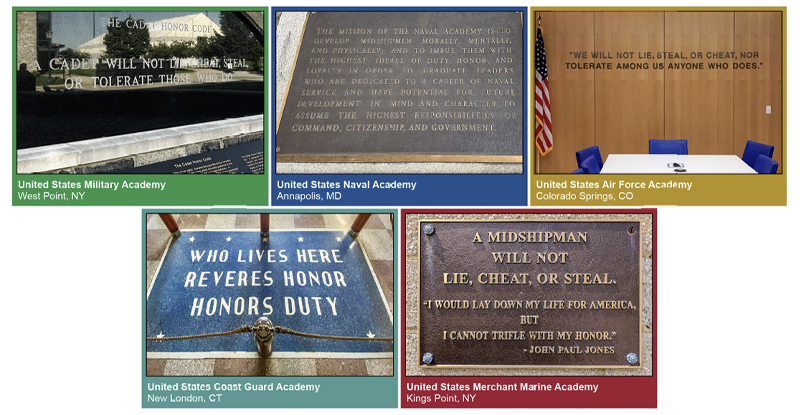
(Government Accountability Office) U.S. service academy graduates are expected to lead as military officers. The academies use honor and conduct systems to enforce ethical and moral standards among students.
Each academy offers due process protections so that students accused of an offense receive a fair hearing. But the guidance at some academies doesn’t clearly specify certain protections. For example, 2 academies don’t have clear guidance on students’ right to access a complete record of the proceeding.
The honor and conduct data that academies collect could help improve these systems but data isn’t always complete or easily accessible.
We recommended addressing these issues (see recommendations at bottom of the page).
Full Report: Clarifying Guidance Would Enhance Effectiveness of Honor and Conduct Systems (PDF)
What GAO Found
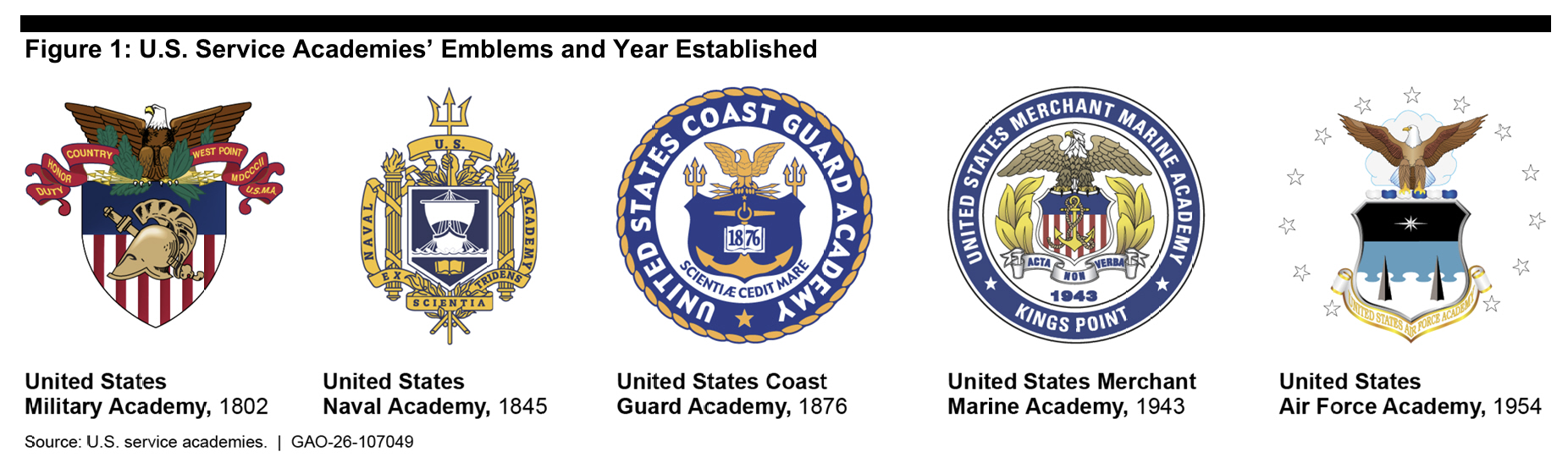
The service academies—West Point, Naval, Air Force, Coast Guard, and Merchant Marine—operate honor and conduct systems to help ensure students adhere to expected ethical and moral standards.
Each academy has student-led honor systems to enforce honor codes that prohibit lying, cheating, and stealing; each also has officer-led conduct systems to maintain good order and discipline.
However, key differences exist across the academies’ systems, such as the use of hearings and the right to appeal hearing findings or punishments.
Typically, each academy offers procedural due process protections to help ensure that students accused of an honor or conduct offense receive a fair hearing.
The academies offer most of the 12 common due process protections GAO reviewed, but some academies’ guidance does not clearly specify the availability of certain protections.
For example, two academies do not provide clear guidance on students’ rights to access a complete record of their proceeding.
By reviewing and revising honor and conduct system guidance to clearly articulate available protections, the academies can help ensure students are informed of their rights when engaging with processes that could impede their ability to graduate and serve as officers.
The honor and conduct offense data collected by the academies are not always complete or easily accessible.
Specifically, some academies do not collect data on certain stages of their honor and conduct systems, such as investigations or appeals.
Further, officials from four academies said they faced challenges in accessing relevant data. Addressing these challenges would improve the academies’ ability to manage their systems with quality information
Students GAO surveyed at the academies generally reported favorable opinions about their honor and conduct systems but raised some concerns about their fairness.
Between about 25 to 45 percent of students, depending on the academy, said honor system findings were not applied fairly to all students, while about 40 to 55 percent said the same for conduct.
Students also stated a reluctance to report honor offenses and minor conduct offenses.
However, around 50 to 80 percent of students, depending on the academy, were willing to report major conduct offenses.
Why GAO Did This Study
The service academies seek to graduate military officers with high ethical and moral standards. Students who violate these standards may be disenrolled.
House Report 118-125 (page 155) (pdf) includes two provisions for GAO to review academies’ honor and conduct processes.
This report assesses the extent to which
(1) academy honor and conduct systems compare to one another and provide common procedural due process protections, and
(2) academies collect honor and conduct data.
It also describes (3) the perceptions of students toward their respective academies’ honor and conduct systems.
GAO reviewed academy policies and honor and conduct data for academic years 2018-2019 through 2023-2024. It also surveyed 6,984 students across the five academies.
The survey results are generalizable to the sophomore through senior population at each respective academy.
Complete survey results can be viewed at GAO-26-108179 (see below at bottom of page).
GAO also interviewed academy officials and conducted site visits to each academy.
Recommendations
GAO is making 13 recommendations, including that the academies assess and update honor and conduct system guidance to ensure that due process protections are clearly articulated and include data collection requirements for all system stages.
GAO also recommends the academies address challenges that limit timely access to data. The Departments of Defense, Homeland Security, and Transportation concurred with all recommendations.
Department of the Army
The Secretary of the Army should ensure that the Superintendent of West Point assesses and updates the conduct system guidance to ensure that the intended range of due process protections available to students accused of conduct offenses are fully and clearly articulated. (Recommendation 1)
Department of the Navy
The Secretary of the Navy should ensure that the Superintendent of the Naval Academy assesses and updates the honor and conduct system guidance to ensure that the intended range of due process protections available to students accused of honor and conduct offenses are fully and clearly articulated. (Recommendation 2)
Department of the Air Force
The Secretary of the Air Force should ensure that the Superintendent of the Air Force Academy assesses and updates the honor and conduct system guidance to ensure that the intended range of due process protections available to students accused of honor and conduct offenses are fully and clearly articulated. (Recommendation 3)
Department of Homeland Security
The Secretary of Homeland Security, in coordination with the Commandant of the Coast Guard, should ensure that the Superintendent of the Coast Guard Academy assesses and updates the honor and conduct system guidance to ensure that the intended range of due process protections available to students accused of honor and conduct offenses are fully and clearly articulated. (Recommendation 4)
Department of Transportation
The Secretary of Transportation, in coordination with the Assistant Secretary for Administration, should ensure that the Superintendent of the Merchant Marine Academy assesses and updates the honor and conduct system guidance to ensure that the intended range of due process protections available to students accused of honor and conduct offenses are fully and clearly articulated. (Recommendation 5)
Department of the Army
The Secretary of the Army should ensure that the Superintendent of West Point identifies a comprehensive set of data collection requirements for all stages of the honor and conduct systems—including reporting, investigation, adjudication, discipline and appeal—and documents these requirements in guidance. (Recommendation 6)
Department of the Navy
The Secretary of the Navy should ensure that the Superintendent of the Naval Academy identifies a comprehensive set of data collection requirements for all stages of the honor and conduct systems—including reporting, investigation, adjudication, discipline and appeal—and documents these requirements in guidance. (Recommendation 7)
Department of the Air Force
The Secretary of the Air Force should ensure that the Superintendent of the Air Force Academy identifies a comprehensive set of data collection requirements for all stages of the honor and conduct systems—including reporting, investigation, adjudication, discipline and appeal—and documents these requirements in guidance. (Recommendation 8)
Department of Homeland Security
The Secretary of Homeland Security, in coordination with the Commandant of the Coast Guard, should ensure that the Superintendent of the Coast Guard Academy identifies a comprehensive list of data collection requirements for all stages of the honor and conduct systems—including reporting, investigation, adjudication, discipline and appeal—and documents these requirements in guidance. (Recommendation 9)
Department of Transportation
The Secretary of Transportation, in coordination with the Assistant Secretary for Administration, should ensure that the Superintendent of the Merchant Marine Academy identifies a comprehensive set of data collection requirements for all stages of the honor and conduct systems—including reporting, investigation, adjudication, discipline and appeal—and documents these requirements in guidance. (Recommendation 10)
Department of the Air Force
The Secretary of the Air Force should ensure that the Superintendent of the Air Force Academy addresses challenges that limit timely access to honor and conduct data by officials responsible for managing and overseeing the systems, including identifying a viable solution for tracking the status of honor offenses and establishing time frames for addressing limitations with its current system. (Recommendation 11)
Department of Homeland Security
The Secretary of Homeland Security, in coordination with the Commandant of the Coast Guard, should ensure that the Superintendent of the Coast Guard Academy addresses challenges that limit timely access to honor and conduct data by officials responsible for managing and overseeing the systems, including establishing time frames for addressing any planned solutions. (Recommendation 12)
Department of Transportation
The Secretary of Transportation, in coordination with the Assistant Secretary for Administration, should ensure that the Superintendent of the Merchant Marine Academy addresses challenges that limit timely access to honor and conduct data by officials responsible for managing and overseeing the systems, including establishing time frames for addressing any planned solutions. (Recommendation 13)
Full Report: Clarifying Guidance Would Enhance Effectiveness of Honor and Conduct Systems (PDF)
House Report 118-125 (pdf)
Page 155:
Review of Service Academy conduct and performance adjudication process
The committee is concerned that all Service Academies, including the Coast Guard Academy and the Merchant Marine Academy, have fair and effective adjudicatory systems to review student conduct and performance.
The committee directs Comptroller General of the United States to review the adjudication processes at all Service Academies, including the Coast Guard Academy and the
Merchant Marine Academy and provide a report to the Senate Committee on Armed Services and the House Committee on Armed services no later than March 7, 2024.
This report should include the following:
(1) review the honor and conduct systems, including punishments given for misconduct and performance issues;
(2) describe how the various systems provide common due process protection;
(3) describe how the systems compare to military misconduct/UCMJ processes;
(4) describe which, if any, honor or misconduct issues are included on an individual’s military record when they are commissioned;
(5) describe how the various academies measure student conduct and performance trends;
(6) describe the attitudes and perceptions of students towards their respective systems;
(7) provide recommendations to standardize the policies and processes across the academies;
(8) provide recommendations on process improvements.
Page 160:
Update of Military Academy Misconduct Process Review
It has been 25 years since the U.S. Government Accountability Office conducted a full-scale review of the adjudicatory process of the Department of Defense service academies.
The last version, published in April 1995, found some discrepancies in how the academies operated, including issues of differences in due process protections and differences in the standard of proof used in honor hearings.
Also, the review found that many students found the application of rules and the disciplinary actions inconsistent.
Therefore, the committee directs the Comptroller General of the United States to update the 1995 ‘‘Department of Defense Service Academies: Comparison of Honor and Conduct Adjudicatory Processes’’ and submit the report to the congressional defense committees by February 1, 2024.
At a minimum, the review shall address the following elements:
(1) compare the honor and conduct systems at each academy, including punishments given for misconduct/performance issues;
(2) describe how the various systems provide common due process protections;
(3) describe how the various systems compare to military misconduct/Uniform Code of Military Justice processes;
(4) describe if certain honor or misconduct issues are included on an individual’s military records when they are commissioned;
(5) describe how the academies measure student conduct and performance trends;
(6) describe the attitudes and perceptions of students toward these systems; and
(7) provide recommendations on process improvement.
GAO: SUPPLEMENTAL MATERIAL FOR GAO-26-107049: Questionnaires for Survey of Service Academy Students
This is a supplement to our report SERVICE ACADEMIES: Clarifying Guidance Would Enhance Effectiveness of Honor and Conduct Systems. In that report, we looked at the honor and conduct systems at U.S. service academies.
This supplement presents the questionnaires we used to survey students at the 5 academies: West Point, Naval, Air Force, Coast Guard, and Merchant Marine. It also presents survey results, with each academy’s results presented in its own spreadsheet.
This supplement is a companion to GAO’s report entitled, Service Academies: Clarifying Guidance Would Enhance Effectiveness of Honor and Conduct Systems (GAO-26-107049).
The purpose of this supplement is to provide information from a survey of service academy students we used to obtain student perceptions, attitudes, and experiences with their academy’s honor and conduct systems.
Background
This supplemental material presents the questionnaires used to survey students at each of the five service academies (United States Military Academy (West Point); United States Naval Academy (Naval Academy); United States Air Force Academy (Air Force Academy); United States Coast Guard Academy (Coast Guard Academy); and United States Merchant Marine Academy (Merchant Marine Academy)).
It also includes the results of our surveys, presented by Academy and each question.
To obtain student perceptions, attitudes, and experiences with their academy’s honor and conduct systems, we surveyed a census of 6,984 sophomore through senior students in the fall semester of academic year 2024-2025 at each academy.
Each Academy population received the same questionnaire, but with question and response options tailored to each academy’s terminology and processes.
We tracked responses with differing terminology by assigning a standardized code to comparable questions and response sets across academies, which helped to ensure the consistency of our analysis.
At the end of our survey period, we received from:
- West Point – 972 complete responses (31 percent response rate)
- Naval Academy – 3,086 complete responses (94 percent response rate)
- Air Force Academy – 2,026 complete responses (68 percent response rate)
- Coast Guard Academy – 503 complete responses (61 percent response rate)
- Merchant Marine Academy – 397 complete responses (88 percent response rate)
For our analysis of survey responses, we performed a nonresponse bias analysis using the available student population data.
We compared nonrespondents to respondents based on characteristics such as class year, gender, and race/ethnicity and identified differences for some race/ethnicity and gender groups, depending upon the academy.
We applied weighting as appropriate to align survey respondents with the overall demographics of their respective academies.
For the academies with lower response rates, non-response bias may exist due to unobservable characteristics, but any bias related to demographics included in the non-response model (race and ethnicity, gender, and class year) is mitigated.
The survey results in our online supplemental materials are presented by Academy and each question, excluding those with open-ended responses, is presented with its weighted results including margins of error for each response.
All survey results are generalizable to the population of their respective academies, unless otherwise noted. Further information on our methodology can be found in appendix I of the report (GAO-26-107049).
We are sending copies of this report to the appropriate congressional committees, the Secretary of Defense, the Secretary of the Army, the Secretary of the Navy, the Secretary of the Air Force, the Secretary of Homeland Security, and the Secretary of Transportation.
In addition, this report is available at no charge on the GAO website at http://www.gao.gov.
We conducted the work upon which this supplement is based in accordance with generally accepted government auditing standards.
Those standards require that we plan and perform the audit to obtain sufficient, appropriate evidence to provide a reasonable basis for our findings and conclusions based on our audit objectives.
We believe that the evidence obtained provides a reasonable basis for our findings and conclusions based on our audit objective.
For more information, contact Kristy E. Williams at williamsk@gao.gov.
Microsoft Excel Sheets of Survey Results:
- Air Force Academy Survey Results
- Military Academy (West Point) Survey Results
- Naval Academy Survey Results
- Coast Guard Academy Survey Results
- Merchant Marine Academy Survey Results
Click to enlarge:





Leave a Comment