
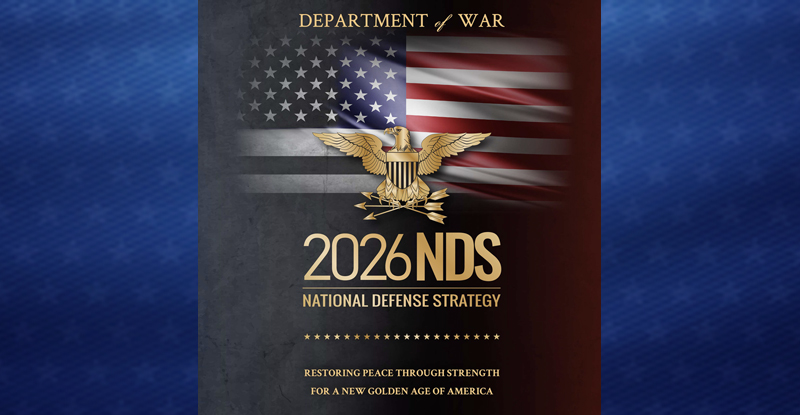
The Department of War has released its 2026 National Defense Strategy (pdf)
From the opening memo from SecWar Hegseth:
For too long, the U.S. Government neglected—even rejected—putting Americans and their concrete interests first.
Previous administrations squandered our military advantages and the lives, goodwill, and resources of our people in grandiose nation-building projects and self-congratulatory pledges to uphold cloud-castle abstractions like the rules-based international order.
These past leaders neglected and often actively undermined our warfighters’ warrior ethos and our military’s core, irreplaceable role—fighting, winning, and thereby deterring the wars that really matter to our people.
Consequently, President Trump entered office with the nation on the precipice of disastrous wars for which we were unprepared.
President Trump has decisively changed that, courageously putting Americans first to truly make America great once again.
Under his leadership, the United States has the world’s strongest, most lethal, and most capable military—indeed, the most powerful military that this world has ever seen.
No longer will the Department be distracted by interventionism, endless wars, regime change, and nation building.
Instead, we will put our people’s practical, concrete interests first. We will support a policy of actual peace through strength.
We will be the sword and shield to deter war, with the goal of peace—but ready to fight and win the nation’s necessary wars if called upon.
This does not mean isolationism. To the contrary, it means a focused and genuinely strategic approach to the threats our nation faces and how to best manage them.
This approach is based on a flexible, practical realism that looks at the world in a clear-eyed way, which is essential for serving Americans’ interests.
As the National Security Strategy articulates, this is the commonsense approach President Trump has advanced.
America First. Peace Through Strength. Common Sense.
Essential to this approach is being realistic about the scale of the threats we face and the resources available to meet those threats.
We recognize that it is neither America’s duty nor in our nation’s interest to act everywhere on our own, nor will we make up for allied security shortfalls from their leaders’ own irresponsible choices.
Instead, the Department will prioritize the most important, consequential. and dangerous threats to Americans’ interests.
We will restore the warrior ethos and rebuild the Joint Force so that America’s enemies never doubt our resolve or ability to respond decisively to those threats.
We will insist that allies and partners do their part and lend them a helping hand when they do step up.
We will be responsible stewards of Americans’ lives, money, and support.
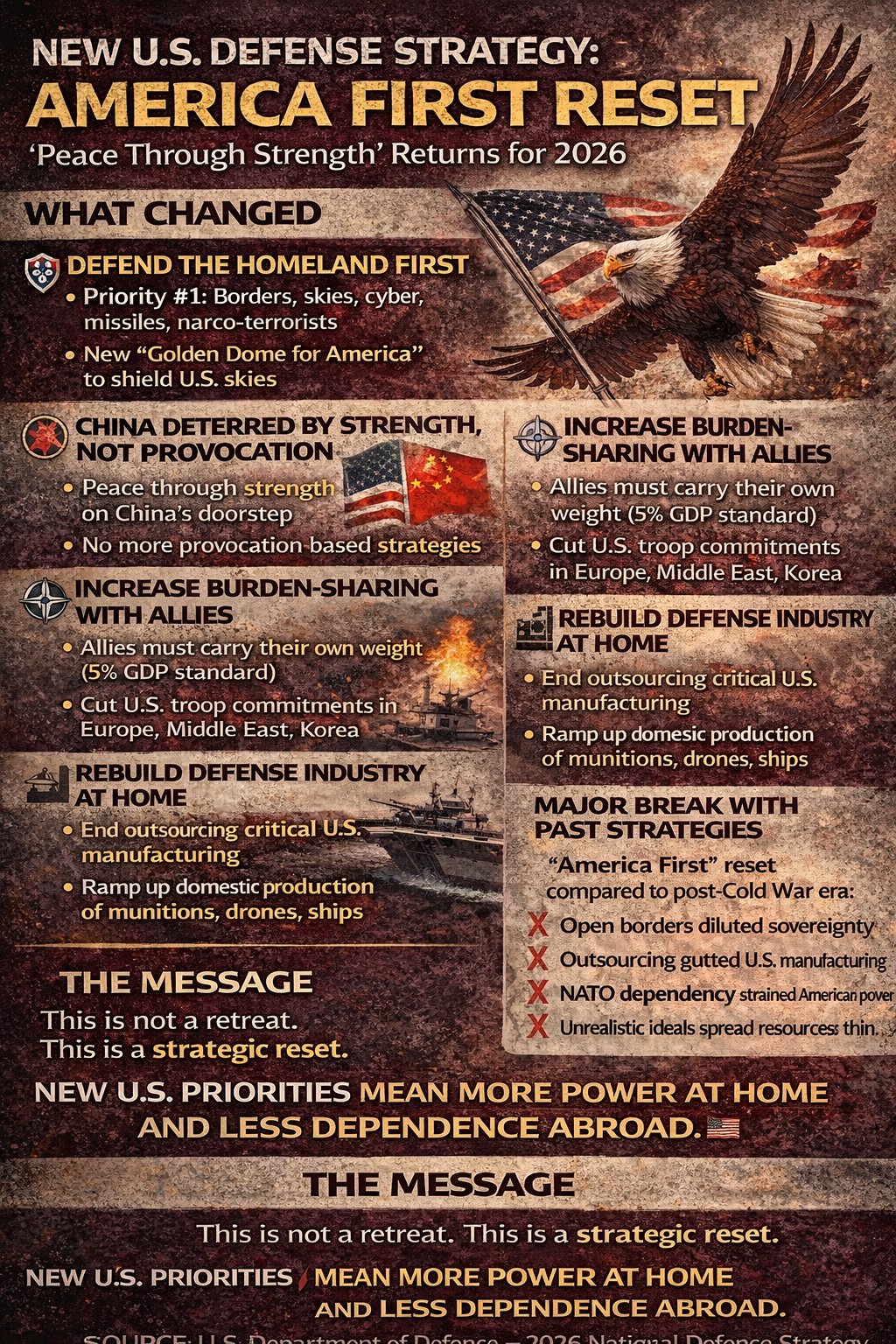
We will defend the homeland and ensure that our interests in the Western hemisphere are protected.
We will deter China in the Indo-Pacific through strength, not confrontation.
We will increase burden-sharing with allies and partners around the world.
And we will rebuild the U.S. defense industrial base as part of the President’s once-in-a-century revival of American industry.
In the process, we will restore peace through strength—not just for the duration of President Trump’s administration but for decades to come, as the American people deserve.
The 2026 National Defense Strategy shows how.
This Strategy reflects President Trump’s historic approach to our nation’s defense. It must be carried out thoroughly, rapidly, and comprehensively.
All Department of War components will adhere to the guidance and direction enclosed.
Secretary of War Pete Hegseth
Read: 2026 National Defense Strategy (pdf)
The 2026 U.S. National Defense Strategy in one page. pic.twitter.com/nWQkdiagiw
— Kayla Haas (@kaylahaas) January 25, 2026
Click to enlarge

🧵 THREAD: The 2026 National Defense Strategy Is a Quiet Revolution in U.S. Power
The Pentagon just released the 2026 National Defense Strategy—and almost nobody understands how radical it is.
This document ends a 30-year era of U.S. military thinking.
Let’s break it down 1/ pic.twitter.com/eW5J1dARNl
— Brandon Weichert (@WeTheBrandon) January 24, 2026
🚨 NEW: PENTAGON DROPS 2026 NATIONAL DEFENSE STRATEGY 🚨
This isn’t business as usual.
This is a full America First reset of U.S. military strategy.For the first time in decades, the Pentagon says the quiet part out loud:
🇺🇸 DEFENDING THE HOMELAND COMES FIRST.
Not… pic.twitter.com/p53WS666ct
— Richard Miriti (@miriti55453) January 24, 2026
My thoughts on the NDS 2026….The 2026 National Defense Strategy Gets It Right: We Must Choose—So We Don’t Have to Fight.
For years, I’ve said this publicly and consistently: the objective of American deterrence is no war. Not delayed war. Not managed war. No war.
The 2026 NDS…
— GEN(R) Charlie Flynn (@GENCharlieFlynn) January 25, 2026
My thoughts on the NDS 2026….The 2026 National Defense Strategy Gets It Right: We Must Choose—So We Don’t Have to Fight.
For years, I’ve said this publicly and consistently: the objective of American deterrence is no war. Not delayed war. Not managed war. No war.
The 2026 NDS reflects that principle more clearly than any strategy in decades—and that clarity is why it matters.
The document opens with an uncomfortable truth Washington often avoids: the United States cannot deter everyone, everywhere, all at once. Pretending otherwise has diluted focus, credibility, and capacity. This strategy does something rare—it prioritizes.
First, it places homeland defense and the Western Hemisphere at the center. Borders, airspace, cyber networks, missile defense, nuclear deterrence, and counter-terrorism are treated as core warfighting missions. A nation that cannot defend itself at home cannot credibly deter abroad; nor can it project power to protect itself and our Allies & Partners.
This shift is especially consequential in the Arctic. And it was the US Army that developed and published the first Arctic Strategy document back in 2021. The manifestation of that strategy was the establishment of the 11th ABN DIV in Alaska and JPMRC-Alaska; the first Arctic Training Center established by the Army in the modern era. I’ve long stated that Russia operates inside the Arctic circle and is militarizing it as home terrain. China sits outside the Arctic circle looking in, using economic, scientific, and espionage tools to gain access and influence. For too long, the United States has been episodic—engaged only when a crisis forced attention. That era is over. The Arctic is no longer a buffer; it is our Northern Flank and it must be defended. Alaska is not a frontier—it is a strategic bastion.
Second, the strategy is explicit about China—without being reckless. China is the pacing threat. The objective is not dominance or humiliation; it is denial. Prevent any power from controlling the Indo-Pacific’s economic and strategic center of gravity. That is how war is avoided. That along with gaining (or re-gaining) positional advantage with hard power forward, extended by a Strategic Landpower Network creating the security architecture that binds the region together. Deterrence in the Indo-Pacific does not come from speeches. It comes from credible military capability and resilient landpower networks—forces, command & control, air & missile defense, medium & long range fires, EW, intel collection, and logistics hubs that become an epoxy for Aliies & Partners together across distances. Landpower is what makes deterrence real and measurable.
Third, the strategy forces Allies to grow up and take stock of their security situation and their military capabilities. Alliances remain central, but dependency is over. Partners in Europe, the Indo-Pacific, and the Western Hemisphere are expected to carry greater responsibility for their own defense. The message is clear your border, your people, your territorial integrity, and your national sovereignty are first and foremost your responsibility. Yes of course the United States can and will provide leverage—but we will no longer subsidize your responsibilities. Said another way, we will help those that help themselves! This is not abandonment. It is accountability. Deterrence works when Allies contribute real capability—forces, access, sustainment, and political will—not just statements.
Finally, the strategy recognizes a truth too often ignored: deterrence fails without production. Manufacturing capacity, logistics, supply-chain resilience, and rapid adoption of technologies like AI are decisive elements of national power. This is a mobilization mindset, not incremental reform. We have to grow our Oil & Gas Capabilities, CM & REE Stocks and the processing to build concentrates and deliver manufacturing at scale, and finally apply rapidly the AI & ML technologies to match greater outputs and productivity levels.
Taken together, the doctrine is simple: peace comes from strength, focus, a sense of urgency, and credibility—not from wishful thinking or endless global obligations.
The United States does not seek war. The purpose of this strategy is to make war unnecessary by denying adversaries the belief that they could succeed.
In an era of great-power competition, clarity is not escalation.
Clarity is deterrence.






Leave a Comment