
By @CynicalPublius on X
Retired US Army Colonel
Recent days have seen the confluence of two news stories that stand on opposite sides of the divide regarding the appropriate public role of our nation’s rank-and-file, uniformed military.
In this article I will briefly explain the two news stories, and then by way of a simple parable explain why those stories are about fundamentally different events (despite the best efforts of some to conflate the two).
The first story has to do with an active duty United States Air Force major named Jason P. Watson.
On July 1, 2026, Watson, a graduate of the United States Air Force Academy, participated in a press conference in front of the U.S. Capitol, in uniform, calling for the impeachment and removal of his Commander-in-Chief.
The press conference was organized by something called the “Removal Coalition,” and Watson was accompanied by Democrat Congressman Al Green. Watson then stood on the Capitol steps holding a sign saying “Impeach—Convict—Remove.”
I will not go into the legal details here, but such contemptuous speech violates several sections of the Uniform Code of Military Justice (UCMJ), and Watson will almost certainly face non-judicial punishment or a court martial for his actions.
The second story is one that has gone hot and cold for many months, and involves serving military members speaking positively on social media in support of the many reforms Secretary Pete Hegseth is instituting in the Department of War.
If you follow me, you likely know two such military officers: @InfantryDort and @KTB_500.
Many members of national security academia, the MILBLOG community and their various apparatchiks have spent countless hours attempting to silence these and other serving military members who do nothing more than speak positively about their chain of command’s orders and policies. The attempted smears have even extended to the national media.
Here is where it gets interesting. Certain members of the self-appointed national security intelligentsia have attempted to conflate the two stories, claiming that the obviously contemptuous and obviously political speech of Major Watson and the supportive, apolitical speech of the above-mentioned social media warriors are the same in nature, and equally violative of the UCMJ.
(See here, here, and here for examples; note that the second two links narrow the applicability of the first link to exemplify what I am pointing out, and the first link must be understood through the second two links.)
In reality, the two stories could not possibly be more different.
I think the problem here is that the aforementioned intelligentsia see things involving Pete Hegseth and/or the Department of War through a purely political lens.
They have been driven to insensibility via their distaste for President Trump and Secretary Hegseth, and it has rendered their reasoning skills suspect.
Further, many of them—having never served in uniform themselves—can only see things military-related as the D.C. Beltway and the national, propagandizing legacy media see them.
So, for those critics who simply do not understand or refuse to understand the U.S. military and the concept of supporting the chain of command, I offer the following hypothetical as a sort of parable.
Here goes:
*******************
Sergeant Jones is a squad leader in B Company, a U.S. Army line infantry company
Captain Smith is the commander of B Company.
First Sergeant Rock is the first sergeant of B Company.
B Company’s former commander had a quite poor company training plan that focused primarily on administrative tasks that were not mission essential, a shoddy training plan that was implemented by the prior first sergeant, who was known widely as a weak leader and a “suck up” to the battalion and brigade command sergeants major. As a result, when B Company went to war there was a steep learning curve, and in the first couple of months in combat several B Company soldiers became casualties unnecessarily.
Sergeant Jones was very unhappy with that training plan and predicted that if they were deployed, the unit would suffer. He was incredibly frustrated when the predictions he had kept inside his head became true in combat.
However, being a true professional, he only ever voiced his concerns to his platoon sergeant and platoon leader, never once spoke out negatively in a public way or to his subordinates, did everything he could to train his squad members effectively despite the terrible training plan, and gave his very best in carrying out all assigned orders (all of which were lawful orders, although sometimes incompetent).
B Company redeployed from combat and Captain Smith took command while First Sergeant Rock took over as first sergeant.
Captain Smith and First Sergeant Rock then implemented an aggressive training plan focused on the unit’s mission essential tasks and the lessons learned from the prior deployment.
Sergeant Jones was overjoyed to see how effective the new training plan was. He knew that if they were deployed again, B Company would be far more effective and proficient. (That is because Sergeant Jones was a true warrior who was very proficient in his tactical and technical skills.)
Sergeant Jones often let his squad members know how happy he was with B Company, the new training plan, Captain Smith, and First Sergeant Rock.
In his on-base neighborhood and anytime he met NCOs from other companies, he would brag about how great B Company had become. Sergeant Jones was an unabashed, vocal champion of the new regime in the Company HQ and the new training plan, and he would let anybody who would listen know his feelings.
Sure enough, a few months later B Company deployed to war again, and this time performed brilliantly, accomplishing all assigned missions with very few casualties.
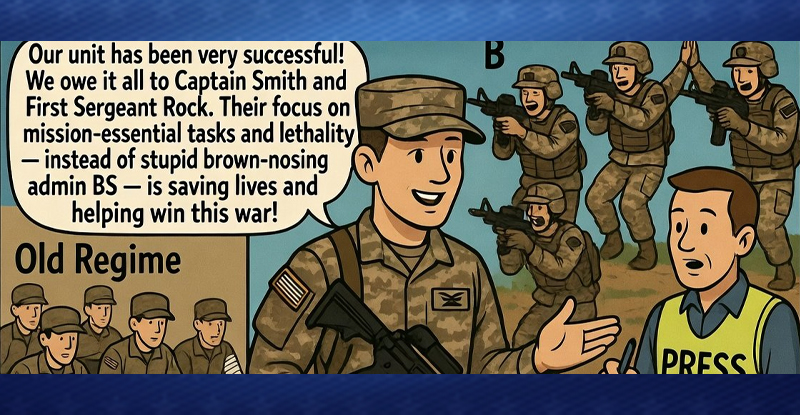
On one patrol of Sergeant Jones’ squad, an embedded “military affairs correspondent” accompanied the squad. After a successful mission, the correspondent interviewed Sergeant Jones. Sergeant Jones said:
“Our unit has been very successful over here. We owe it all to Captain Jones and First Sergeant Rock. Their focus on mission essential tasks and lethality over stupid brown-nosing administrative BS is saving lives and helping to win this war. I cannot say enough good things about my chain of command—they are the best and have made all the difference in the world.”
The correspondent then reported this in his major national periodical, repeating Sergeant Jones’ words verbatim, and questioning whether a sergeant E-5 should be so “political” and outspoken about his chain of command, and wondering if he should be punished under the UCMJ.
*******************
For you low-information voters out there (thanks, Rush Limbaugh), let me break it down for you:
The old company commander and first sergeant = Joe Biden, Lloyd Austin and their Pentagon team.
Captain Smith and First Sergeant Rock = President Trump, Pete Hegseth and their Pentagon team.
Sergeant Jones = serving officers, NCOs and junior enlisted vocally supportive of their current chain of command.
If Sergeant Jones had badmouthed his old chain of command publicly = Major Watson.
Military affairs correspondent = the self-appointed national security intelligentsia.
Too simple of an analogy?
Nope.
Exactly on point.
I stand by our uniformed military standing by their oaths and the entirely necessary reforms President Trump and Secretary Hegseth have instituted across the U.S. military, and if you pay close attention you’ll realize that almost everyone in uniform today is a Sergeant Jones and there are only a tiny handful of Major Watsons.
— Cynical Publius (@CynicalPublius) July 3, 2026






Leave a Comment