

By Will Thibeau, veteran Army Ranger, and Lukas Wagner
The National Defense Authorization Act restores DEI loopholes, protects bureaucrats, and undermines Trump’s national security plan.
The Trump administration recently released an extremely promising National Security Strategy — but the same cannot be said about the proposed National Defense Authorization Act for the 2026 fiscal year.
The House and Senate’s compromise NDAA appears to be in tension with the goals of the administration’s strategy.
While the National Security Strategy prioritizes a hemispheric defense of the American homeland, the NDAA locks decision-makers into maintaining unnecessary overseas troop levels.
Despite President Trump’s stated strategic aims, Congress seems intent on safeguarding the national security priorities and infrastructure of previous eras.
Restricting the drawdown of troops stationed overseas, increasingly murky foreign entrenchment through legally binding efforts to sell arms, and dubious clauses requiring congressional approval at every turn, all serve to bind the commander in chief’s hands.
All of this reeks of a shadowy order desperately trying to maintain the status quo at the expense of the will of the people who elected Donald Trump in 2024.
This cannot stand.
Section 1249 of the NDAA states that U.S. forces in Europe cannot fall below 76,000 for more than 45 days without presidential certifications to Congress. This is supposed to ensure that troop reductions present no threat to NATO partners or U.S. national security. (Absurdly, the bill requires the U.S. to consult with every NATO ally and even “relevant non-NATO partners.”) But stripping the president of essential discretion through ludicrous legislative roadblocks categorically subverts his authority under the Constitution.
Section 1255 states that troop levels cannot dip below 28,500 in the Korean Peninsula, nor can wartime operational control be transferred without an identical trial by fire of congressional approvals and national-security certifications.
Shifting our military focus to our own backyard was a stated goal of the National Security Strategy. If this vision is to be implemented, Congress cannot serve as a bureaucratic middleman that hinders deployment flexibility through pedantic checklists.
Americans need to understand that the NDAA would obstruct the execution of President Trump’s agenda.
As written, it functions as a deliberate statutory barrier to presidential decision-making. This denotes a redistribution of war powers from the elected executive to a sprawling and unaccountable institutional structure.
The NDAA represents what Americans call the “deep state,” a combination of entrenched interests, committees, lobbies, and bureaucracies that value continuity over strategy and reform.
This continuity becomes clear when you look at what the House and Senate didn’t include in the compromise NDAA.
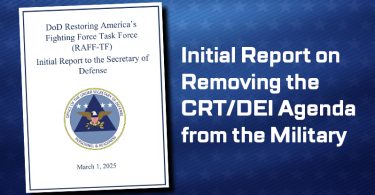
The Senate’s original bill contained a provision barring the use of DEI in service-academy admissions — a measure that would have required merit-only standards and prevented racial profiling.
Congress stripped that section out. The final bill includes a few weak gestures toward limiting DEI, but none of them meet President Trump’s goal of a military that rejects race and sex as factors altogether.
First published on Blaze Media




Leave a Comment