
By Col. Rob Maness, USAF ret
STARRS Board of Advisors
Folks, today we’re diving deep into America’s greatest threat: Communist China, empowered by our own missteps. The United States faces two enemies—one external and one internal.
Externally, it is China, now the most powerful adversary America has ever confronted—openly determined to surpass and replace the United States as the world’s leading superpower.
Internally, it is the Radical Left—whose influence has fueled unrest, riots, and what increasingly resembles open insurrection.
What connects these two forces? Communism. Socialism. Marxism—and its modern variant, often called neo-Marxism or “wokeism.” Even threats like Islamism gain ground under its intellectual cover and institutional protection in the West.
President Trump called Nixon’s opening to China the worst mistake in American foreign policy, and he’s right: we don’t blame China for exploiting us; we blame American leaders who allowed it. If we’d understood communism earlier, the CCP might never have seized power.
Today the CCP has embedded itself inside our institutions—academia, business, technology, media, culture—while benefiting from ideological sympathy on the American left. This is an undeclared, unrestricted, protracted war, and knowledge is our first weapon.
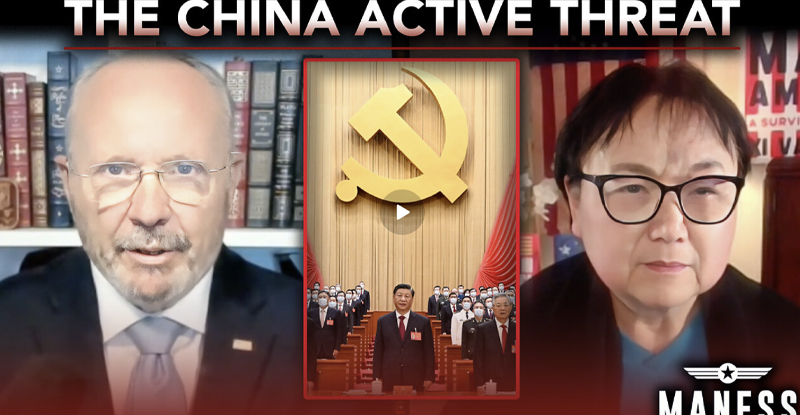
I’m honored to have the great American patriot Xi Van Fleet join me to discuss her powerful new book that lays all of this bare. Xi lived through the horrors of the Chinese Cultural Revolution as a schoolgirl.
Forced to the countryside with other young Chinese for re-education after high school, she later escaped communism and found freedom and a new life in America. But more than 30 years later, she disturbingly sees signs of the same Cultural Marxism that ravaged her birth country threatening to destroy the America she now calls home.
Xi is the author of Mao’s America: A Survivor’s Warning and her powerful new book: Made in America: The Hidden History of How the U.S. Enabled Communist China and Created Our Greatest Threat.
Watch:
Description of her new book: Made in America: The Hidden History of How the U.S. Enabled Communist China and Created Our Greatest Threat
From the acclaimed author of Mao’s America comes the untold story of how misguided and selfish U.S. elites transformed China from a Communist wasteland into a global superpower—at America’s expense.
One of the most effective anti-communist voices in America today, Xi Van Fleet made waves with her breakout book Mao’s America, exposing eerie parallels between China’s past and America’s present woke revolution. Now, alongside renowned Chinese dissident Yu Jie, she sounds the alarm once more—revealing how the CCP’s rise was not just enabled by Soviet Russia but, shockingly, by the United States itself.
Understanding this hidden history is essential for Americans in confronting the CCP’s global ambitions and stopping the spread of Communism at home.
For over a century, progressive and Communist ideologies have steadily infiltrated American society, shaping U.S.-China policies that have, intentionally or not, empowered the CCP. From its founding in 1921 to its brutal takeover of China 28 years later, the CCP’s ascent was fueled by foreign support—first from the Soviets, then increasingly from the U.S. After the Sino-Soviet split and the near-collapse of China, the United States emerged as the CCP’s primary enabler, helping transform it into the world’s second-largest economy and our greatest geopolitical threat.
Most Americans remain unaware of their own country’s role in the CCP’s unprecedented success. While others have explored pieces of this story, no book has revealed the full picture—until now. With meticulous research and unflinching clarity, this book exposes the uncomfortable truth: to effectively counter the CCP, we must first dismantle communist influence at home.
Book Review of “Mao’s America: a Survivor’s Warning” by Xi Van Fleet

Leave a Comment