

By Capt. Brent Ramsey, USN ret
STARRS Board of Advisors
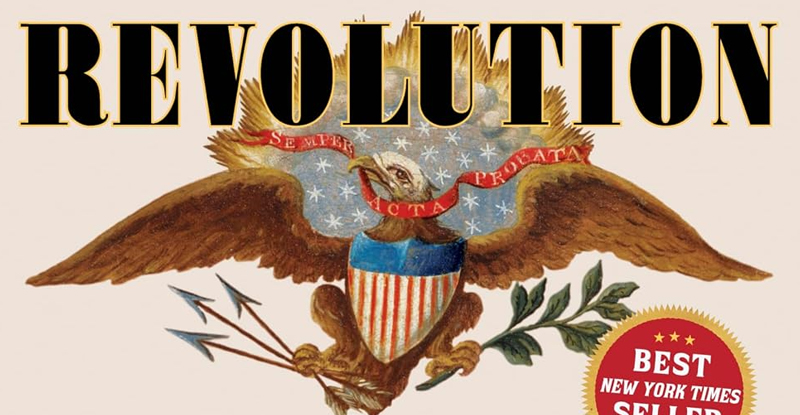
Review of Revolution: The Birth of the Greatest Nation in the History of the World by Eric Metaxas. 640 pages
 Eric Metaxas has written a masterpiece, a must-read classic!
That he is already a noted author of many acclaimed books is well known. He has written biographies, books on Christianity and American culture, humor, children’s books, essays, and scripts—including work for the famous TV show, VeggieTales. His writing has been featured in The New York Times, The New Yorker, The Atlantic, The Wall Street Journal, The Washington Post, National Review, and First Things.
Among his notable books are Amazing Grace: William Wilberforce and the Heroic Campaign to End Slavery, Bonhoeffer: Pastor, Martyr, Prophet, Spy, and Martin Luther: The Man Who Rediscovered God and Changed the World. He has also written over 30 children’s books.
Many prominent people have greatly praised Revolution including President Donald Trump who gave it an unusually enthusiastic endorsement, praising Metaxas for honoring the faith, wisdom, courage and sacrifice of the Revolution’s patriots and calling it an “incredible new book.”
Larry P. Arnn, president of Hillsdale College, praised it as a timely reminder not merely of America’s principles but of the sacrifice necessary to preserve them.
Mark Helprin, the distinguished novelist and author of Winter’s Tale, supplied perhaps the most intellectually substantial endorsement. He praises the book’s readability, historical analysis, and Metaxas’s argument concerning the deeply religious character of the Revolution, concluding that the book gives America “the love it deserves.”
People across the political spectrum have greatly praised the book from Jonathan Turley to Steve Bannon.
Revolution tells the story of how America came to be. It is not speculation. It is the facts of how the British subjects that occupied the North America continent from Maine to Georgia over a period of decades became a separate nation.
Initially there was no plan. Plans came later. But Britain’s treatment of its colonies over time in the new world set the minds of literally millions to thinking about something new.
The Stamp Act was passed in 1865 when the population of the colonies was estimated to be 1.8-2.2 million. This was probably the spark that set things off that led to revolution. Metaxas covers in detail the events and the people who were instrumental in creating a slow-motion revolution in the way people thought of themselves and their relationship to their ancestral homeland.
The book is meticulously researched and footnoted and has hundreds of quotes from key figures both in England and in the colonies. The author’s bibliography lists 69 reference books that he consulted to be able to reconstruct how the revolution started, who the key players were, what the timeline of key events was, and how an impossible concept grew to be an inevitable outcome as time passed.
Throughout the book special attention is given to the mindset and religious faith of those we now refer to as founders. Focus is right and necessarily on key leaders of the colonies like Washington, Jefferson, Adams and several dozen others that we all remember from grade school.
But the point is made repeatedly that it wasn’t just those towering figures of yore that created a new country, it was that much of the populace was aligned with the thinking of the leaders.
The key aspects of the book are:
1. The revolution was truly a sacred cause. Americans truly believed God was on their side. Almost all the leaders were highly religious people as was most of the populace. Even if not involved in organized religion, the people were distinctly religious. People prayed publicly including prominent members of society. They put aside days to reflect on their faith and give thanks to their creator. They looked to the Bible for guidance on how they should live their lives and most lived a life of faith. This was largely a protestant revolution. Catholics in America played a less significant role in the revolution.
Repeatedly when things were not going well and that was the case for much of the war, the leaders and the people prayed for deliverance and held fast to their faith that God would somehow deliver them out of their bad circumstances.
And miracles did seem to occur repeatedly where either circumstances or even changes in weather at the last minute became the difference between winning or losing a key battle.
Throughout the war, Americans publicly expressed their faith, had events to honor God and a majority were pious believers who felt the revolution was a sacred cause and had similarities to the escape from Egypt in the Bible. It is no accident that the first two sentences in the Declaration of Independence refer to God.
The first sentence names“Nature’s God and the second holds these immortal words, “We hold these truths to be self-evident that we are endowed by our Creator with certain inalienable rights to life, liberty and the pursuit of happiness.”
From the very first inkling of the coming revolution through to its declaration and then completion, Americans spoke their faith, acted on faith, and thanked their faith for bringing their dreams of freedom and independence to fruition.
When the war was won, the original American Seal that was created by Franklin, Jefferson and Adams contained distinctly Christian references and images.
2. While their Christian values were supremely important to the leaders of the Revolution and the population in general, issues of freedom from unfair treatment and taxation and being considered second-class citizens by the Brits was a major cause of the revolution.
When the colonies were established, it was clear that those that lived in America were still British subjects. They expected to be respected and treated fairly. Over time, British treatment of the colonies became more harsh, more dictatorial and more expensive and resentment built. But, in the 1700’s the conditions and relations between the colonies and England and its rulers became worse. Eventually, it reached a boiling point, and the revolution began in earnest.
3. English society, their politicians, and especially leadership all the way up to the King were non-religious, self-serving, vile hedonists and had zero respect for America, Americans, and their Christian values. In fact, they ridiculed and reviled them. Decadence was the norm in England and Metaxas describes in detail how corrupt the government and most of its leaders were. Most had complete disdain for the Americans and their values.
The British crown, the leaders and the people in general resented and despised the colonies and looked to America for only the money it could generate for them. They cared not for any rights for the colonies. They saw the colonies as a source of funds only and applied taxes to them that were unique to the colonies and not practiced at home.
4. A largely untold and ugly part of the Revolution was the truly awful and barbaric behavior of the English and their agents the Hessians and Indians. Horrendous war crimes against the Americans were encouraged and carried out. Captured prisoners were horribly abused, tortured and a large percent were just killed or kept in such horrible prisons that they died of either starvation, disease or abuse or a combination of all three.
In contrast, Americans for the major part were not abusive to captured prisoners and treated them with kindness and respect. George Washington insisted on humane treatment and often pointed to Christian values in how prisoners of war should be treated well. When Washington and his forces were on the run or depleted or starving, he continued to live his Christian values serving as a remarkable witness to his faith to his troops. His faith was always in plain view to all including his troops and he made frequent public statements of his faith in God.
5. The French helped the Americans win the war, but they delayed acting many times, often did what they wanted and not what Washington wanted and were responsible for the war dragging on so long and for casualties on our side piling up much higher. Had the French kept to their commitments and followed Washington’s lead instead of their own judgement and agenda, the war would have be won much more quickly and with far fewer casualties. In fact, the French even at one point secretly advanced a divided country idea to the British. Their idea was that some states would stay British and others would be part of a new America. Ultimately, towards the end of the war the French came through and with their help the Americans won the final battle that ended the war.
I cannot recommend this book highly enough.
To understand America of the present and how far we have strayed from the founders’ vision, you must read this book. By understanding our founding, may we redouble your efforts to restore the America we live in today to its founding faith and values.
Ben Franklin when asked what form of government we had famously said, “A republic, if you can keep it.”
John Adams said,
“We have no government armed with power capable of contending with human passions unbridled by morality and religion. Avarice, ambition, revenge, or gallantry, would break the strongest chords of our Constitution as a whale goes through a net. Our Constitution was made only for a moral and religious People. It is wholly inadequate to the government of any other.”
Estimates are that the people at the time of the revolution were 80-90% culturally Christian. Today that figure has declined to 62%. If we are to survive as the nation our founders created, that decline must be reversed.
Revolution: The Birth of the Greatest Nation in the History of the World by Eric Metaxas. 640 pages


Leave a Comment