
By Francis Sempa
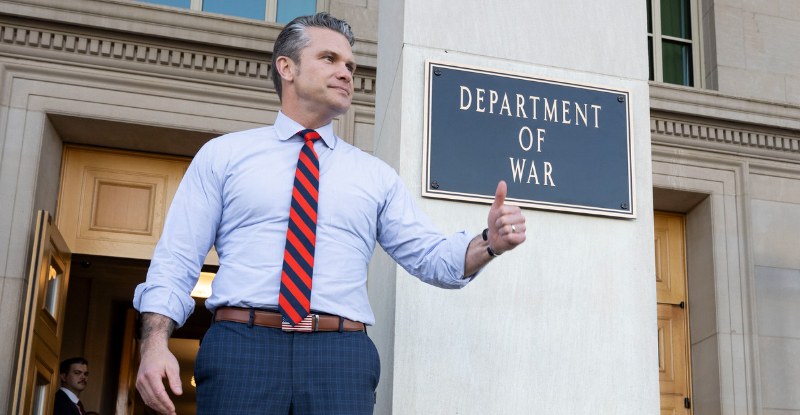
A front-page story in the Washington Times by Ben Wolfgang is headlined “Top Officers Lose Trust in Hegseth.” The story quotes “numerous high-ranking officers,” anonymous retired and current generals and flag officers, and top civilians at the Pentagon who contend that War Secretary Hegseth is an “unserious” and “grandstanding” leader with a “junior officer’s” mentality who is doing “deep damage to the military.” Hegseth, they say, is seen as “unprofessional,” and his personnel moves are leading to “an unprecedented and dangerous exodus of talent from the Pentagon.”
Hegseth is weakening the military by fighting the “culture war” within the ranks, according to liberal defense commentator Michael O’Hanlon of the Brookings Institution.
O’Hanlon, it appears, speaks for the pro-DEI and pro-woke high-level officers who implemented the Obama-Biden transformation of the armed forces from the warrior ethos of the past into a kinder, gentler force where promotions were based not on merit but on diversity.
It is a military that has not won a war since 1991 in the Persian Gulf, and that was spread thin fighting endless wars in Afghanistan and Iraq and waging the Global War on Terror.
It is a military where physical standards were sometimes lowered in the name of diversity, and where rules of engagement sometimes gave advantages to our enemies and unnecessarily exposed our forces to greater danger.
None of this was the fighting force’s fault—it was, instead, the fault of civilian and military leaders who forgot or simply ignored that the primary mission of our armed forces is, in Gen. Douglas MacArthur’s words, “to win our wars.”
The brass at the Pentagon and in the field are apparently miffed that Secretary Hegseth and President Trump recently required them to attend a meeting at Quantico where Hegseth reiterated his commitment to reestablishing the “warrior ethos,” to discarding previous administrations’ DEI and woke agendas, and to insist on exacting standards of physical fitness for the nation’s soldiers, sailors, airmen (and air women) and Marines.
After years of having to stomach the Obama-Biden administrations’ promotion of diversity, equity and inclusion and wokeness—
- where armed forces secretaries called climate change the country’s most pressing existential threat;
- where administrators and commanders implemented a woke agenda of erasing history and tradition by removing monuments, renaming forts, ships, buildings, and streets; and
- where our military academies institutionalized DEI programs and courses
—you would think that the military brass would welcome the Trump administration’s prioritizing of warfighting and its trashing of political correctness.
Alas, like all bureaucratic institutions, the Pentagon gets used to doing things a certain way. Change makes them uncomfortable.
The anonymous sniping at Hegseth—and effectively at Trump—shows that the rot in our military is at the top.
These leaders, after all, are the men and women who after the end of the Cold War dropped bombs and shot missiles at people in the Balkans, planned and oversaw endless and futile wars in Afghanistan and Iraq, and conducted a seemingly endless Global War on Terror.
And while they and their civilian masters expended American lives and treasure to no victorious outcome, the military-industrial complex that they feed, and that President Eisenhower warned us about so many years ago, thrived.
President Trump tried to stop the endless wars during his first term, and some of his more effective advisers like Elbridge Colby tried to shift the nation’s and the armed forces’ focus from small, peripheral wars to great power competition. But the overseers of 750 military bases in some 80 countries resisted. Presidents and Cabinet secretaries, after all, come and go, but the Pentagon bureaucracy lives on.
At issue in this dispute is civilian control of the military, which liberals profess to cherish except when Donald Trump and Pete Hegseth are the civilian leaders.
We have seen this before during the presidency of Richard Nixon who sought to end the war in southeast Asia, establish détente and institutionalize arms control with the Soviet Union, and launched the opening to communist China—all policies vehemently opposed by higher-ups in the Pentagon.
As Len Colodny and Robert Gettlin revealed in Silent Coup, the members of the Joint Chiefs of staff “watched with rising frustration” as Nixon and Kissinger “exerted dictatorial control” over the Pentagon bureaucracy. The Pentagon brass, the authors wrote, believed that Nixon and Kissinger were “undermining the military’s legitimate efforts to conduct a war and to keep the country safe from external threats.”
So, according to Colodny and Gettlin, the Chiefs had a navy Yeoman spy on the President and Kissinger, while Nixon-Kissinger top aide and confidant Alexander Haig sided with the Joint Chiefs against the president. The authors also revealed that Bob Woodward, before becoming the famous Washington Post reporter who broke the Watergate story that doomed Nixon, was a navy briefer for the Joint Chiefs and Al Haig.
The forces looking to drive Nixon from office, therefore, included higher-ups in the Pentagon who instead of loyally carrying out the policies of a sitting president, worked behind the scenes to undermine those policies in a sincere belief that Nixon and Kissinger were harming our country’s national security. That explains but does not excuse their conduct.
The Pentagon spying on Nixon and Kissinger was reminiscent of the 1964 movie Seven Days in May, where the Joint Chiefs of Staff hatch a secret plot to overthrow the government because in their view the president (played by Frederick March) is conceding too much in arms control talks with the Soviet Union and is not spending enough on national defense programs. An aide to the chiefs (played by Kirk Douglas) learns about the plot, warns the president, and joins with the president and his advisers to attempt to foil the plot. Watch the movie if you want to see how it turns out.
While the anonymous generals and flag officers quoted in the Washington Times piece are not attempting to overthrow the Trump administration, they certainly are attempting to undermine Secretary Hegseth’s authority over the Pentagon and military commanders in the field.
It is likely that they, too, have a sincere belief that Hegseth is unqualified to head the Pentagon and oppose his anti-woke, anti-DEI, and other initiatives of the Trump administration.
Hegseth, after all, is only attempting to implement Trump’s policy priorities. By opposing Hegseth, they are effectively opposing their commander-in-chief.
None of the anonymous critics of Hegseth apparently have the courage of Gen. MacArthur, who publicly voiced opposition to President Truman’s conduct of the Korean War even though he knew it could cost him his command—which it did when Truman relieved him. The “old soldier” expressed his concern over Truman’s war policy not by anonymously sniping to reporters about Truman and his Secretary of Defense, but by publicly explaining why he believed Truman was harming our nation’s interest. Judging by the Washington Times piece, there are no more Douglas MacArthurs left.
_
Francis P. Sempa writes on military and foreign policy.
First published in Real Clear Defense





Leave a Comment