
By Matthew Newgent, USMA 1996
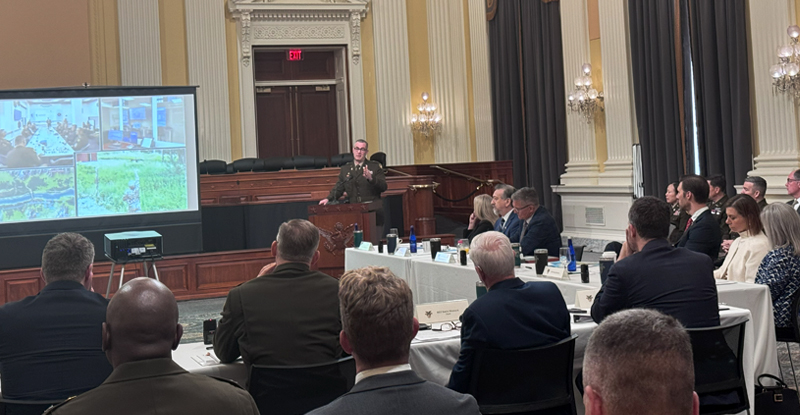
I, along with other members of the MacArthur Society, attended the USMA Board of Visitors (BoV) meeting in Washington, DC. It was 2.5 hours of a parade with bad sound and only about 30 minutes of substantial discussion.
The Superintendent, LTG Steve Gilland, brought a large uniformed contingent from West Point, and the “show” was entertaining: West Point history, WWII battles, a West Point cadet pulled a man from a burning car and was receiving the coveted Soldier’s Medal (which was worthy of mentioning and made us all proud to have served and associated with West Point), and multiple cadets this year are Rhodes and Marshall scholars, but there was little substantial discussion between the USMA Leadership and the BOV members on reform or adaptation to the modern battlefield.
The USMA leadership articulated as it does at every BoV meeting how West Point attracts very bright, super physically fit, selfless Americans. This is important, but this explanation should not take so much of this important time in front of the BOV members representing the President, Senators, and Representatives. Every BoV member is aware of West Point’s history and its achievements. However, the USMA leadership is making some major misses which threaten our security and will cost the lives of our soldiers if not addressed appropriately and decisively.
The Air Force Academy BoV leadership already took control of the agenda and has made tremendous progress. Much credit goes to the Secretary of the Air Force for engaging with the USAFA BoV to make positive strides to reform and improve the Air Force Academy. The USMA BoV and its chairman, Cong. Steve Womack (now beginning his 9th term as Chairman), can also take control of the agenda, with or without the involvement of the Secretary of the Army.
Credit goes to LTG (Ret.) Mike Flynn for bringing up the serious problem of protecting our country domestically from radical Islam in our country. “Europe is already lost. We are 10 years behind Europe. If we don’t solve this problem, we are going to be in the same place.” –LTG (Ret.) Mike Flynn.
To be clear, the radical Islam problem in our country is a complex issue that deserves more attention than this short article can address.
USMA Leadership Missed Opportunities
No discussion of the EOs and SECWAR directive compliance. If there was any meaningful discussion on this topic, the audio was so bad that very few attendees could hear it. Imagine 50 people seated in the back of the room leaning forward to try to hear the BoV members and the USMA leadership talk at the tables. The only audible sounds was the single speaker at the podium.
Audio. Was the poor audio part of the design? Unknown, but the audio team that set up the meeting immediately following the BoV meeting added microphones at every seat of the same U-shaped table the BoV used.
Drones. According to the Commandant, BG RJ Garcia (Class of ’96), 90% of the 2 million casualties in the Ukraine-Russia war came from indirect fire, i.e., drones and artillery; and 70% of the total came from drones.
Said in another way, 1.4 million casualties in a 2 million casualty war came from drones. 200,000 came from direct fire, i.e., rifles, hand grenades, and crew-served weapons. What training has USMA implemented to prepare our future leaders to face this new combat landscape at the squad and platoon level? This war has dragged on for years, and USMA has not implemented meaningful drone training at the levels where the casualties will be greatest: the squad and platoon level.
West Point’s Agincourt moment. The current military training regimen at USMA evokes images of the French knights facing English long bow archers. Spoiler: the French were soundly defeated. I am of course talking about the 1415 Battle of Agincourt during the Hundred Years’ War. King Henry V of England led a smaller, exhausted force (roughly 6,000 to 9,000 men) against a much larger French army (20,000 to 30,000+), which included a large number of mounted and dismounted knights/nobles (1). The knights (a member of the French nobility) were truly noble in their cause to defend their homeland of France, but they failed to appropriately respond to the reality that the long bow (much less expensive that an armored knight and wielded by a non-nobility class, the foot soldier) was superior to mounted or dismounted knights. Surprisingly, French knights lost two previous battles where the long bow was decisive in their defeat, the Battle of Poitier (1356) and the Battle of Crecy (1346).
To be fair, West Point is building a drone center for study, which will be a massive building to allow for drone technology development, but USMA does not appear to have implemented drone tactics at the squad and platoon levels.
For example, USMA has a strong, meaningful competition called Sandhurst, a squad-level infantry tactics competition held annually at West Point. Many allied countries participate. There was no use of drones. This is a deadly missed opportunity.
This author also attended the BoV meeting at West Point in July of 2024 and spoke directly to the Commandant and suggested the use of drones at the squad level. While this author was not a flag officer, the validity of the need to implement drones at the squad and platoon level is nevertheless valid, necessary, and obvious.
It is possible for a two-man team to specialize in deploying dozens of drones and control them with AI pre-set commands. Each infantry platoon can have two of these teams with 50 drones each, with varying adaptive purposes. Some can be used in “sentry mode,” acting as near security. Some can be on a “search and destroy” mode, others on standby for a direct attack. All can be controlled remotely by a single operator, controlled by the platoon leader—just as the platoon leader would control the deployment of crew-served weapons. This AI-empowered drone-team technology already exists, and the costs are very low compared to the value.
If costs are an issue, the “drone battle” can be a “virtual battle” controlled digitally and take place on a computer. Large military training exercises already use this “virtual battle” methodology, i.e., at the Joint Readiness Training Center (JRTC) in Ft. Polk, LA as a train-up to larger or “real” operations. This author/former Army officer participated in such an operation as a train-up for a large-scale JRTC rotation of Airborne units our of Ft. Bragg.
West Point has access to the technology and the personnel to build and integrate such a drone battle into the Sandhurst, and West Point could do in in less than 6 months. Adding drones to Sandhurst would set up the US Army and our allies to be petter prepared to win on today’s battlefield, thus reducing casualties.
Changing Battlefield
We are at an inflection in the history of warfare again, and the leadership at West Point is failing to respond to the change in warfare quickly enough. Is West Point going to respond swiftly and decisively to the shift in warfare, or will our sons and daughters—and our country–be victim to our inability to think critically and move decisively?
The results can be catastrophic—not only for our sons and daughters who graduate from West Point, but the sons and daughters they lead.
Recommendations
Make the American public a part of the conversation. USMA serves the American people. Many civilians were there to witness the BoV proceedings, including eight (8) attendees from the MacArthur Society (including this author). Livestream the meeting. Comms check, over.
The BoV should set the agenda. The most active and engaged BOV members at this meeting the audience could hear were LTG Mike Flynn, Cong. Pat Harrigan (USMA Class of 2009), Medal of Honor awardee David Bellavia, and former Army Captain Marueen Bannon (USMA Class of 2010). This author recommends these leaders draft an agenda for the next BOV meeting and consider including these recommendations:
Of the 3 hours, take at least 90 minutes to cover
- Compliance with SECWAR’s directives to remove DEI and other dangerous ideologies. New curricula to training every cadet on how the enemy fights: AI; Drones + AI.
- New training on implementing drone training and AI at the squad and platoon level.
- Bring in a subject matter expert to discuss major findings on drone warfare in the Ukraine-Russia war.
- Ask the superintendent to present a plan and required funding no later than the next BoV meeting—if not sooner.
- Develop technology needed to adapt in the drone and kinetic AI space.
For Duty, Honor, Country.
_
Matthew Newgent is a founding member of the MacArthur Society of West Point Graduates, former Board Member, current VP for Donor Relations, and member of the USMA Class of 1996.
Contact Matt at Mission@MacArthurSociety.org.
(1) Grok AI. “Battle in which English archers routed French knights.” https://grok.com/c/ba3eae6c-f534-4128-8a64-20e93e31dc27?rid=4c2da193-5a1f-4277-bb53-90f84cdac140.
See Photos from February USMA BOV Meeting on the MacArthur Society website





Leave a Comment