
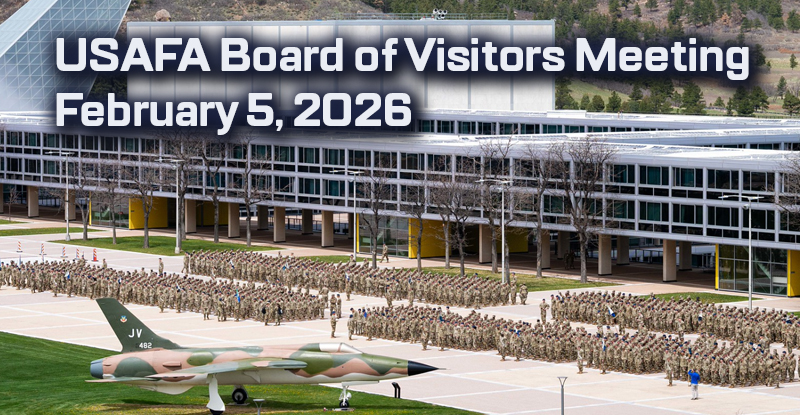
The US Air Force Academy Board of Visitors held a meeting on Capitol Hill in Washington, DC and via Zoom with USAFA staff at the Air Force Academy on Thursday, February 5, 2026.
The BoV Chairman is Congressman August Pfluger, a 2000 graduate of the Academy. The Vice Chairman is retired USAF Col. Doug “Stoli” Nikolai, a 1989 graduate.
Watch:
AI TRANSCRIPT of Meeting (pdf)
AI EXECUTIVE SUMMARY:
The Board of Visitors met in Washington, DC, with Secretary of the Air Force Troy Meink emphasizing the Academy’s central role in shaping Air and Space Force culture and leaders for a rapidly evolving, high‑tech fight.
His priorities included strengthening cadet exposure to AI/autonomous systems, upgrading IT/simulation and training infrastructure, reinforcing competitive mindset across academics and athletics, and accelerating major facility recapitalization—especially dorms—while learning from the Chapel overhaul.
He endorsed BoV focus groups (AI, infrastructure, discipline, accreditation, admissions, athletics) and asked for targeted recommendations.
Superintendent Lt Gen Tony Bauernfeind reviewed 2025 progress:
- expanded small UAS and scenario-based training;
- new warfighting minors (future conflict, quantum tech, aerospace materials);
- cadet-led instruction and year‑round weapons qualification;
- “space week;”
- robust flight and jump ops;
- >100 intel briefs; expanded field exercises;
- significantly increased rated slots (448 in ’25 to 605 in ’26);
- athletic and cyber wins;
- tougher fitness standards;
- holistic Honor Code;
- strong scholarship outcomes;
- accreditation concerns resolved; and
- opening of the Madeira Cyber Innovation Center.
For 2026, he outlined
- onboarding the new Dean (Col James Valpiani),
- America’s 250th events,
- a vision for “airmanship for all” (including VR, soaring, possible IPT before graduation),
- potential reassignment of the 306 FTG to USAFA,
- consideration of growing the Cadet Wing to 4,400,
- and the USAFA 2050 plan—seeking a top‑line funding model and ~$340M/year to recapitalize, sustain, and modernize facilities (AeroLab is shovel‑ready;
- a new Space Education Center with TS capacity is proposed).
Members discussed dorm replacement strategies, training aircraft recapitalization, competition for enterprise funds vs. a top‑line carve-out, accelerating the Chapel timeline (currently Fall 2028), and ensuring curriculum emphasis on American, world, and military history and the Constitution.
Public comments highlighted urgency on Chapel completion and raised concerns about faculty staffing/morale and STEM capacity; the Board noted an Air Force manpower audit and requested transparent faculty data.
Open action items continued (including military‑professor copyright parity), and new ones were added for USAFA 2050, airmanship for all, and Cadet Wing growth.
The Visitor Center opening is set for May 15, with an emphasis on inspiring prospective cadets.
The Board committed to deliver a follow‑on report and to advocate on NDAA/appropriations priorities aligned to the Superintendent’s top three: USAFA 2050 infrastructure, airmanship for all, and potential growth to 4,400 cadets.
AI NOTES
Here’s a structured, detailed summary of the key topics covered in the Board of Visitors meeting:
1) Secretary of the Air Force remarks (Troy Meink)
- – Strategic importance of culture and leadership: USAFA sets the culture and leadership pipeline for decades; integrity, mental fortitude, resilience, and mental flexibility are essential in a rapidly changing, high-stress warfighting environment.
- – Emerging operational realities: Increasing integration of autonomous agents across operations, logistics, and acquisition; pilots will coordinate with advanced drones and fuse massive data at the edge—leaders must be technically fluent and cognitively agile.
- – Training and infrastructure gaps:
- – Need modern IT, simulation, ranges, and lab environments at USAFA; cadets often have better sims at home than at the Academy.
- – Competition (athletics, academics, flying, cyber) should be deliberately cultivated; teach to win.
- – Academic balance: Military training with solid technical grounding (not all engineers, but all tech literate), with strong ethics and integrity education.
- – Leadership transitions: New Dean of the Faculty select, Col James Valpiani (fighter/test pilot background; DARPA AI experience).
- – Physical plant urgency:
- – Chapel lessons learned—must not repeat poor execution.
- – Dormitories need replacement; boilers/facility failures risk cadet living conditions.
- – Call for a comprehensive, cost-effective, fast approach to recapitalization; openness to nontraditional approaches and Hill support.
- – Support for Board focus groups and bringing in outside expertise.
2) Board leadership and semiannual report highlights (Chairman Rep. August Pfluger)
- – New Senate members: Sens. Ted Budd, Markwayne Mullin, Kevin Cramer.
- – Key recommendations submitted:
- – Increase cadet wing end strength from 4,000 to 4,400 (match authorization; parity with other academies).
- – Faculty composition audit by Air Force Manpower Analysis Agency (all categories: AD, civ, reserve, visiting, privately-funded, international, fellows).
- – Establish a Military Service Academy Commission to study NIL impacts, standardize merit-based admissions, and consider standardized accreditation.
- – Conduct top-down review of disciplinary procedures to ensure justice, fairness, integrity.
- – Include a specific section in FY27 NDAA to reinvest in Service Academies, including funding the Air/Space/Cyber Education Center.
- – Working groups created: Accreditation, Admissions (merit-based), AI, Athletics, Infrastructure, and Disciplinary Processes.
3) Superintendent’s update (Lt Gen Tony Bauernfeind) — USAFA 2025 review, 2026 priorities, and USAFA 2050 vision
A. USAFA 2025 year in review
- – Forging warfighters to win:
- – Procurement of more advanced SUAS/drones for tactical and academic use.
- – New warfighting minors: Future Conflict (with Institute for Future Conflict), Quantum Technologies, Aerospace Materials.
- – Summer training pivot: 480 cadet instructors trained to teach military skills; year-round weapons qualification (Class of ’29: 97% qualified on M4; 15% expert—even as many had never handled a weapon).
- – Introduced Space Week; integrated space and cyber into training.
- – 306 FTG exceeded goals: 12,700+ flying hours; 22,000+ parachute jumps.
- – 100+ intel briefs (90 led by cadets); “Midnight Hammer” team briefed the wing.
- – Fall validation and spring assessment exercises expanded to 3,500+ cadets; cadet commanders empowered to lead and train their squadrons.
- – Significant increase in rated positions:
- – Class of ’25: 448 rated (+16% over ’24)
- – Class of ’26: 605 rated (+35% over ’25); targeted outreach to IC athletes boosted rated interest.
- – Leaders of character:
- – Cultural reset—“year of why” and cadet empowerment with accountability.
- – Re-established minimum standards on every PFT component; wing-wide PFT/AFT up ~3%; Class of ’29 PFT ~+5% vs. five-year average.
- – Welsh Leadership Program refocused: Master’s in Military Leadership (with Air University/UCCS).
- – Multi-domain lab infused into military training; “Silver Saturdays” to train/pace cadet squadrons; “Protect Our House” op order to support IC events.
- – Honor Code revitalized—no parsing; progressive sanctions early but stricter with time; emphasis on honor probation, rehabilitation, mentorship.
- – NCLS centered on “warfighters to win”; Class of ’28 commitment rate ~98%.
- – Motivating critical thinkers:
- – 259 research partnerships; 30 majors/22 minors sustained; USAFA ranked #2 Top Public School; advanced to #5 Top Liberal Arts College.
- – Madeira Cyber Innovation Center opened (gov/donor partnership) with ACC/CyberWorx/National Guard/industry.
- – Adversary-focused military training; 300+ cadets in summer research; 180 independent research projects.
- – AFIT beta: 9 cadets started systems engineering master’s while at USAFA.
- – PE curriculum updated for warfighting (rated readiness, advanced water survival, advanced combatives).
- – 1,000+ publications; seven patents (19 cadet contributors); FalconSat missions ongoing; multiple prestigious scholarships (Rhodes, Fulbright, Goldwater, Truman, Hollings).
- – Accreditation complaint addressed; standing confirmed in mid-December.
- – Athletics/competition outcomes:
- – Strong head-to-heads vs. USMA/USNA (e.g., 10–4 vs. West Point; 7–6 vs. Navy); national titles in flying/cyber; multiple NCAA Top-25 finishes; Wings of Blue medals/records.
B. 2026 near-term priorities
- – Onboarding Dean Col Valpiani (Feb/Mar).
- – America’s 250th programming across 13 events (from NCLS to Parents’ Weekend).
- – Airmanship for all (concept under development with CSAF/AETC):
- – Freshman Aviation 100 (VR-based + one flight).
- – Sophomore soaring opportunities for all.
- – Consider moving job selection earlier to tailor development.
- – Potential recapitalization of Powered Flight; explore completing Initial Pilot Training at USAFA so grads go straight to UPT T-6s.
- – Potential transition of 306 FTG back to USAFA.
- – Increase USAFA end strength to address Space Force growth and Air Force rated shortfalls (facilities can support; requires modest O&M and ~100–125 personnel, mainly in Dean/Athletics).
C. USAFA 2050: Installation recapitalization and modernization
- – The challenge:
- – Main campus built 1955–1966 with 50-year design life; most facilities now 15+ years beyond that.
- – Chronic underfunding (approx. $40M/year vs. 4% PRV target); donor dollars help but come with no sustainment funds.
- – Deferred requirements ~ $4.2B; frequent failures: 50 emergency repairs in Sijan Hall, Aeronautics frozen pipe event, gym flooding, ongoing Chapel rehab.
- – Proposed approach:
- – Treat USAFA as a unique, DAF top-line funded institution (not competing against 183 installations for IMSC sustainment/MILCON).
- – Estimated requirement: ~$340M/year in perpetuity to recapitalize/sustain/modernize on a rational cycle (e.g., dorm renovations, central heat/wastewater, Fairchild SCIF).
- – Create an Air, Space, and Cyber Complex:
- – Upgrade Aeronautics Lab (’60s era; shovel-ready, ~ $25M FSRM).
- – Leverage the new Madeira Cyber Innovation Center.
- – Build a Space Education Center with TS labs/classrooms, modern space ops/engineering infrastructure.
- – Chapel:
- – Current AFCEC/IMSC/USACE program; water testing successful; weekend cadet tours resumed.
- – Current completion estimate: Fall 2028. The Board urged acceleration (aspiration: Class of ’27).
- – Visitor Center: Opening targeted for May 15; partnership-driven activation to inspire recruiting; coordination ongoing for opening ceremony.
4) Q&A highlights with Superintendent and Board
- – Airmanship recapitalization: Vision for VR aviation academics, soaring for all, powered flight recap; explore earlier job selection and even IPT at USAFA for rated candidates.
- – Dorm strategy: Phased renovations; consider 3-person rooms; exploring a small swing-space dorm concept.
- – Funding competition: USAFA now competes against operational units; Superintendent favors top-line carve-out like Army/Navy academies.
- – Curriculum (history/Constitution): Current core includes world history and military history; American history was removed years ago as HS coverage increased—USAFA is assessing incoming cadets (Class of ’29) for baseline; Constitution content is woven across multiple disciplines and touchpoints (also issued pocket constitutions).
- – Silver Weekends: Monthly Friday/Saturday cadet-led military training blocks (e.g., land nav, tac radios, TCCC, SUAS, ranges) integrated with IC and airmanship schedules.
- – Athletics/soccer cadets: Rehabilitation progressing; multiple seniors slated for pilot training/Space Force/DevEngr; new men’s coach reinforcing culture and teamwork.
5) Working groups: goals and early actions
- – Merit-based admissions (Rep. Bacon, Dan Clark):
- – Seek a balanced, merit-based model beyond test scores (e.g., leadership credentials such as Eagle Scout, captains, service).
- – Accreditation (Vice Chair Doug “Stoli” Nikolai):
- – Exploring shift to a new, more aligned accreditor (Commission of Public Higher Education); coordination underway with USAFA and DAF.
- – Artificial Intelligence (Dina Powell, Rep. Don Davis, Sen. Budd):
- – Three lines of effort: integrate AI across curriculum; explore cadet internships/secondments in AI companies; track national AI policy/standards.
- – Athletics (Sen. Tuberville – lead; Dan Clark briefed):
- – Football success drives applications; data on recruiting/retention; NIL pressures; request parity with USMA/USNA admissions treatments for elite athletes with leadership and character; ensure standards are comparable and competitive.
- – Infrastructure (Chair Pfluger, Rep. Crank):
- – Seek a dedicated NDAA section to recapitalize USAFA; consider innovative, nontraditional delivery/funding alongside foundations to reduce cost and accelerate delivery.
- – Disciplinary processes (Doug “Stoli” Nikolai):
- – Examine due process and consistency; benchmark USNA/USMA procedures; elevate to SecAF if a tri-service policy review is warranted.
6) Open action items and new items
- – Existing:
- – Space Education Center: Folded into USAFA 2050 line-of-effort.
- – BASAI/USAFA updates received.
- – Military professor copyrights: Legislative fix needed to align with civilians. House support strong; Board senators to engage for Senate passage this year.
- – New Superintendent requests designated as open items:
- – USAFA 2050 modernization and funding framework.
- – Airmanship for all.
- – Cadet wing growth.
7) Public comments (themes and responses)
- – Curriculum (Lt Col Mark Claudefelter, USAFA ’77): Advocated three history core courses—American, World, Military—taught by historians. Board members expressed strong support for deep history grounding; USAFA is assessing incoming American history proficiency and weaving constitutional education across the curriculum.
- – Chapel/community assistance (Zack Miller, ’04): Asked how the community can help accelerate chapel completion; proposed a national skilled-labor surge. Board will explore recommendations to SecAF; reinforced urgency and leadership attention at DAF and Presidential levels.
- – Faculty/morale, STEM capacity, and governance concerns (Prof. Thomas Buhly; Prof. Kent Murphy):
- – Cited DOX survey data showing 136-person decline across DF (vs. 16 previously cited in leadership remarks); noted morale issues and anticipated impacts in 2026–27 on class sizes, lab staffing, and STEM continuity (e.g., systems engineering focus loss).
- – Requested transparency on department-by-department faculty composition (AD/civilian/degree/experience) last year, now, next year; raised concerns about the use of NDAs; urged restoring “education” in USAFA mission statement; proposed a long-term civilian Provost model; recommended removing DEI/gender/DoD policy screening question from presentation approval forms.
- – Board response: Acknowledged seriousness; reiterated that validated DOX figures will be released by DAF; committed to continued scrutiny via audits/working groups and requests for data; reinforced transparency and faculty strength as central to mission.
8) Board member closing perspectives
- – Strong advocacy posture: Members emphasized the Board’s action orientation, the unique ability (through HASC/SASC/Appropriations members) to translate USAFA needs into legislative action, and a commitment to transparency (including public comment).
- – Academic transformation ideas (Vice Chair Nikolai):
- – Warned academics are at a tipping point; proposed:
- – A School of Civic Thought (civic Western values, Constitution, American exceptionalism).
- – Integrative, multidisciplinary STEM core with embedded AI/ML across curriculum.
- – A mission-driven, multi-domain warfighting course leveraging the multi-domain lab and Institute for Future Conflict.
- – Structural reforms: a Provost model with five interdisciplinary schools and deans; rationalize governance to free permanent professors for teaching/research.
- – Strategic framing: Repeated emphasis that air and space power have delivered decisive strategic effects this year; USAFA’s role is central to producing officers ready to lead on day one.
9) Next steps and schedule
- – Board will convene a virtual meeting in the spring (May) to refine and adopt recommendations based on today’s discussions and working group inputs, followed by delivery of a report to SecAF/DoD leadership in the summer.
- – Continued engagement expected on:
- – USAFA 2050 funding approach (including potential top-line carve-out).
- – Airmanship for all concept and resource plan.
- – Cadet wing growth to 4,400 and associated manpower/facilities.
- – Chapel acceleration options.
- – Faculty composition audit and academic governance/quality issues.
- – Accreditation pathway decision.
- – AI integration and industry partnerships.
- – Admissions/athletics parity and NIL implications.
- – Disciplinary due process benchmarking.



Leave a Comment