
By Lt. Col. David T. Cloft, USA ret, USMA ’97 | AFNN
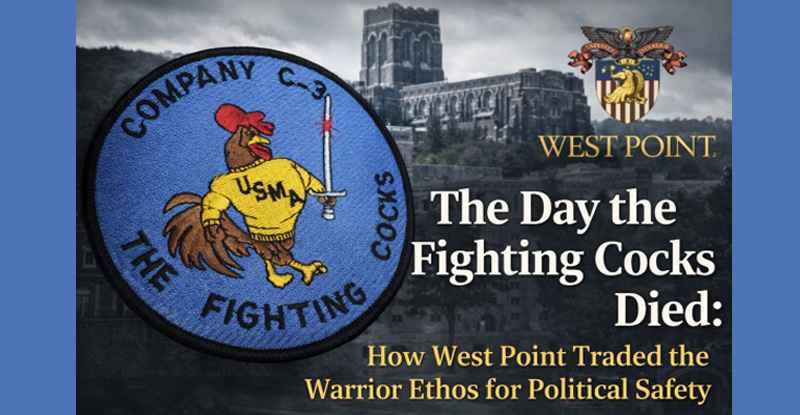
There was a time when a group of young men at the United States Military Academy—back when it was still comfortable admitting that war is violent, masculine, and occasionally darkly funny—looked around at themselves and said, “We’ll call ourselves the Fighting Cocks.”
And nobody called a lawyer. Nobody convened a sensitivity panel. Nobody demanded a town hall. They laughed, slapped a patch together, and went back to learning how to close with and destroy the enemy.
That was 1967. Vietnam was raging. Cadets were not being groomed for cable news panels or Senate confirmation hearings. They were being prepared for jungles, rice paddies, ambushes, and body counts. Humor, especially gallows humor, wasn’t a problem to be solved—it was a survival mechanism.
The name “Fighting Cocks” wasn’t vulgar to them; it was irreverent, aggressive, and just juvenile enough to signal that these were young men who understood they were not being trained for polite society. They were being trained for war.
Fast-forward a few decades, and the same institution begins to get uncomfortable with its own reflection. “Fighting Cocks” quietly morphs into “Gamecocks.” Same animal, less edge. The joke is still there, but now it wears a tie.
This is the institutional equivalent of saying, “We’re still fun, but not in a way that might get us yelled at.” It’s the midpoint of cultural decay: the joke survives, but only after being neutered, laundered, and approved by committee.
By the early 2010s, even that becomes too much. Enter the Coyotes. Safe. Neutral. Nature-documentary approved. Coyotes are clever, sure, but they don’t make anyone uncomfortable. They don’t imply masculinity, sexuality, or aggression in a way that might trip a DEI wire. Coyotes are what happens when an institution decides that the highest virtue is not excellence, lethality, or cohesion—but risk avoidance.
This wasn’t an isolated mascot change. It was a cultural weather vane.
West Point did not wake up one morning and decide to stop producing warriors. It drifted there, one well-intentioned memo at a time.
Each small accommodation made sense in isolation. Each change was justified as “modernization,” “professionalism,” or “alignment with Army values.”
And yet, the cumulative effect is impossible to ignore. When humor dies, candor soon follows. When candor disappears, conformity takes its place. When conformity reigns, institutions stop producing leaders and start producing politicians.
A warrior culture tolerates rough edges because it understands reality is rough. A political culture polices language because it believes reality can be managed with terminology. Warriors joke about death because they expect to face it. Politicians avoid jokes altogether because someone might clip them out of context.
The Fighting Cocks weren’t dangerous because of a name. They were dangerous because they belonged to a generation that expected to fight, expected to bleed, and expected to be judged by outcomes rather than optics.
The Coyotes, by contrast, are the perfect mascot for an era obsessed with process, perception, and paperwork. Coyotes survive by avoiding conflict when possible. They adapt. They scavenge. They thrive on the margins. None of this is inherently bad—but it is revealing.
The deeper issue isn’t nostalgia for crude humor. It’s the loss of institutional confidence. Great military cultures don’t constantly apologize for themselves. They don’t fear their own shadows. They don’t rebrand every decade to keep pace with civilian political fashion. They know who they are, what they’re for, and why discomfort is sometimes a feature, not a bug.
When an academy begins to measure success by how well it avoids offense rather than how well it forges leaders capable of moral courage under fire, it sends a message. That message is heard clearly by cadets, whether leadership intends it or not. Don’t stand out. Don’t joke wrong. Don’t think dangerously. Play it safe. Manage narratives. Climb carefully.
That is how you get politicians in uniform rather than warriors in command.
No one is arguing that a mascot alone defines an institution. But symbols matter. Names matter. Humor matters. They are the canaries in the cultural coal mine. When the jokes are gone, when the edges are sanded smooth, when every expression of masculine aggression must be pre-approved, you haven’t civilized the warrior—you’ve bureaucratized him.
The Fighting Cocks didn’t disappear because they were offensive. They disappeared because offense became unforgivable. And that tells us far more about who we are now than who they were then.



Leave a Comment