
By James E. Fanell, retired Naval officer | American Greatness
As America faces the very real threat of an armed conflict with a peer competitor—the People’s Republic of China (PRC)—it is worth noting that since the fall of the Soviet Union, America’s military has been infected by a peacetime mentality deluged with grade inflation, careerism, and politics and, for the purposes of this article, an awards program that makes our senior officers and senior enlisted look like cheap, tin-pot military dictators.
After two years of bloody fighting in Gaza, President Trump made history, once again, by negotiating a pathway towards peace in the Middle East.
This past week, as the world witnessed President Trump and leaders of the Israeli government give speeches in the Knesset, one individual in the gallery stood out: the current Commander of U.S. Central Command (CENTCOM), Admiral Brad Cooper.
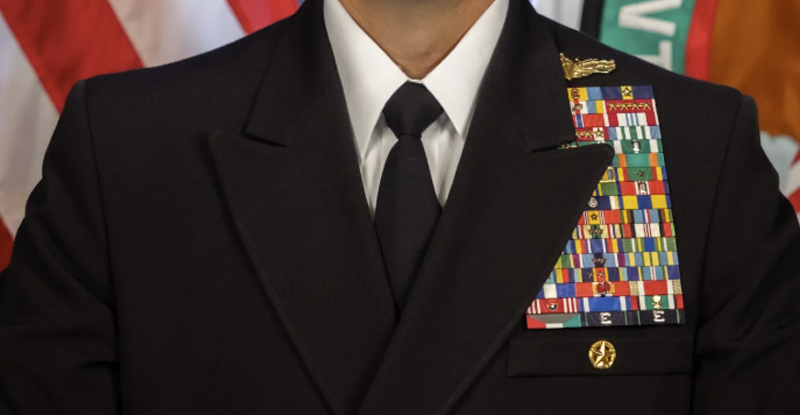
Wearing his service dress blue uniform, one could see that the admiral had seventeen rows of ribbons (up to 51 awards depending on what was under his lapel), Surface Warfare and Command pins, along with a Presidential Service Badge and CENTCOM identification badges; see his official photograph.
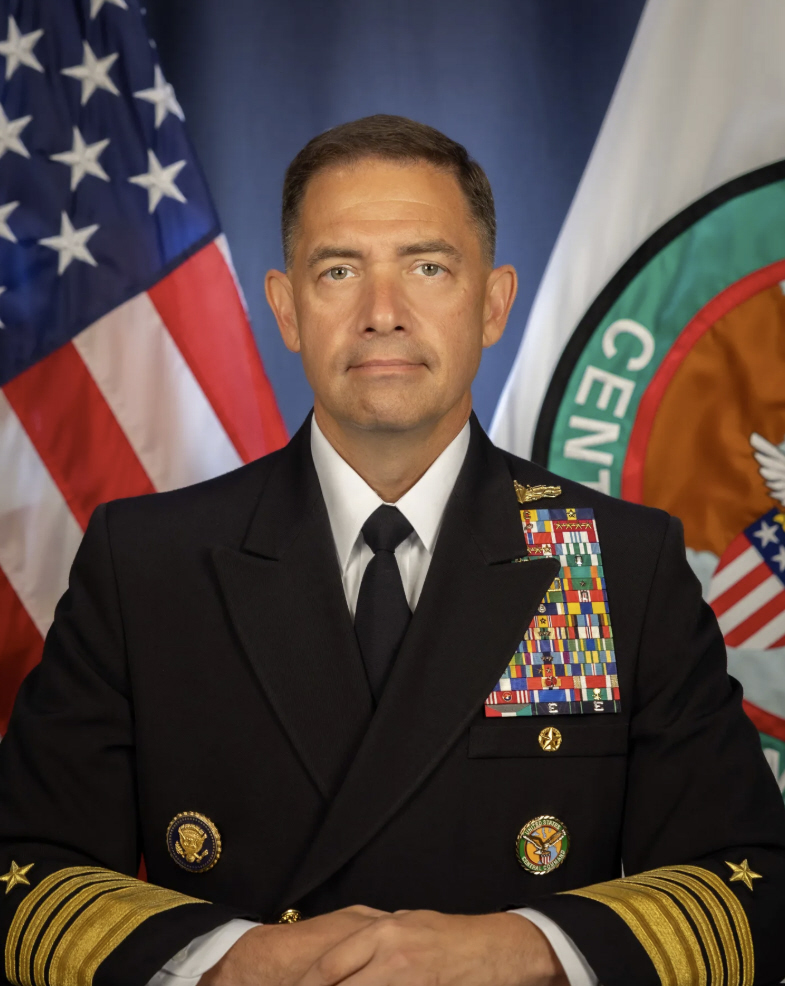
The admiral’s appearance, while lawful and within standards, does raise the issue of the Pentagon’s awards system, where America’s senior military officers are able to obtain, let alone wear, that many rows of ribbons, awards, decorations, and badges—the latter of which are worn throughout a career just for being assigned to a command.
In other words, how does the existing U.S. military awards program actively promote the Secretary of War’s call to restore America’s warfighting ethos? Unfortunately, the answer is that it does not.
While Napoleon is famous for stating, “A soldier will fight long and hard for a bit of colored ribbon,” today’s senior Flag and General Officer (FOGO) ranks remind those of a certain age of the way former Soviet Union marshals used to look with row upon row of medals or like we still see North Korean generals looking today.

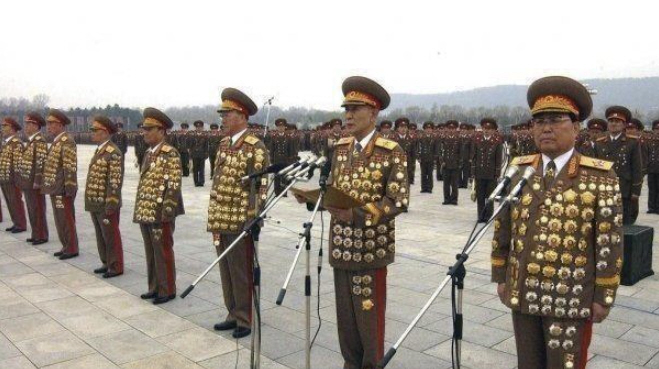
The wearing of a chest full of ribbons by American military FOGOs arguably is the result of the “participation trophy” mentality that took root across the Department of Defense over the last 35 years since the fall of the Soviet Union.
This current awards system has now reached the point where it has become detrimental to good order and discipline—as it promotes self-recognition over service to the national defense.
Consider that FOGOs from the 1950s, 60s, and 70s received maybe one or two Legions of Merit (LOM) for 30-plus years of service, yet today the Commander of CENTCOM is wearing five LOM ribbons—and his career is far from over.
The result of these institutionalized “end of tour awards” and other participation rewards undermines the principle of a merit-based reward system that is based on courage under fire.
It is time to end this institutionalized erosion of the American warfighting ethos.
Or compare the image of Admiral Cooper with Fleet Admiral Chester Nimitz, as Chief of Naval Operations, arguably the single most important military officer responsible for winning the war in the Pacific during WWII.

As you will notice, Admiral Nimitz only wore his top “top three” awards, a practice that remained in the Pacific Fleet as late as 2015, at the time of my retirement.
It is also worth pointing out that among Admiral Nimitz’s “top three” awards was his second ribbon, the U.S. Coast Guard Silver Lifesaving Medal, which he wore for personally rescuing a sailor who is believed to have fallen off the deck of a surfaced submarine. In other words, what mattered most to the warfighters of that era were undisputable acts of personal bravery or unit citations from combat action.
Lest it be thought this is just a problem for the U.S. Navy, take a look at the former Chairman of the Joint Chiefs of Staff, Army General Mark Milley, who is adorned with an array of ribbons, unit identifications, badges, and personal qualifications, or, as one retired officer noted, “just too much stuff.”

Compare General Milley’s uniform with that of five-star General Dwight Eisenhower, the man who successfully led the D-Day Landings at Normandy and the defeat of the Nazi warfighting machine across North Africa, Italy, France, and Germany.

Why does this problem with the Department of War’s award program need our attention? Because of Secretary of War Hegseth’s undeniable and aggressive efforts to prepare the Pentagon for a potential war with the People’s Republic of China (PRC)—one that could start as early as next year—which will take everything we have with no distractions.
Some may ask, why does the Secretary of War need to take action? Can’t the services do this internally? Unfortunately, previous efforts to reverse this trend inside the services have failed. Therefore, the time has come for the Secretary of War to take action on a system that has clearly run amok.
Just as Secretary Hegseth has held those in uniform who are out of physical readiness standards (i.e., being too fat), he should also reduce the department’s “participation” awards, decorations, medals, and badges in order to restore the mindset of austerity and decorum where such recognition was rare and principally for acts of valor and courage.
My recommendation to the SECWAR is to address this issue head-on. Make it a new rule that when you are privileged enough to be selected as an Admiral or General, then you are authorized to only wear your top three awards—nothing else.
I’d also go so far as to recommend that the SECWAR allow these officers to choose their top three awards to wear—like Admiral Nimitz did—as it will reveal more about an officer’s character.
And if this rule is applicable to the FOGOs, then it should apply to all service members, as there are plenty of O-6s and E-9s whose wearing of ribbons, awards, and badges is also over-the-top.
While there may not be a war with the PRC in 2026, our best chance of deterring one is to be as seriously ready as Xi Jinping is making the PLA. That means that everybody in uniform must be focused on preparing to destroy the PLA, not spending time on writing up their end-of-tour awards package, holding endless awards boards or spending time on preparing dress uniforms for functions, as we saw in the Knesset last week.
Let’s keep our focus on the main thing—fighting and winning wars.
***
James E. Fanell served as a career naval intelligence officer whose positions included senior intelligence officer for China at the Office of Naval Intelligence and chief of intelligence for CTF-70, Seventh Fleet, and the U.S. Pacific Fleet. He is the co-author of the book Embracing Communist China: America’s Greatest Strategic Failure.
First published in American Greatness
Overdue for De-NORKification of our Uniforms
can we just stop with the institutional cringe?
By Commander Salamander



Thank you, James Fanell for your critical and in places stinging article . For some time I have been wondering about the fruit salad draping the Class A blouses of members of the military. You are correct that the senior officers and other overly decorated personnel do look like tin pot dictators of banana republics and communist hell hole countries. I was wondering if the DOD/DOW was granting medals for correctly brushing one’s teeth every other Thursday morning. Hell, I was in the AF for six years. My tour of duty was remarkably average with no combat, leadership, bravery, or valor; yet I accumulated 7 medals/ribbons simply for showing up to work every day and performing my expected duties. My WW II combat veteran father was awarded only 4 medals but they were the DFC, Bronze Star, Air Medal, and Pacific Campaign citation. He never wore any of them on his Class A blouse. He was a humble citizen airman. Perhaps today’s “warriors” should take a class in humility before accepting any citation. Get all that crap off the uniform.