

By Lt. Colonel Eric Vogel, USAF ret, USAFA ’73
STARRS Ambassador, Connecticut State Leader
How do lectiophiles select their reading material?
Perhaps they base their choices on subject matter. They may prefer non-fiction, love history, and decide—for a time—to focus on stories about allied spies who heroically worked in France under the German Occupation of WWII. Sonia Purnell’s A Woman of No Importance, Alex Kershaw’s Avenue of Spies, and Larry Loftis’ Code Name: Lise would all be excellent choices.
Other readers might choose a theme for their reading: Redemption, for example. Paul’s story in Chapter 9 of the Book of Acts, might be on their list. Right Turns by Michael Medved–another individual who “saw the light”–would be a good choice. Bella Dodd’s School of Darkness would also be a very worthy selection.
Rarely–but it happens–the reading material itself, without an intention on the part of the reader, evolves into a theme of its own.
Here is how that recently happened to me. A Connecticut patriot and author, thrilled with a book she had just read, sent me a copy. Shortly after receiving that volume, I read a favorable book review in The New York Post—yes, The New York Post—which motivated me to buy and read the featured book. Next, I received a copy of a high school newspaper from a polling place on Election Day.
From these two books and a student newspaper, a theme emerged: The Good, the Bad and the Ugly.
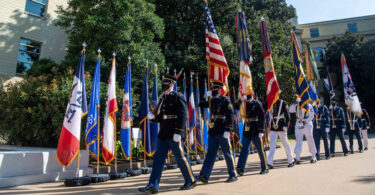
The Good. Mark Leepson’s Flag is an intriguing and thorough history of the Red, White and Blue, the Star Spangled Banner, or Old Glory—whichever historical and respectful name you prefer. Subtitled An American Biography, Leepson masterfully traces the growth of our flag, covering the design itself and the corresponding legal and political steps involved in its evolution. Leepson centers his chapters on significant historical periods which correspond to changes in design and increasing national pride in the flag.
We learn, first off, that a person who studies flags is a vexillologist; that expert focuses on design, symbols, history and cultural meaning. These functions sum up much of the key points of Flag. Leepson also clears up common misunderstandings: Betsy Ross did not make our first flag; a number of classic historical paintings portray flags which are anachronisms; and although “The Star Spangled Banner” was written in 1814 by Francis Scott Key, it was not officially our national anthem until 1931.
One of the most significant events in the history of our flag was the resolution adopted by the Second Continental Congress on June 14, 1777: Resolved, That the flag of the United States be thirteen stripes, alternate red and white: that the union be thirteen stars, white in a blue field representing a new constellation. Prior to that resolution, there were a variety of flags being used in “the thirteen united States of America” (as we called ourselves in the Declaration of Independence). Military divisions, in particular, displayed a multitude of designs of their own creation.
War with the British not only led to our national flag; some 35 years later, another war with the same enemy led to our national anthem. The bombardment of Fort McHenry by the British during the War of 1812 inspired Francis Scott Key to write the “The Star Spangled Banner” in 1814. His writing of that beautiful poem was, as all Americans know—or used to know—was an extremely important event in the history of our flag. As the Secretary of the Smithsonian Institution stated in 1998, when often asked which is the greatest treasure among the 140 million objects it holds, he finds this “the easiest [question] to answer: our greatest treasure is the Star-Spangled Banner.”
Other important events in the “biography” of our flag include the establishment of The Pledge of Allegiance—written in the late 19th century but not fully approved by the Federal Government until 1942; the development of the Flag Code in the 1930s—not official until 1942; and the designation of June 14th as Flag Day—a movement begun in the late 19th century, receiving presidential approval in 1949,
Along with this history of the flag itself, Leepson documents the significant growth of our flag as a national symbol. “Nowhere on earth do citizens fly their national flag as Americans do, everywhere they live and everywhere they go…Nor does any nation turn to its flag as an emotional, political and patriotic symbol in good times as in bad as the Americans do.”
Leepson’s Flag: An American Biography beautifully reinforces The American’s Creed which states that it is “my duty to my country…to respect its flag…”
The Bad. Priscilla West’s The New Face of Woke Education is a thought-provoking and eye-opening warning regarding the American Education system. The book is not bad; it is excellent. It is the subject that is troublesome, even frightening.
Many of us know, instinctively and intellectually, that CRT and DEI are wrong, even immoral. West agrees. Despite actions—such as Executive Orders—to eliminate CRT and DEI, they are still present, sometimes called by the innocuous sounding “resilience.”
But there’s worse: CASEL.
CASEL is the Collaborative for Advancement (later, Academic) of Social Emotional Learning. Forget about the basics of Reading, Writing and Arithmetic–and make room for Social Emotional Learning (SEL). And with it, get ready for the “Five Competencies of CASEL: self-awareness, self-management, social awareness, relationship skills, and responsible decision making.”
If you sense that this is a ploy, within the American Education System, to control and profit, you are correct. Unfortunately, governments and school districts have fallen into the trap.
CASEL’s psychological roots have grown into a multibillion dollar industry for school software, while encouraging “healthy identities,” “collective goals,” and “just communities.” And SEL is a “Lever for Equity and Social Justice” according to the CASEL President Karen Niemi. Challenging that bromide, author West labels SEL as a means of “ideological indoctrination.”
Christopher Rufo of the Manhattan Institute has criticized the portrayal of SEL as uncontroversial while it “serves as a delivery mechanism for radical pedagogy, such as critical race theory and gender deconstructionism.”
Educational software companies profit by sales of programs to school districts which provide for the tracking of students by “race, gender, incomes…to justify interventions or programmatic changes to boost things like ‘belonging” or ‘school climate’…” West notes that SEL “measures and tracks today’s children with a precision that would impress George Orwell himself.”
It’s not a stretch to say that CASEL has global interests. CASEL leaders have interacted with the Organization for Economic Cooperation and Development (IOECD), UNESCO and the World Economic Forum.
What to do? In this short book, an issue of Encounter Broadsides, West makes several excellent suggestions. She encourages pushback through organizations like Moms for Liberty and Parents Defending Education. Psychometric tracking of students must end. We should encourage lawmakers to defund SEL programs. Finally, we must fully understand that “learning is not therapy.”
The Ugly. My wife took her father to vote in Stratford, Connecticut, on Election Day, returning with the October copy of a school paper. As it turns out, the polling place was my alma mater—Bunnell High School—and The Scribe is the student newspaper.
Back in 1969, the Vietnam War was raging. I was chastised by a history teacher and several friends for choosing the USAF Academy at graduation. However, despite those troubled times, patriotism was not totally doomed and the U.S. flag remained dominant, unifying and–for the most part–respected in Connecticut schools.
How times have changed.
There, on page 3 of The Scribe, was a photo of students draped in flags from Latin American countries. The photo was part of an article entitled “From Salsa to SOL: Bunnell Honors Hispanic Heritage.” (SOL is “Student Organization of Latinos.”) This celebration was part of Hispanic Heritage Month, beginning with “Wear Your Flag Day” in the first week. Teachers taught cultural dances, Spanish love songs were performed, and Hispanic music was played over the intercom in the morning. There were Hispanic treats at the SOL table.
A junior declared that “Bad Bunny would be proud of our celebration here at Bunnell.” Mahatma Ghandi was quoted as saying that “A nation’s culture resides in…the soul of its people.” The article continued with: “But at Bunnell it resides in SOL.”
I was disturbed, to put it mildly, by the photo and the article. Here was a prime example, as recently articulated by Victor Davis Hanson, of the lack of assimilation, integration and acculturation by immigrants.
Students: which flag do you consider as your flag? How about honoring and respecting the American Flag? (Of course, that would not be done by draping it on one’s shoulders.)
What about taking time to learn about and honor other heritage groups, such as Asians or (God forbid) Europeans? Why don’t they have a heritage month?
Why reference Bad Bunny, a cross-dressing Puerto Rican pop star, as someone who would be proud of your school—and why do you care?
Finally, if our nation’s culture “resides in SOL,” might we be in deep trouble?
Immediately, I came up with an idea: write a letter to the Stratford, Connecticut Superintendent of Schools, with informational copies to the President of the Board of Education, the Principal of Bunnell High School, and the student editors of The Scribe. That was my plan until Tony, my barber (also a Bunnell Grad), straightened me out that afternoon. His advice: “Don’t waste your time!”
If nothing else, this Ugly high school newspaper article proved the Bad of Priscilla West’s book.
I sure hope that the next serendipitous theme that emerges from my reading also begins with something Good, but continues to The Right Stuff.
Other book reviews & articles by Eric Vogel

Leave a Comment