
(Press Release) As first reported in the Air and Space Forces Magazine, Congressman August Pfluger (TX-11), Chairman of the United States Air Force Academy (USAFA) Board of Visitors (BOV), formally sent the Board’s comprehensive, forward-looking report of recommendations for the Academy to Secretary of War Pete Hegseth.
This report fulfills one of the Board’s key statutory responsibilities and delivers a strategic roadmap to strengthen institutional effectiveness at the United States Air Force Academy. It centers on restoring cadet capacity, modernizing infrastructure, and reinforcing warfighting preparedness across the institution.
Chairman Pfluger:
“I am immensely proud that the U.S. Air Force Academy Board of Visitors has completed a forward-focused, comprehensive report for Secretary Hegseth outlining concrete recommendations to strengthen the Academy’s institutional effectiveness,” said Chairman Pfluger.
“At a time when global operations continue to highlight the decisive role of airpower, these recommendations reflect our commitment to ensuring the Academy remains focused on and equipped to develop the warfighters and leaders needed for future complex, multi-domain conflict.”
“I look forward to working with Secretary Hegseth and Secretary Meink to turn these recommendations into lasting improvements for the Academy and our Air Force and Space Force.”
Senator Tuberville:
“Secretary Hegseth is 110% committed to restoring lethality to our military and understands the importance of removing woke, DEI propaganda from our U.S. service academies, and I look forward to working with him on the recommendations outlined in our report to help achieve this mission. Under his leadership at the Department of War, military recruitment is soaring, and we are returning to President Trump’s mission of ‘Peace through Strength.’ It’s an honor to continue supporting this mission to ensure America’s military remains the strongest in the world,” said Senator Tuberville.
Senator Budd:
“As a proud member of the USAFA Board of Visitors, I am confident that our semiannual report provides a thorough review of the Academy to continue elevating its standing as a premier institution for military leadership. I urge Secretary Hegseth to restore the cadet wing to 4,400 cadets and to back the USAFA 2050 infrastructure initiative to modernize facilities and strengthen our warfighting advantage. I stand ready to work with the Secretary, Congress, and other stakeholders to secure the resources the Academy needs,” said Senator Budd.
Rep. Crank:
“The U.S. Air Force Academy Board of Visitors is working diligently to ensure the Academy’s continued success. The release of the USAFA Semiannual Report reflects the Board’s commitment to restoring the Cadet Wing to 4,400 students, increasing transparency in faculty decisions, and strengthening the Academy’s long-term future through leadership of the Infrastructure Working Group. Thank you to Chairman Pfluger for his leadership of the USAFA Board. While our work is just beginning, we are already seeing meaningful progress,” said Rep. Crank.
Rep. Davis:
“The United States cannot meet tomorrow’s national security threats with yesterday’s constraints,” said Rep. Davis. “Restoring the Air Force Academy to 4,400 cadets, addressing our aging infrastructure, and providing Space Force Guardians with a permanent home are mission-critical to maintaining American dominance in air and space.”
The report outlines recommendations to improve readiness, governance, and institutional effectiveness at the Academy. You can read the report in its entirety HERE or see key recommendations below:
1. Increasing the Cadet Wing end strength to align with West Point and the U.S. Naval Academy
2. Conducting a faculty composition audit through the Air Force Manpower Analysis Agency
3. Establishing a Military Service Academy Commission within the Department of War
4. Reviewing the Academy’s disciplinary procedures.
5. Working with the House and Senate Armed Services Committees to dedicate a section of the FY 2027 National Defense Authorization Act (NDAA) to focus on reinvesting in our nation’s Military Service Academies.
Read more about the report in the Air and Space Forces Magazine HERE
USAFA Board of Visitors January 2026 Semiannual Report _Feb 3_ (pdf)
USAFA BOARD OF VISITORS SEMIANNUAL REPORT
ACTIONABLE RECOMMENDATIONS
EXECUTIVE SUMMARY
July – December 2025
This summary outlines the key findings and urgent recommendations from the USAFA Board of Visitors Semiannual Report.
The Board has identified critical deficiencies and opportunities that require immediate attention and action to ensure USAFA maintains its standing as a premier institution for developing military leaders and to align its operations with the strategic priorities of the Department of War.
The Board’s analysis reveals systemic challenges across multiple domains, from leadership and infrastructure to cadet welfare and strategic alignment.
The following recommendations are presented for immediate review and assistance.
1. Leadership & Governance:
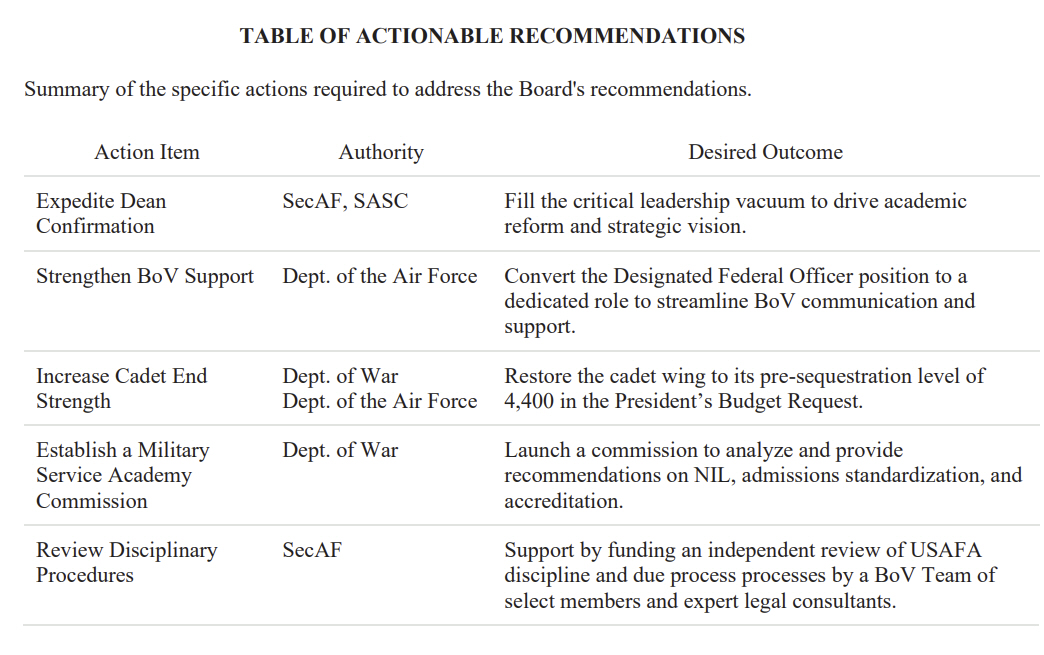
- Expedite Dean of Faculty Confirmation: The most pressing issue is the leadership vacuum in the Dean of Faculty position, which has been vacant since May 2025. This delay hinders positive academic reform and is in direct opposition to the Secretary of War’s guidance on installing key leaders. We urge the immediate selection, nomination, and expedited confirmation of a permanent Dean.
- Strengthen BoV Support: The increased engagement of the BoV requires a corresponding increase in support. The Designated Federal Officer (DFO) role must be elevated from a collateral duty to a dedicated position to ensure timely and transparent communication between the Board and the Department of the Air Force.
2. Cadet End Strength:
- Increase the Cadet Wing to 4,400: USAFA’s authorized end strength of 4,000 cadets is significantly lower than West Point (4,459) and Annapolis (4,350). This disparity, a result of past budget cuts, hinders officer production, especially with the need to commission graduates into the U.S. Space Force. We strongly recommend restoring the cadet wing to its pre-sequestration level of 4,400 in the President’s Budget Request.
3. Institutional Reviews & Modernization:
- Establish a Military Service Academy Commission: The landscape of collegiate athletics has changed due to Name, Image, Likeness (NIL) rules. Additionally, new merit-based admissions guidance should be standardized and a review of the current accreditation agencies should occur because of the removal of regional restrictions. A commission is needed to analyze these areas and ensure the Military Service Academies remain competitive and effective.
- Review Disciplinary Procedures: Significant concerns have been raised regarding the lack of due process in the cadet disciplinary system. An independent, top-down review of disciplinary procedures by a SecAF-funded BoV Team and expert legal consultants across all USAFA Disciplinary Systems is required to ensure the principles of justice and fairness are upheld.
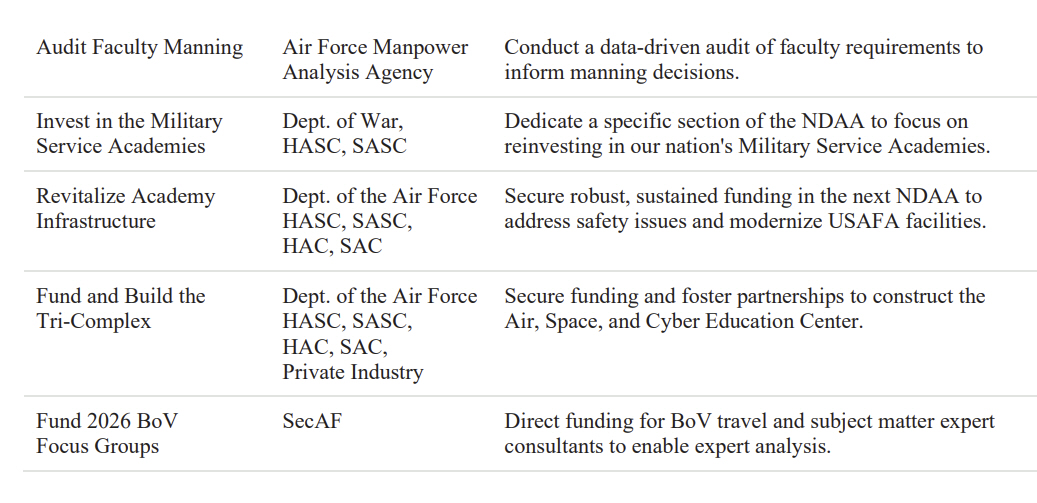
- Audit Faculty Manning: An audit by the Air Force Manpower Analysis Agency is needed to assess the current faculty composition (military, civilian, reserve component, visiting professors, privately funded professors, international officers, fellows) and determine the required number of faculty, especially in light of the proposed increase in cadet end strength.
4. Infrastructure & Future Development:
- Invest in the Military Service Academies: The Board strongly recommends that the Department of War collaborate with the House and Senate Armed Services Committees to dedicate a specific section of the Fiscal Year 2027 National Defense Authorization Act (NDAA) to focus on reinvesting in our nation’s Military Service Academies. The Board also recommends the Secretary of War engage with the Secretary of Homeland Security and Secretary of Transportation to revitalize the Service Academies in their Departments.
- Revitalize Academy Infrastructure: USAFA’s 1950s-era infrastructure is failing, creating lifehealth-safety concerns. The next NDAA must prioritize robust and sustained funding to restore facilities, meet modern standards, and build cutting-edge centers for technology and tactics development.
- Fund and Build the Tri-Complex: A visionary Air, Space, and Cyber Education Center is proposed to create a multi-domain learning ecosystem, establish a home for the U.S. Space Force at USAFA, and create a premier center for UAS excellence. This project requires funding and a strong push for public-private partnerships.
5. Enhanced BoV Efforts for 2026:
- Fund 2026 BoV Focus Groups: To provide more insightful and expert-driven advice, the BoV is establishing focus groups for 2026 covering Accreditation, Admissions, AI, Athletics, and Infrastructure. The success of these groups is contingent on funding for on-site travel and the invitation of essential Subject Matter Expert (SME) consultants, as authorized by the BoV charter.
Click to enlarge:





Leave a Comment